

























Mark Twain once said of Niagara Falls: “Although it was wonderful to see all that water tumbling down, it would be even more wonderful to see all that water tumbling up.”
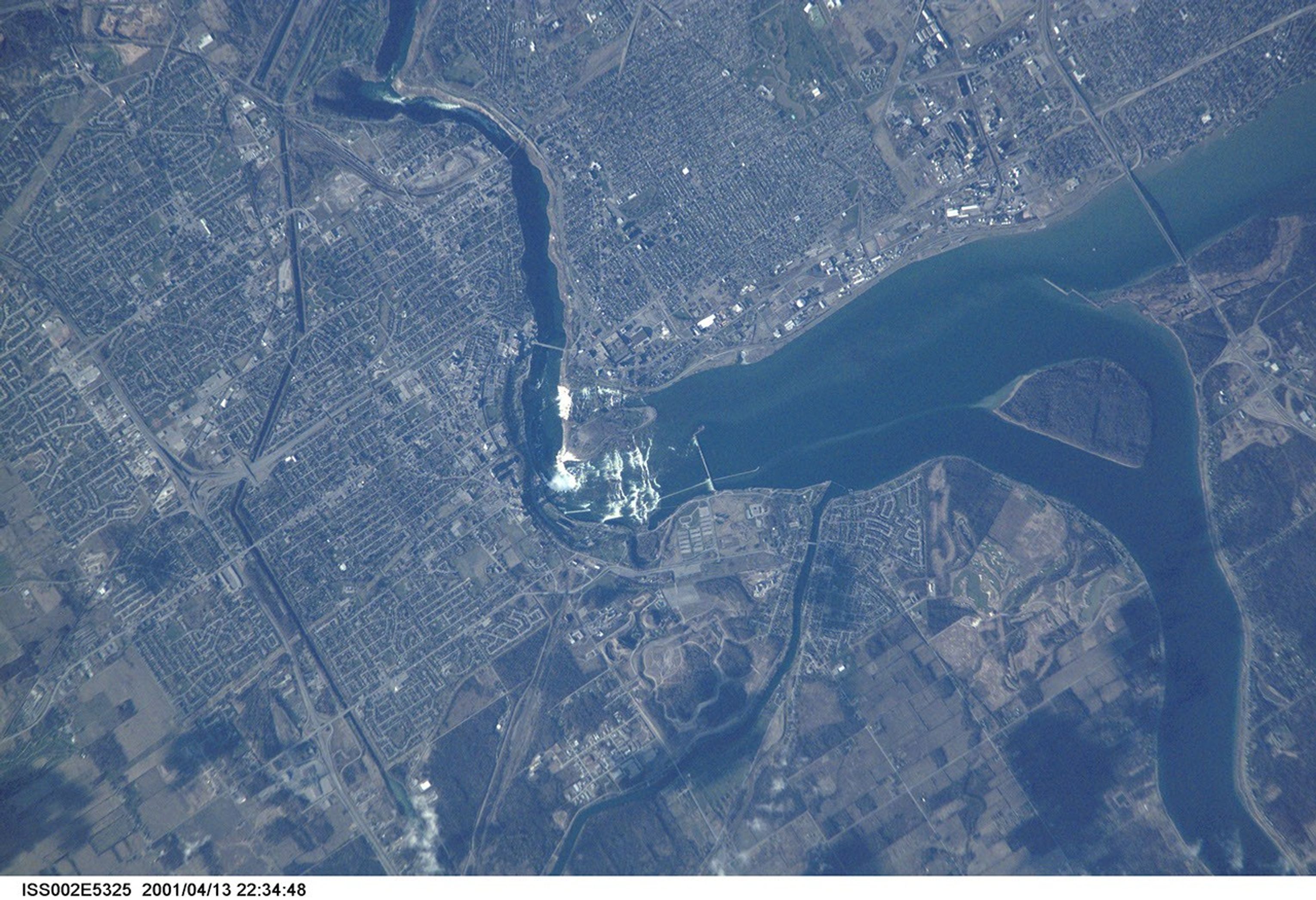
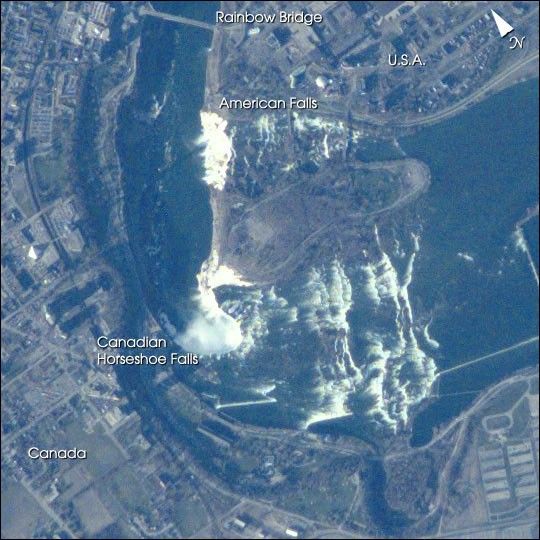
Viewing the tumbling waters of the Niagara River from the microgravity environment of the International Space Station, astronauts recently acquired this image. They were at an orbit of 207 nautical miles (383 km) above the Falls, and used a digital camera with an 800 mm lens. In taking these kinds of detailed images, Space Station crewmembers have compensated for the relative motion of the Earth, thus achieving spatial resolutions of less than 6 m and surpassing the previous records for spatial resolution from human spaceflight. Details of the city of Niagara Falls are easy to see; for spatial reference, the American falls is 328 m wide (1075 ft), and the Horseshoe Falls is 675 m wide (2200 ft).
The Niagara River forms the U.S.-Canadian Border and allows Lake Erie to drain northwest into Lake Ontario. Lake Ontario is about 100 m lower than Lake Erie; the Falls and the rapids account for most of the elevation difference. The energy derived from water falling over the falls, with average total flows of 750,000 U.S. gallons (2.8 million liters) per second, fuel multiple power plants on the river. Power Plants downstream from the plant generate 4.4 million kilowatts of power for both Ontario and New York.
References & Resources
Image ISS002-E-5325 was provided by the by the Earth Sciences and Image Analysis Laboratory, Johnson Space Center. Additional images taken by astronauts and cosmonauts can be viewed at the NASA-JSC Gateway to Astronaut Photography of Earth.