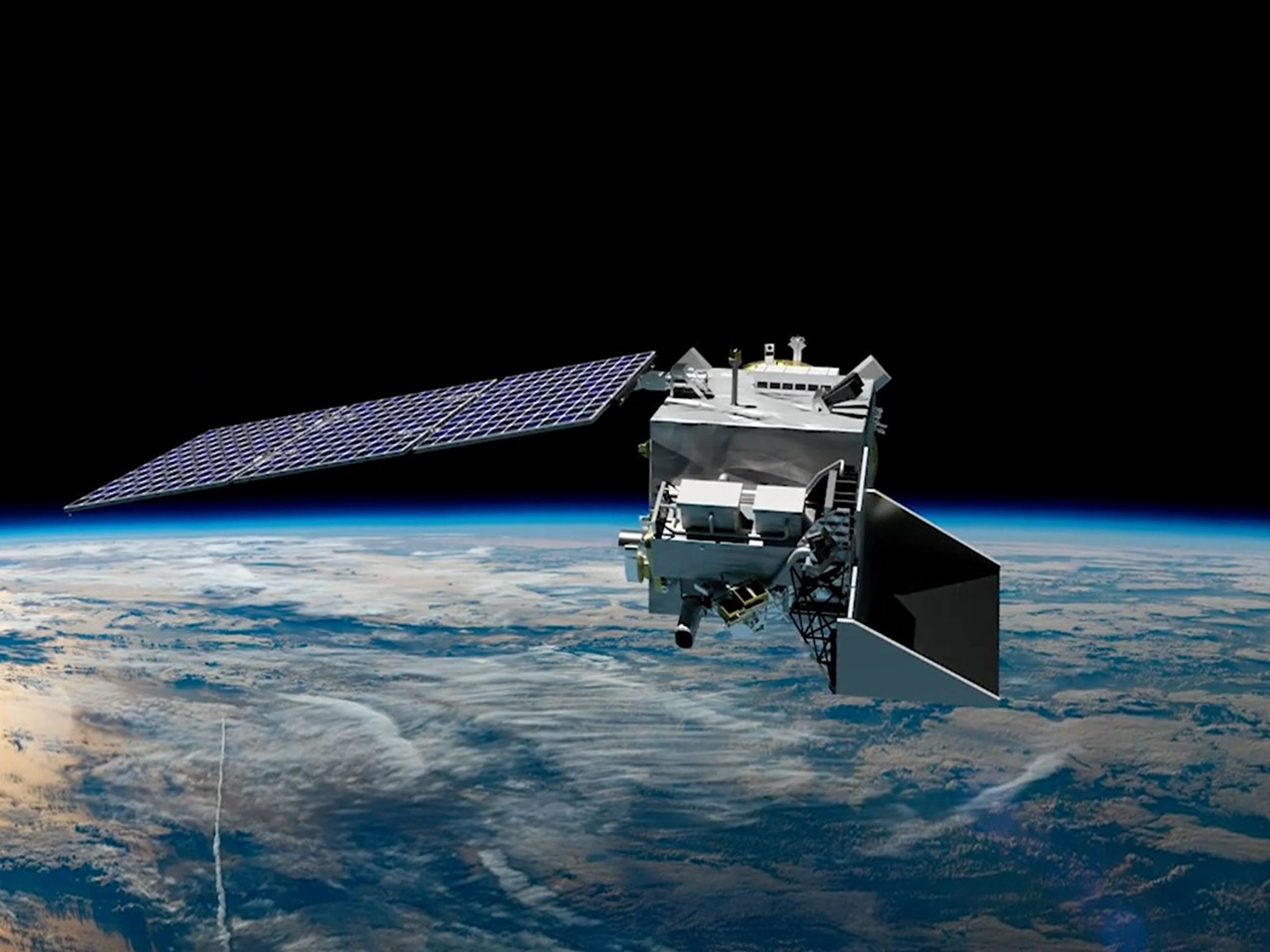



















The Aqua Spacecraft and Instruments

| Spacecraft Stats | |
| Orbit: | Sun synchronous, near polar orbit |
| Equatorial crossing: | 1:30 p.m. ascending node |
| Inclination: | 98.2° |
| Altitude: | 705 km |
| Period: | 98.8 minutes |
| Semi-major axis: | 7085 km |
| Eccentricity: | 0.0015 |
| Launch Statistics | |
| Vehicle: | Two-stage Delta II 7920-10L with 9 strap-on solid rocket motors and 10 foot, bisector, composite fairing |
| Site: | SLC-2W, Western Range, Vandenberg Air Force Base, California |
| Launch date: | May 4, 2002 @ 2:55 a.m. PDT |
| Vital Statistics | |
| Weight (at launch): | 2,934 kg (6,468 pounds) |
| Power: | 4,860 watts end of life |
| Size (stowed): | 2.7 m (8.8 ft) x 2.5 m (8.2 ft) x 6.5 m (21.3 ft) |
| Size (deployed): | 4.8 m (15.8 ft) x 16.7 m (54.8 ft) x 8 m (26.4 ft) |
| Mission design life: | 6 years |
Instruments

Aqua carries six state-of-the-art instruments in a near-polar low-Earth orbit. The six instruments are the Atmospheric Infrared Sounder (AIRS), the Advanced Microwave Sounding Unit (AMSU-A), the Humidity Sounder for Brazil (HSB), the Advanced Microwave Scanning Radiometer for EOS (AMSR-E), the Moderate-Resolution Imaging Spectroradiometer (MODIS), and the Clouds and the Earth's Radiant Energy System (CERES). Each has unique characteristics and capabilities, and all six serve together to form a powerful package for Earth observations.
On-orbit progress, May-September 2002
| May 4, 2002 | The Aqua spacecraft was successfully launched on board a Delta II rocket at 2:55 a.m. PDT from Vandenberg Air Force Base, CA. As scheduled, the Aqua spacecraft successfully separated from the Delta rocket over Africa on its first orbit in the early morning of May 4, and the solar array unfurled over Europe a few minutes later. The AMSR-E antenna was then deployed, followed several hours later by deployment of the two CERES instruments and the X-band antenna. |
| May 12, 2002 | AMSU begins sending science data. |
| May 14, 2002 | HSB begins sending science data. |
| May 15-23, 2002 | AMSR-E rotation rate is spun-up from 4 rpm to its operational value of 40 rpm. |
| May 23, 2002 | The MODIS instrument begins outgassing. |
| May 24, 2002 | AMSR-E begins sending science data. Some anomalies are seen. |
| May 25, 2002 | The AIRS scanner is turned on (although the AIRS Earth shield is still stowed). |
| May 29, 2002 | The AIRS Earth shield is deployed. |
| Late May / Early June 2002 | The two CERES instruments are being checked out through all modes of operation prior to opening the contamination covers in late June. |
| June 1, 2002 | An adjustment is made to the automatic gain control for AMSR-E, after which high quality data begin to flow from the instrument. |
| June 12, 2002 | AIRS is now in its standard science data-collection mode and is doing well. |
| June 17, 2002 | Following the final ascent burn, Aqua reaches its final, operational altitude of 705 km. |
| June 18, 2002 | The CERES covers are opened, and both CERES instruments are now collecting data. |
| June 24, 2002 | First light images from AMSR-E are released: global sea surface temperature and brightness temperature. MODIS begins sending science data, completing the complement of Aqua's six science instruments. |
| July 12, 2002 | Aqua direct broadcast begins. |
| July 19, 2002 | Beginning at 21:00:24 GMT DOY 200 (July 19, 2002), the Aqua spacecraft rolls away from the Earth in order to allow for a calibration to the MODIS instrument. The maneuver is complete by 21:29:10 GMT, at which time the spacecraft resumes an Earth-pointing attitude. |
| September 1, 2002 | The 120-day checkout period for Aqua ends. The Aqua responsibilities transfer from the Aqua Project at Goddard Space Flight Center (GSFC) and TRW to the Earth Science Mission Operations (ESMO) program, located at GSFC. |