Messier 60
Hubble captured the elliptical galaxy, Messier 60, and a smaller spiral galaxy, NGC 4647.
Distance
54 million light-years
Apparent Magnitude
9.8
constellation
Virgo
object type
Elliptical Galaxy

The Virgo cluster is a collection of more than 1,300 galaxies, including the elliptical galaxy M60. Unlike spiral galaxies, elliptical galaxies lack an organized structure and are nearly featureless, resembling the core of a spiral galaxy. The Virgo cluster’s third brightest member, M60 has a diameter of 120,000 light-years and is as massive as one trillion Suns. At its center lies a huge black hole, 4.5 billion times as massive as the Sun — one of the most massive black holes ever found.
In this stunning image, which includes observations taken in infrared and visible wavelengths, Hubble has captured M60 (the large, diffuse galaxy at the center) along with the bluish spiral galaxy NGC 4647 (upper right). NGC 4647 is about two-thirds the size of M60 — or roughly the size of the Milky Way galaxy — and is much less massive. The two galaxies form a pair known as Arp 116.
Astronomers have long tried to determine whether these two galaxies are actually interacting. Although from Earth they appear to overlap, there is no evidence of new star formation, which would be one of the clearest signs that the two galaxies are indeed interacting. However, recent studies of very detailed Hubble images suggest the onset of some tidal interaction between the two.

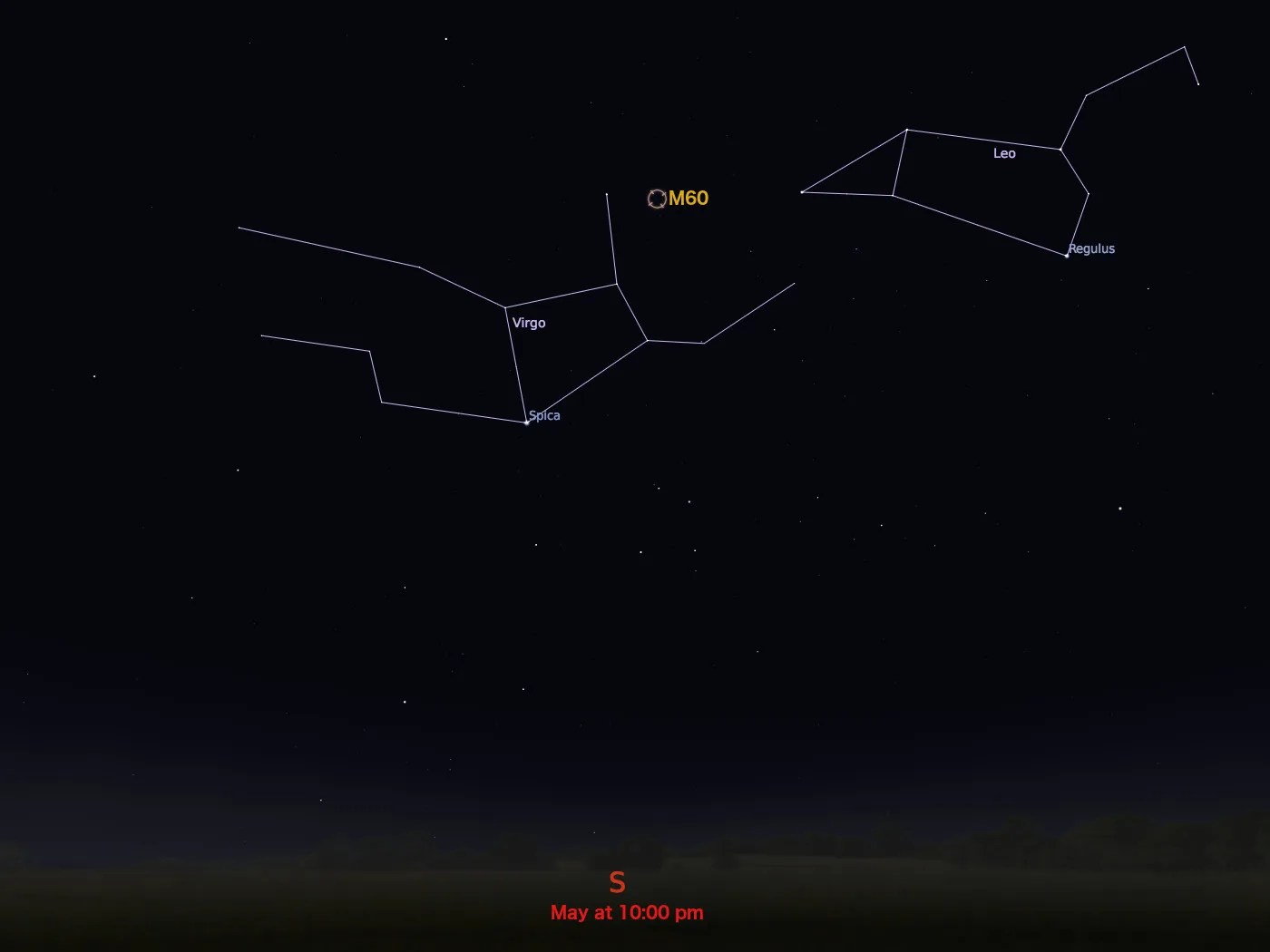
Discovered by the German astronomer Johann Gottfried Keohler in 1779, M60 is located in the constellation Virgo roughly 54 million light-years from Earth. It has an apparent magnitude of 9.8, and its central region can be seen through a small telescope most easily during May. A larger telescope can reveal NGC 4647 as well.
For more information about Hubble’s observations of M60, see:
Explore Hubble's Messier Catalog
The following pages contain some of Hubble’s best images of Messier objects.

Overview The Messier catalog, begun by astronomer Charles Messier in the 18th Century and revised over the years, includes some…
Better known as the Crab Nebula, Charles Messier originally mistook Messier 1 for Halley’s Comet, which inspired him to create…
Hubble's image of Messier 2 is comprised of visible and infrared wavelengths of light.