















1 min read
Exposed Cranium Nebula (NIRCam and MIRI Images)

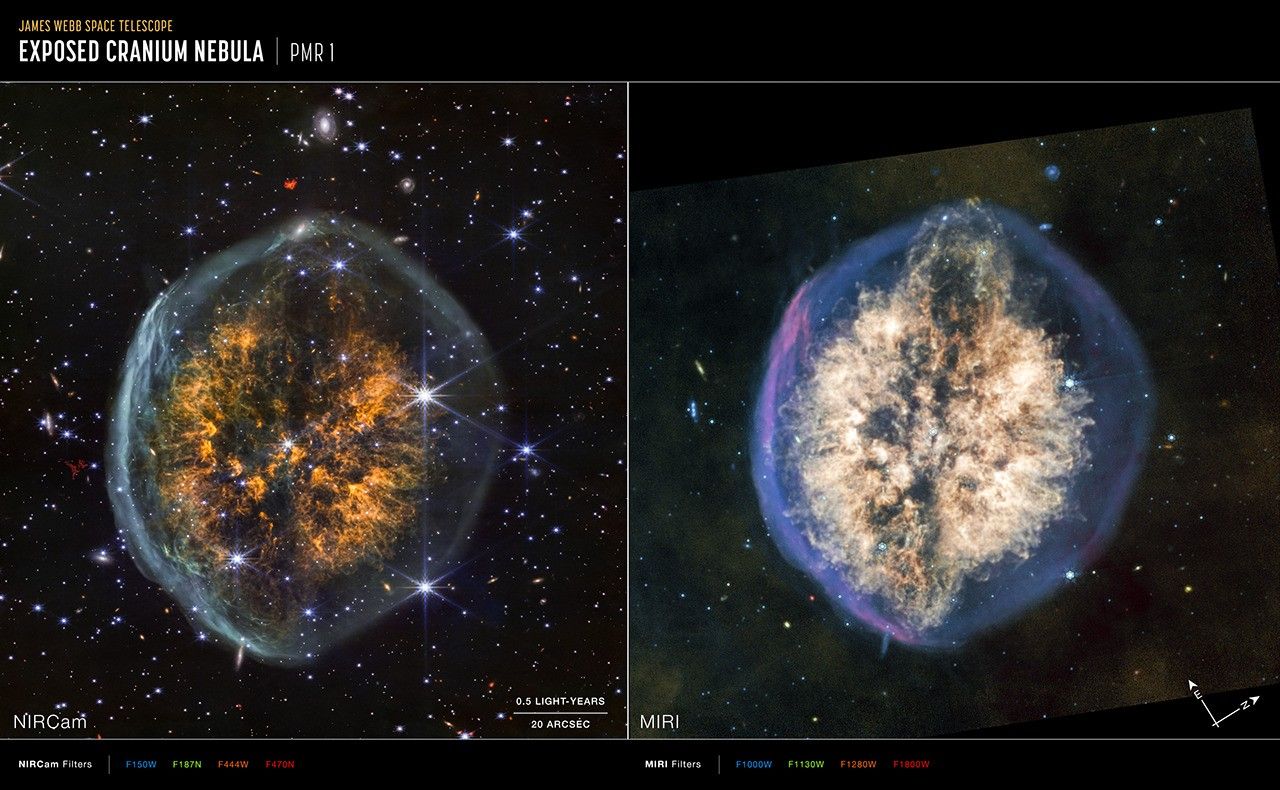
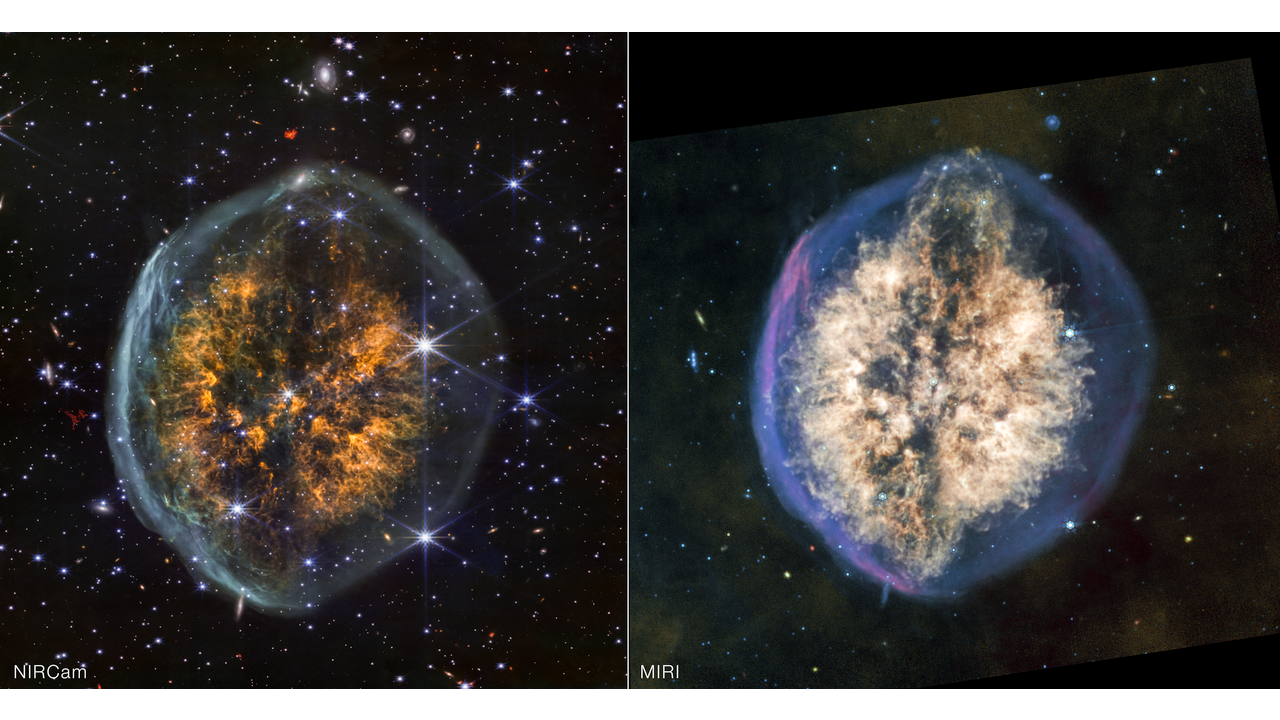
The differences in what Webb’s infrared instruments reveal and conceal within the PMR 1 “Exposed Cranium” nebula is apparent in this side-by-side view. More stars and background galaxies shine through the view of Webb’s NIRCam (Near-Infrared Camera), while cosmic dust glows more prominently in the light captured by MIRI (Mid-Infrared Instrument).
The dark center lane that contributes to this nebula’s distinctive brain-like appearance is more noticeable in NIRCam, but its apparent role in the ejection of material at the top and bottom of the nebula is seen more clearly in MIRI’s view. Observing the cosmos in various wavelengths of light provides a more complete picture of how the universe works.
See links at right to download the individual images or the side-by-side version.
About the Object
- R.A. PositionR.A. PositionRight ascension – analogous to longitude – is one component of an object's position.09:28:40.9
- Dec. PositionDec. PositionDeclination – analogous to latitude – is one component of an object's position.-49:36:26.6
- ConstellationConstellationOne of 88 recognized regions of the celestial sphere in which the object appears.Vela
- DistanceDistanceThe physical distance from Earth to the astronomical object. Distances within our solar system are usually measured in Astronomical Units (AU). Distances between stars are usually measured in light-years. Interstellar distances can also be measured in parsecs.5,000 light-years
- DimensionsDimensionsThe physical size of the object or the apparent angle it subtends on the sky.Image is about 2.2 arcmin across (about 3.2 light-years)
About the Data
- Data DescriptionData DescriptionProposal: A description of the observations, their scientific justification, and the links to the data available in the science archive.
Science Team: The astronomers who planned the observations and analyzed the data. "PI" refers to the Principal Investigator.This image was created with Webb data from proposal: 9224 (M. Garcia Marin).
- InstrumentInstrumentThe science instrument used to produce the data.NIRCam, MIRI
- Exposure DatesExposure DatesThe date(s) that the telescope made its observations and the total exposure time.March 30-31, 2025
- FiltersFiltersThe camera filters that were used in the science observations.NIRCam: F150W, F187N, F444W, F470N; MIRI: F1000W, F1130W, F1280W, F1800W
- Object NameObject NameA name or catalog number that astronomers use to identify an astronomical object.PMR 1, PN G272.8+01.0, Exposed Cranium Nebula
- Object DescriptionObject DescriptionThe type of astronomical object.Planetary Nebula
- Release DateFebruary 25, 2026
- Science ReleaseNASA’s Webb Examines Cranium Nebula
- CreditImage: NASA, ESA, CSA, STScI; Image Processing: Joseph DePasquale (STScI)
Downloads
This image is a composite of separate exposures acquired by the James Webb Space Telescope using the NIRCam and MIRI instruments. Several filters were used to sample specific wavelength ranges. The color results from assigning different hues (colors) to each monochromatic (grayscale) image associated with an individual filter. In this case, the assigned colors for both the NIRCam and MIRI images are: Blue: F150W and F1000W, Green: F187N and F1130W, Orange: F444W and F1280W, Red: F470N+F1800W

Related Images & Videos
Share
Details
Laura Betz
NASA’s Goddard Space Flight Center
Greenbelt, Maryland
laura.e.betz@nasa.gov