
























1 min read
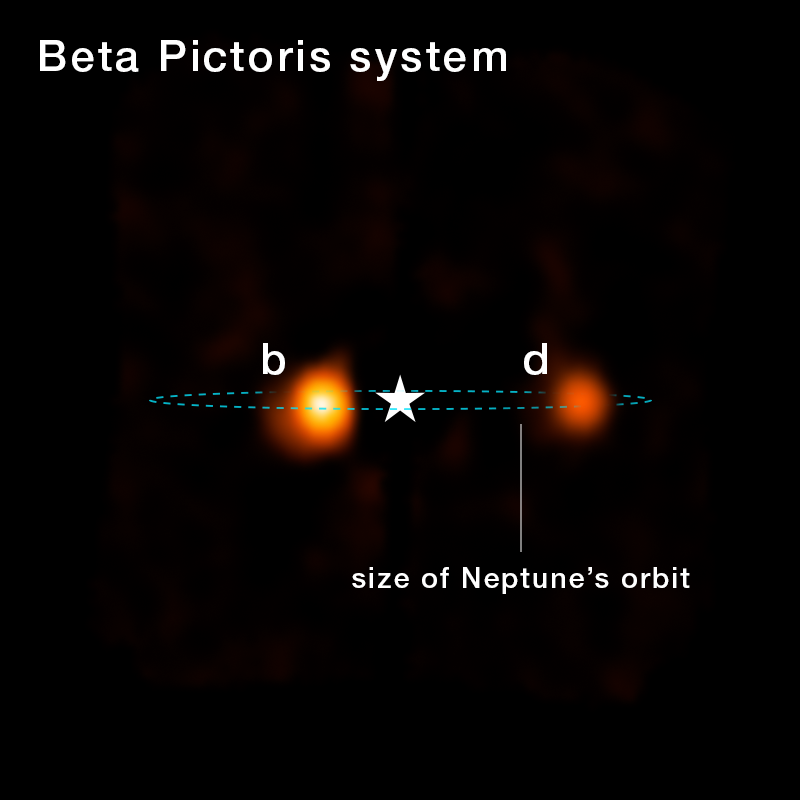
Beta Pictoris System (NIRSpec IFU Image and Spectrum)
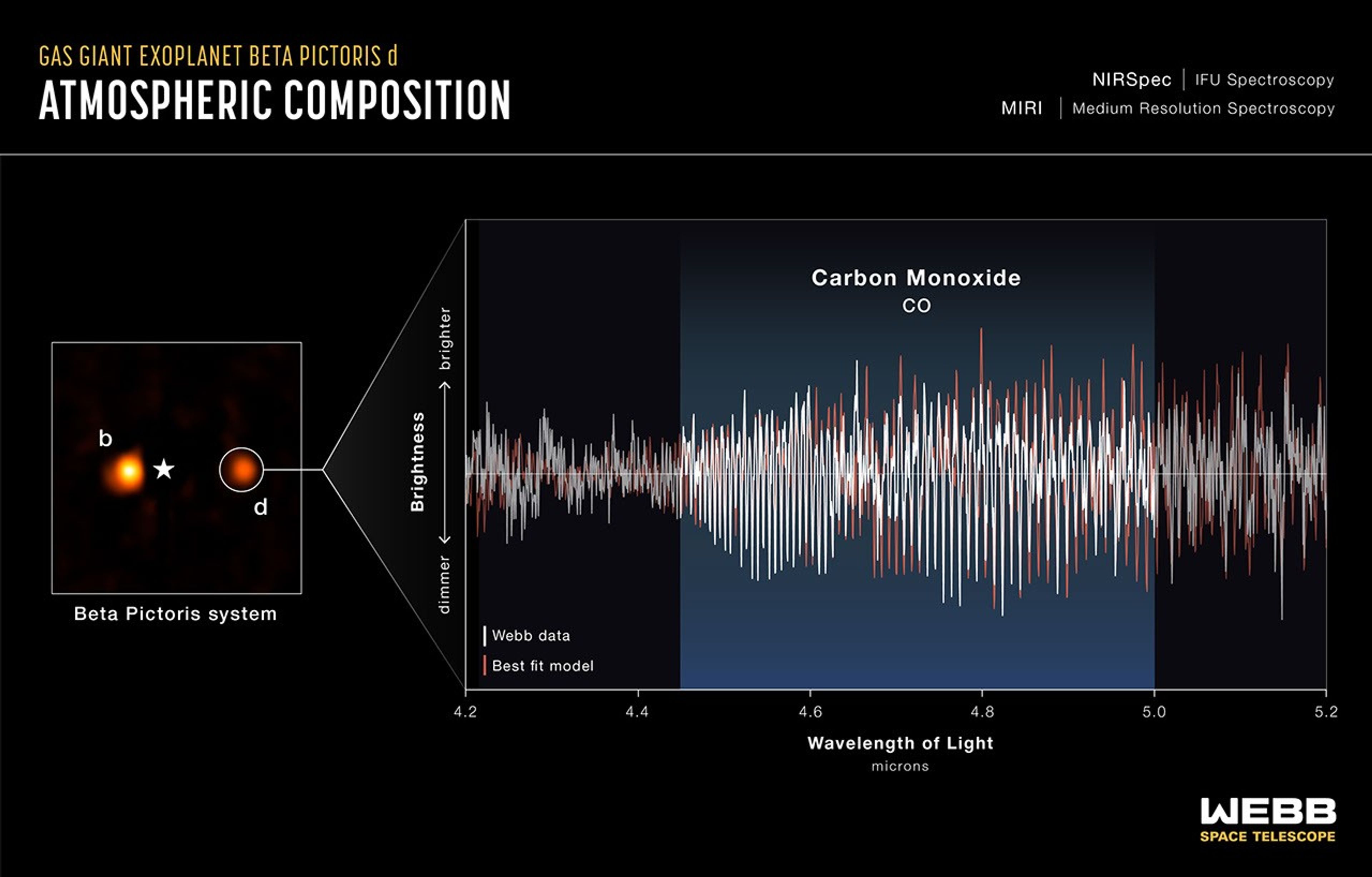
Researchers used the NIRSpec (Near-Infrared Spectrograph) Integral Field Unit on NASA’s James Webb Space Telescope to map chemical contents of the Beta Pictoris system. As a result, they discovered a third planet, Beta Pictoris d, orbiting the young star.
Instead of identifying the planet as a bright point of light, as seen in the reconstructed image, researchers searched the spectroscopic data for the molecular signatures expected from a giant planet atmosphere, allowing the object to stand out from the surrounding debris disk.
The extracted NIRSpec and MIRI (Mid-Infrared Instrument) spectra of Beta Pictoris d display a distinctive series of carbon monoxide (CO) absorption lines. This molecular “fingerprint” identified the object as a giant planet, while measurements of the Doppler shift of the spectral lines provided the planet’s radial velocity, confirming it is gravitationally bound to the Beta Pictoris system.
- Release DateJuly 15, 2026
- Science ReleaseNASA’s Webb Discovers Hidden Planet in Famous Star System
- CreditImage: NASA, ESA, CSA, STScI, Leah Hustak (STScI); Science: Aidan Gibbs (UC San Diego), Jean-Baptiste Ruffio (UC San Diego), Alexis Bidot (STScI); Image Processing: Alyssa Pagan (STScI)
Related Images & Videos
Share
Details
Laura Betz
NASA’s Goddard Space Flight Center
Greenbelt, Maryland
laura.e.betz@nasa.gov