



















Explore the Roman Telescope
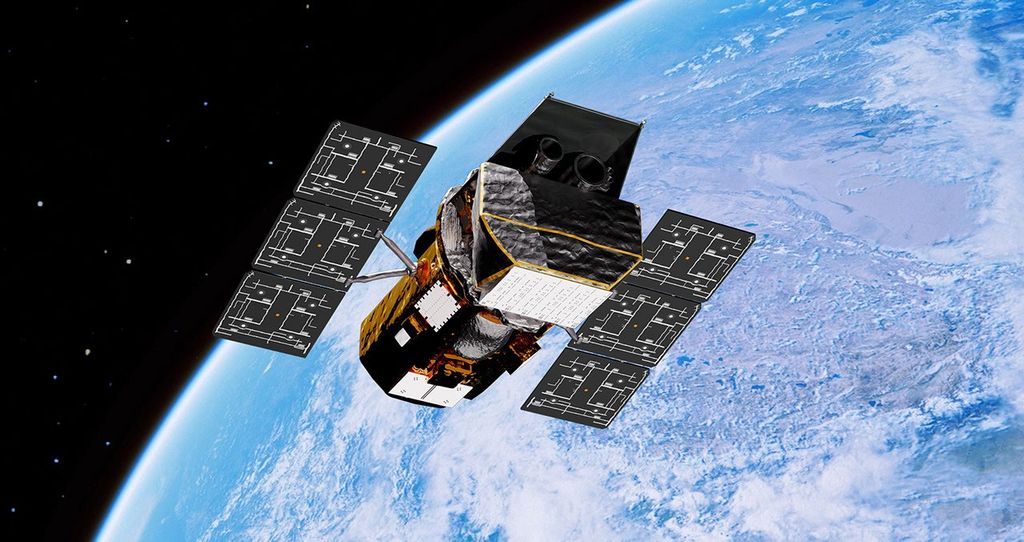
Roman's telescope collects light from distant objects, focusing it and passing it on to the instruments.
To make Roman’s sensitive measurements possible, the telescope will observe from a vantage point about 930,000 miles (1.5 million km) away from Earth in the direction opposite the Sun. At this special place in space, called the second Sun-Earth Lagrange point, or L2, gravitational forces balance to keep objects in steady orbits with very little assistance.
Roman’s barrel-like shape will help block out unwanted light from the Sun, Earth, and Moon, and the spacecraft’s distant location will help keep the instruments cool. The thermal stability of an observatory at L2 will provide a ten-fold improvement beyond Hubble in much of the data Roman will gather.
Primary Mirror Assembly (PMA)
The PMA includes the telescope's main mirror and its supporting structure. The mirror has a diameter of 7.9 feet (2.4 meters), just like Hubble's, and will be cooled to about 19 degrees Fahrenheit (-7 degrees Celsius).

Partner(s): L3Harris Technologies, Inc.
Secondary Mirror Assembly (SMA)
The SMA is the telescope's second optic. The mirror has a diameter of 22.9 inches (581 millimeters) and will be cooled to about 19 degrees Fahrenheit (-7 degrees Celsius). The secondary mirror is positioned by six alignment drives and two focus drives to align with the primary mirror.

Partner(s): L3Harris Technologies, Inc.
Aft-Optics Module (AOM)
The AOM consists of three optics and their supporting structure to relay the light beam to the Wide Field Instrument. It has a concave tertiary mirror and two flat mirrors. One of the flat mirrors is positioned with three actuators for tip, tilt, and focus corrections. The AOM will be cooled to about -67 degrees Fahrenheit (-55 degrees Celsius).

Partner(s): L3Harris Technologies, Inc.
Tertiary Collimator Assembly (TCA)
The TCA consists of five optics and their supporting structure to relay the light beam to the Coronagraph Instrument. The TCA has three concave mirrors and two flat mirrors. One of the flat mirrors is positioned with two actuators for tip and tilt corrections. Most of this assembly will operate at room temperature, with one mirror at about 19 degrees Fahrenheit (-7 degrees Celsius) due to its proximity to the primary mirror assembly.

Partner(s): L3Harris Technologies, Inc.
Telescope Control Electronics (TCE)
The TCE is the brain of the telescope. It is designed to provide thermal control using hundreds of heaters and sensors. The TCE will also control the secondary mirror's position with six alignment drives and two focus drives, and the aft-optics relay mirrors with five actuators.

Partner(s): L3Harris Technologies, Inc.
Deployable Aperture Cover (DAC)
The DAC is responsible for keeping light out of the telescope barrel. This sun shade is deployed once in orbit using a soft material attached to support booms and remains in this position throughout the observatory's lifetime. Outer Barrel Assembly (OBA)

Partner(s): NASA's Goddard Space Flight Center
Outer Barrel Assembly (OBA)
The OBA will protect the telescope from stray light and help keep the mirrors cool. It also serves as structural support for the Solar Array Sun Shield and Deployable Aperture Cover. The OBA is connected directly to the upper deck of the spacecraft support system's primary structure with a series of struts that extend past the Wide Field Instrument and the Coronagraph Instrument.


Partner(s): NASA's Goddard Space Flight Center