























1 min read
Little Red Dots
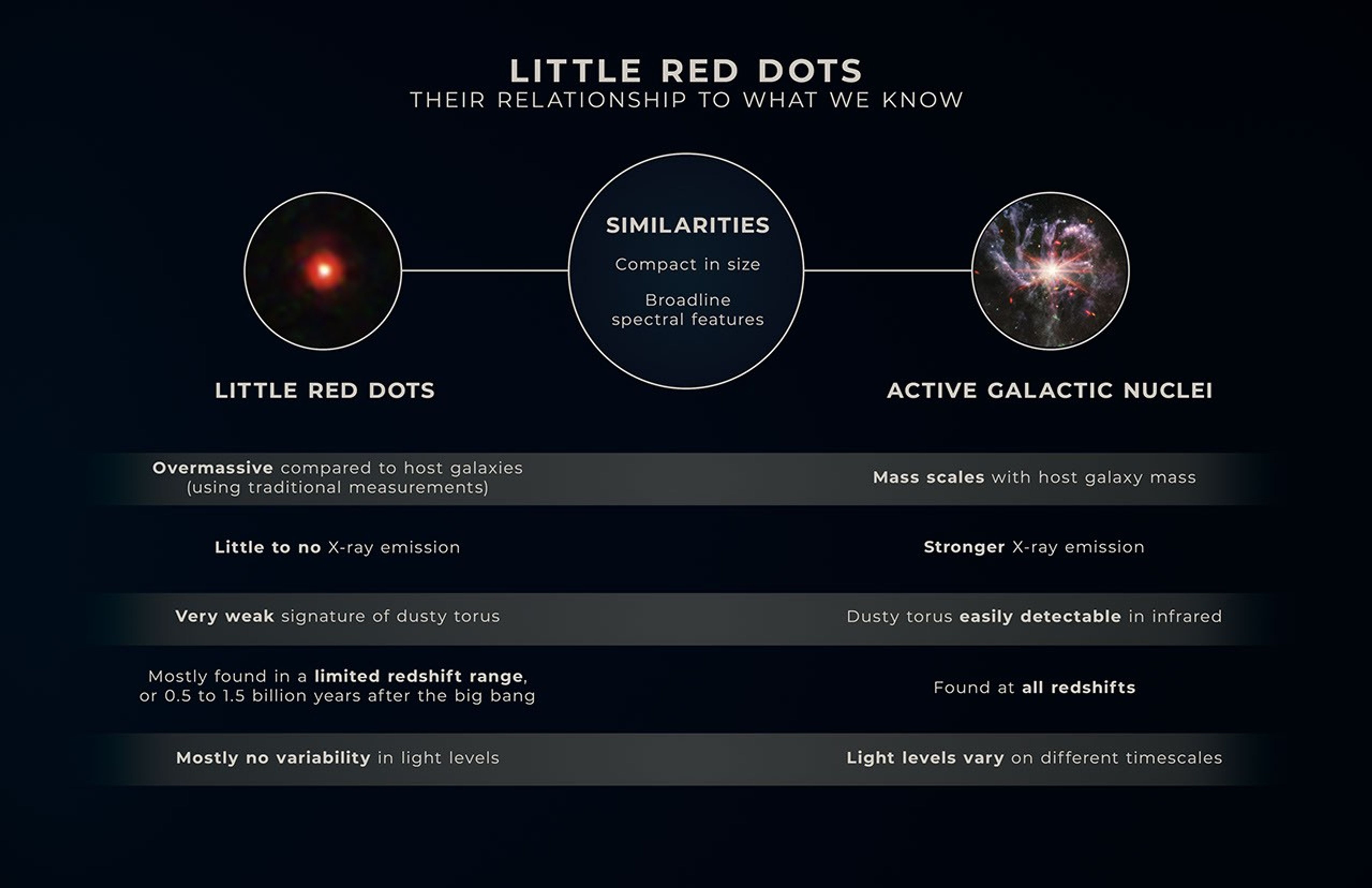
Since active galactic nuclei are heavily studied, astronomers use them to identify characteristics in little red dots, the compact, red objects that are typically found in the early universe. Astronomers theorize that little red dots could be active supermassive black holes themselves.
This is supported by two similarities: their compactness and their spectral features. However, despite those similarities, astronomers note that there are many areas where they differ, including where they’re found, the strength of the light they emit, and even their size when compared to their host galaxy.
Extended Description and Image Alt Text
Extended Description
Infographic titled “Little Red Dots, Their Relationship To What We Know.” It contains two columns. The left column is labeled “Little Red Dots” and the other is labeled “Active Galactic Nuclei,” with lists of their traits appearing beneath each label. Above the "Little Red Dots" label is an image of a little red dot that appears as a fuzzy red orb enclosed within a white circle. Above the "Active Galactic Nuclei" label is an image of a gray galaxy with a bright white core, also enclosed within a white circle. Lines extending from both images converge at a third white circle between the other two. The circle contains the text: “Similarities,” “compact in size,” and “broadline spectral features.”
Underneath the “Little Red Dots” label, there are five rows of text. The first row says, “Overmassive compared to host galaxies (using traditional measurements).” The second says, “Little to no X-ray emission.” The third says, “Very weak signature of dusty torus.” The fourth says, “Mostly found in a limited redshift range or 0.5 to 1.5 billion years after the big bang.” The fifth says, “Mostly no variability in light levels.”
There are also five rows underneath the “Active Galactic Nuclei” label, which provide a point of comparison to the rows under the “Little Red Dots” label. The first row says, “Mass scales with host galaxy mass.” The second says, “Stronger X-ray emission.” The third says, “Dusty torus easily detectable in infrared.” The fourth says, “Found at all redshifts.” The fifth says, “Light levels vary on different timescales.”
Image Alt Text
Infographic titled “Little Red Dots, Their Relationship To What We Know.” It shows two columns, one labeled “Little Red Dots” and the other labeled “Active Galactic Nuclei,” each with five rows of their respective traits underneath those labels. These traits show how both little red dots and active galactic nuclei differ. Between the “Little Red Dots” and “Active Galactic Nuclei” sections, a list of similarities are provided.
- Release DateOctober 9, 2026
- Science ReleaseThe Impact of Webb on Our Understanding of Black Holes
- CreditImage: NASA, ESA, CSA, STScI, Ralf Crawford (STScI)
Related Images & Videos
How To Measure What Can’t Be Seen
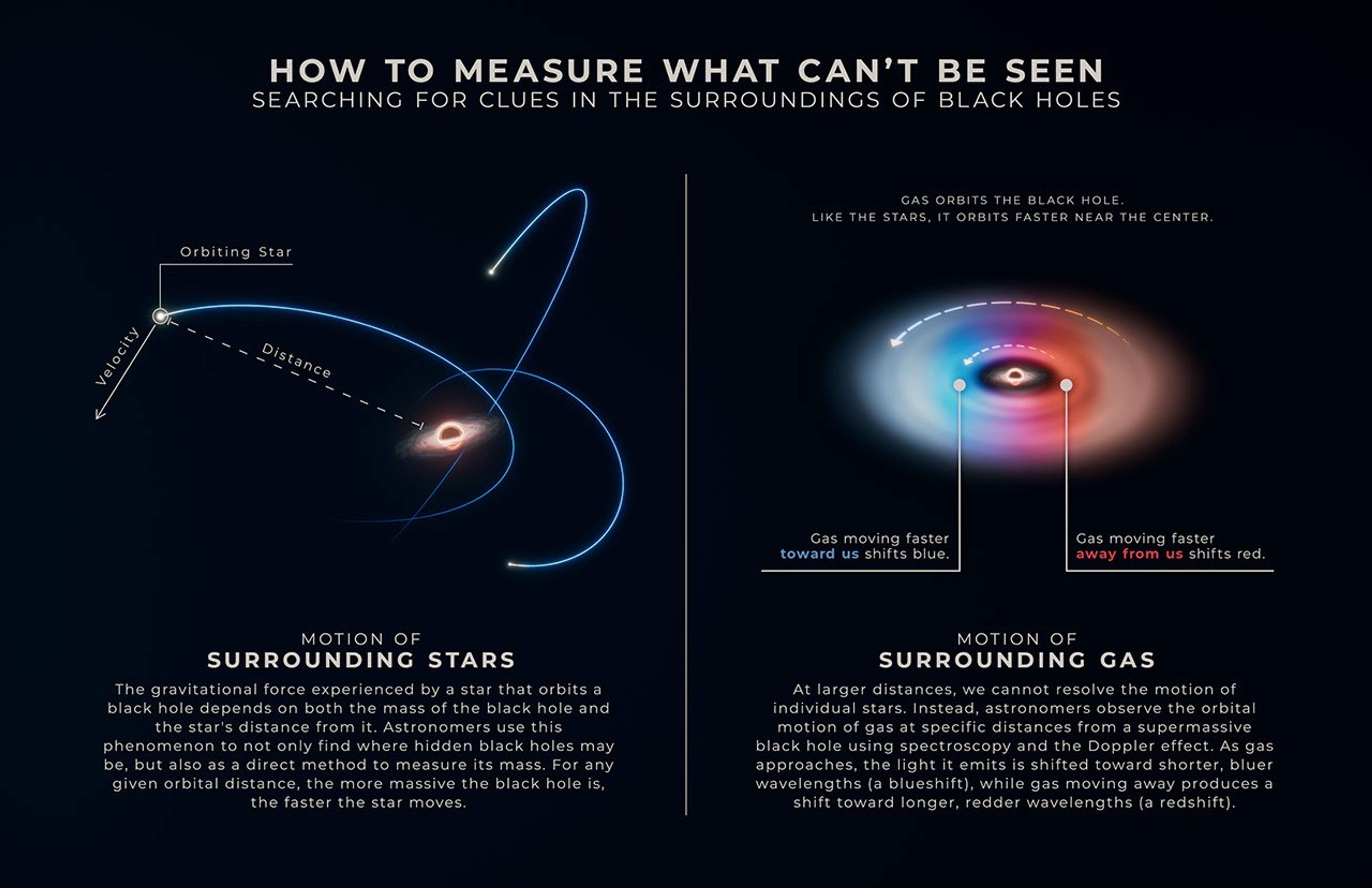
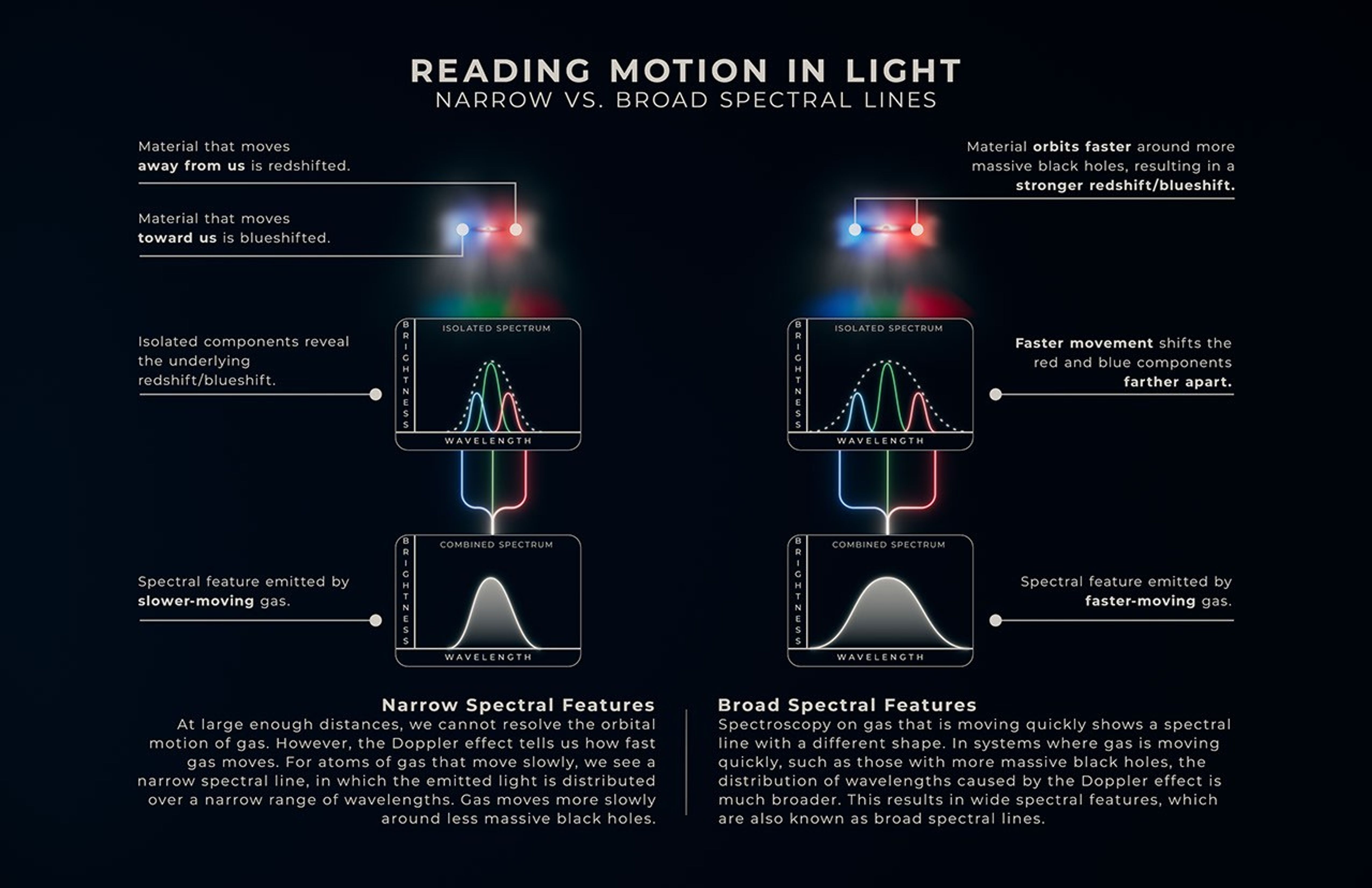
Although black holes themselves can’t be seen, astronomers can employ several techniques to infer their masses. For nearby black holes, astronomers observe the motion of orbiting stars, while, for those further away, astronomers study the motion of gases surrounding black holes.
Share
Details
Laura Betz
NASA’s Goddard Space Flight Center
Greenbelt, Maryland
laura.e.betz@nasa.gov