













1 min read
Egg Nebula
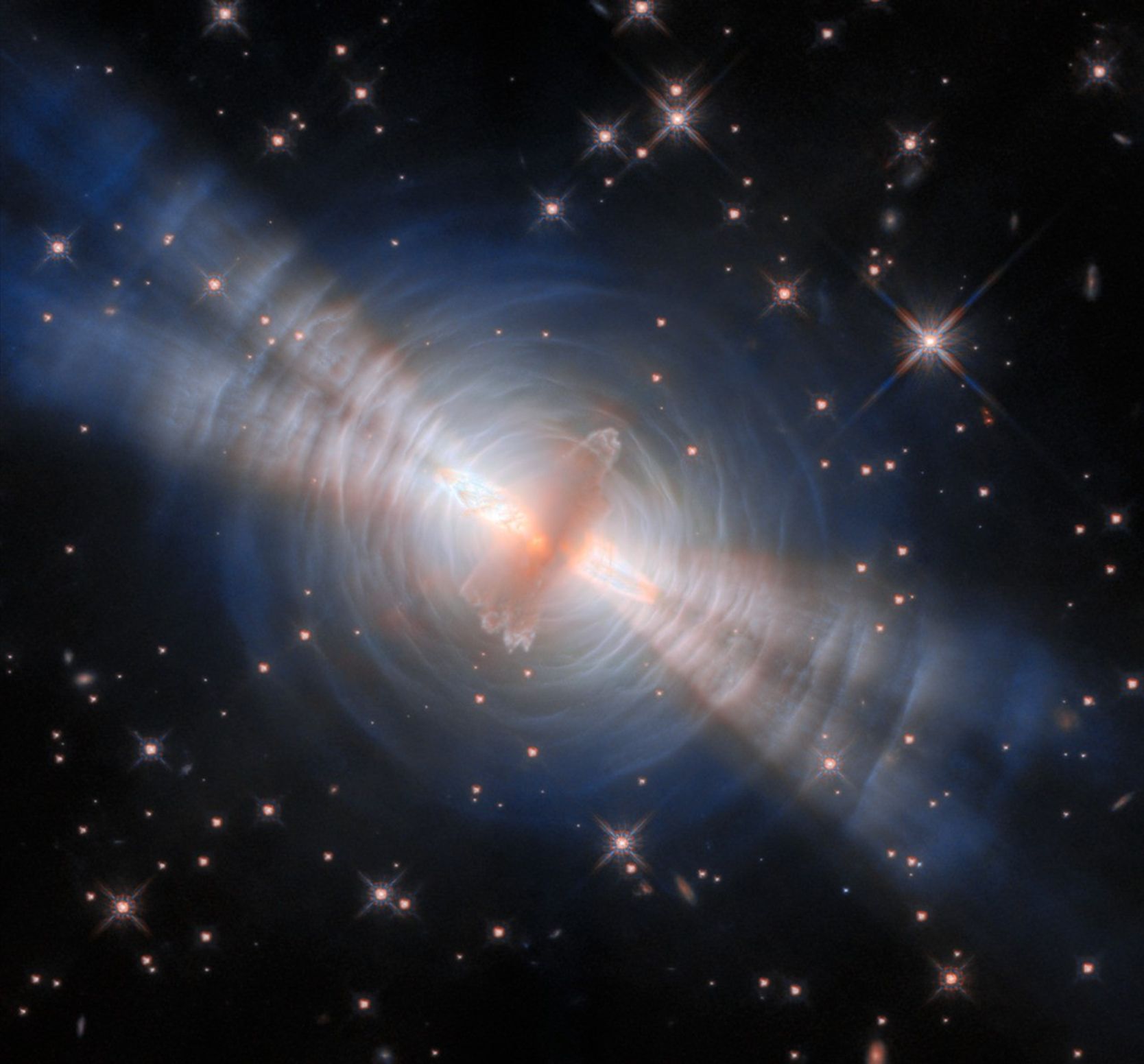
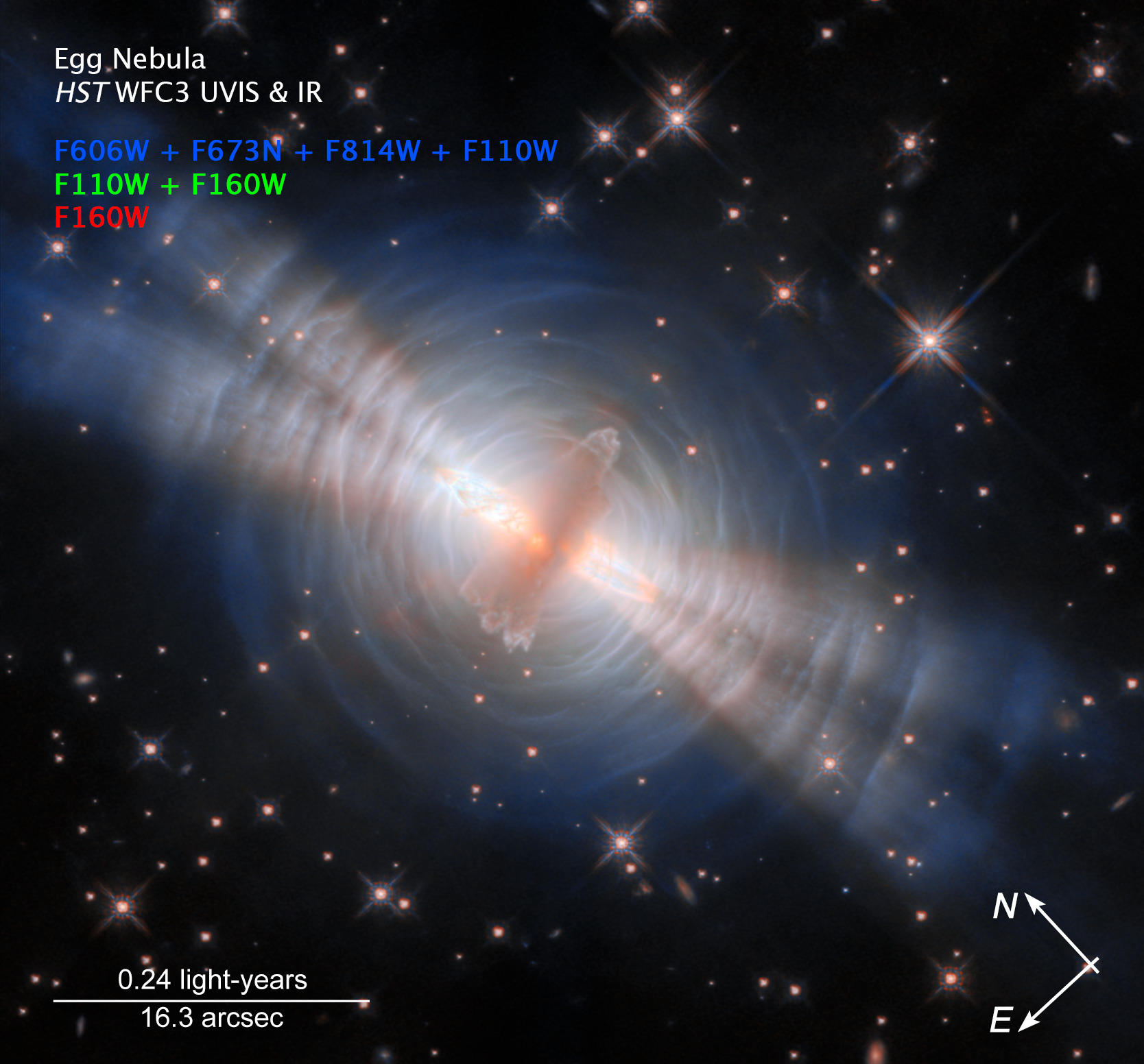
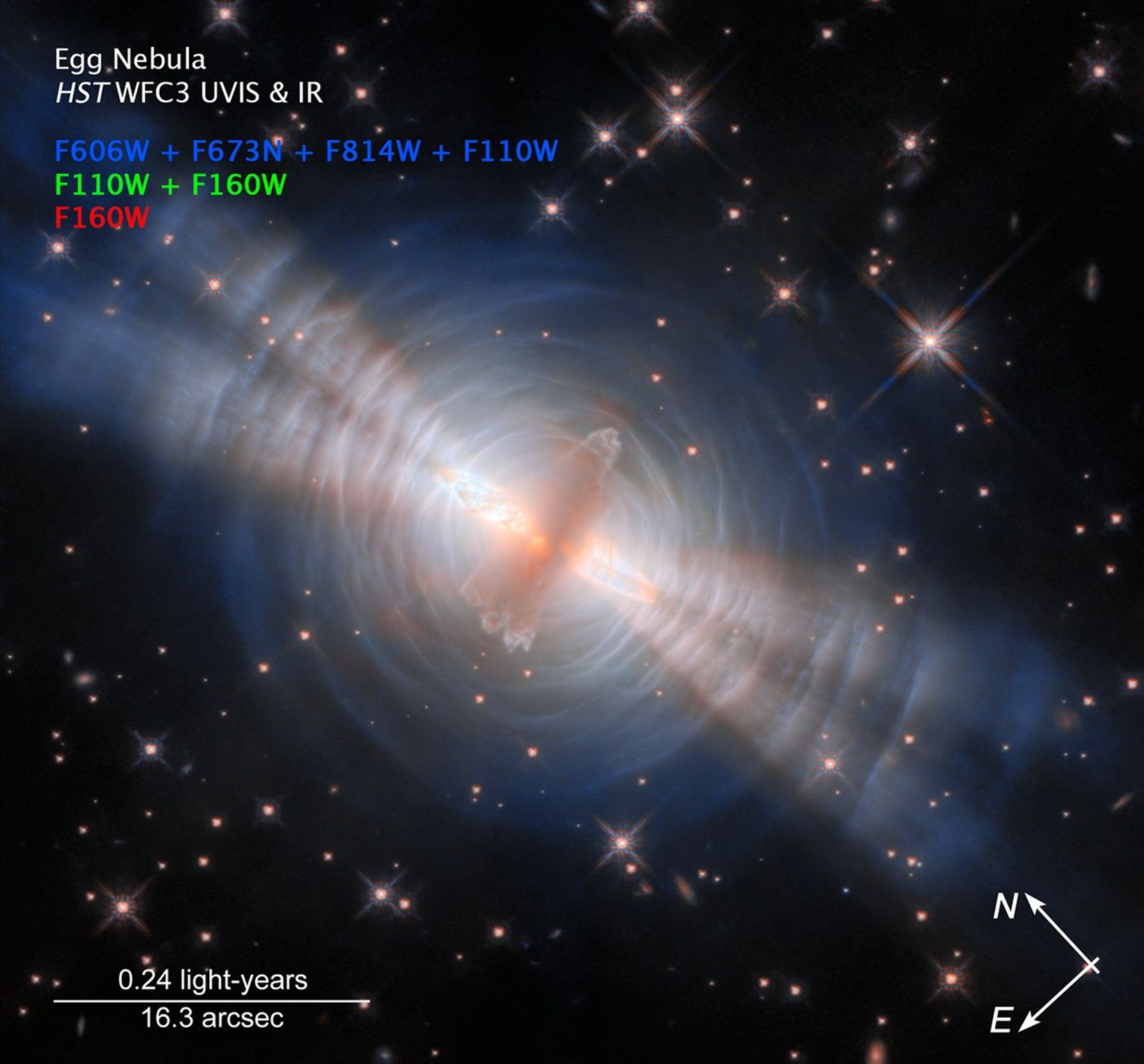
NASA's Hubble Space Telescope reveals the clearest view yet of the Egg Nebula — a pre-planetary nebula of gas and dust created by a dying, Sun-like star. These newest observations, taken with Hubble's Wide Field Camera 3, include infrared data. Powerful beams of starlight blast out of the inner cloud, illuminating the cosmic structure. Fast-moving outflows of hot molecular hydrogen also emerge from within the dust cloud, visible at the base of the searchlight beams. These outflows glow with infrared light, which appears as orange highlights. The central dust cloud is surrounded by concentric rings of thin, faint arcs of gas. These were created by successive outbursts from the central star, which ejected material from its outer surface every few hundred years. The beams of starlight are reflected by these layers of gas, creating the appearance of ripples. The reflected starlight reveals important details about the central star, which is impossible to view directly in its dusty shell.
About the Object
- R.A. PositionR.A. PositionRight ascension – analogous to longitude – is one component of an object's position.21:02:18.75
- Dec. PositionDec. PositionDeclination – analogous to latitude – is one component of an object's position.+36:41:37.8
- ConstellationConstellationOne of 88 recognized regions of the celestial sphere in which the object appears.Cygnus
- DistanceDistanceThe physical distance from Earth to the astronomical object. Distances within our solar system are usually measured in Astronomical Units (AU). Distances between stars are usually measured in light-years. Interstellar distances can also be measured in parsecs.About 1,000 light-years
- DimensionsDimensionsThe physical size of the object or the apparent angle it subtends on the sky.Image is 1.12 arcmin across (about 0.97 light-years)
About the Data
- InstrumentInstrumentThe science instrument used to produce the data.WFC3 UVIS & IR
- FiltersFiltersThe camera filters that were used in the science observations.F606W, F673N, F814W, F110W, F160W
- Object NameObject NameA name or catalog number that astronomers use to identify an astronomical object.Egg Nebula; CRL 2688
- Object DescriptionObject DescriptionThe type of astronomical object.Pre-planetary nebula
- Release DateFebruary 10, 2026
- Science ReleaseNASA’s Hubble Captures Light Show Around Rapidly Dying Star
- CreditImage: NASA, ESA, Bruce Balick (UWashington)
These images were acquired by the WFC3 Instrument on the Hubble Space Telescope. The color results from assigning different hues (colors) to a monochromatic (grayscale) image. In this case, the assigned colors are: Blue: F606W+F673N+F814W+F110W, Green: F110W+F160W, Red: F160W
Related Images & Videos
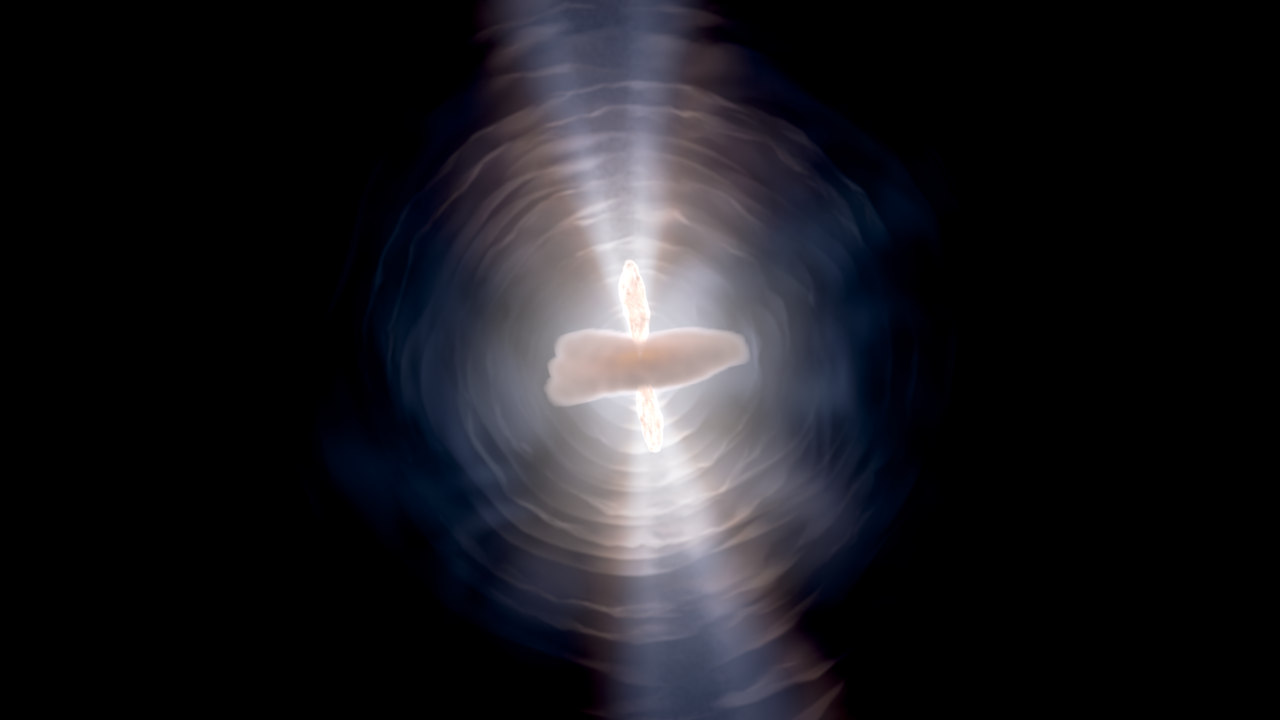
Exploring the Structure of the Egg Nebula
This visualization examines the Hubble Space Telescope image of the Egg Nebula and showcases the shape and development of its three-dimensional components. The dying star has repeatedly ejected thin shells of gas and dust over the last 5,000 years. During the last 400 years, bipo...
Share
Details
Claire Andreoli
NASA’s Goddard Space Flight Center
Greenbelt, Maryland
claire.andreoli@nasa.gov