













1 min read
HST Image of Massive Galaxy Cluster IDCS J1426.5+3508

About the Object
- R.A. PositionR.A. PositionRight ascension – analogous to longitude – is one component of an object's position.14h 26m 28.79s
- Dec. PositionDec. PositionDeclination – analogous to latitude – is one component of an object's position.35° 7' 48.0"
- ConstellationConstellationOne of 88 recognized regions of the celestial sphere in which the object appears.Boötes
- DistanceDistanceThe physical distance from Earth to the astronomical object. Distances within our solar system are usually measured in Astronomical Units (AU). Distances between stars are usually measured in light-years. Interstellar distances can also be measured in parsecs.z > 1.5
About the Data
- Data DescriptionData DescriptionProposal: A description of the observations, their scientific justification, and the links to the data available in the science archive.
Science Team: The astronomers who planned the observations and analyzed the data. "PI" refers to the Principal Investigator.The HST data were taken from the following proposals: 11663: M. Brodwin (University of Missouri, Kansas City), P. Eisenhardt (JPL), A. Stanford (UC Davis/LLNL), D. Stern (JPL), L. Moustakas (JPL), A. Dey (NOAO), B. Jannuzi (University of Arizona/NOAO), and A. Gonzalez (University of Florida, Gainesville); 12203: A. Stanford (UC Davis/LLNL), M. Brodwin (University of Missouri, Kansas City), A. Gonzalez (University of Florida, Gainesville), A. Dey (NOAO), D. Stern (JPL), G. Zeimann (Penn State University), and P. Eisenhardt and L. Moustakas (JPL); 12994: A. Gonzalez (University of Florida, Gainesville), M. Brodwin (University of Missouri, Kansas City), A. Stanford (UC Davis/LLNL), J. Rhodes and D. Stern (JPL), P. Eisenhardt (JPL), C. Fedeli (University of Florida), G. Zeimann (Penn State University), A. Dey (NOAO), and D. Marrone (University of Arizona). The science team includes: M. Brodwin (University of Missouri, Kansas City), M. McDonald (MIT), A. Gonzalez (University of Florida, Gainesville), A. Stanford (UC Davis/LLNL), P. Eisenhardt and D. Stern (JPL), and G. Zeimann (Penn State University). - InstrumentInstrumentThe science instrument used to produce the data.HST>ACS/WFC, HST>WFC3/IR
- FiltersFiltersThe camera filters that were used in the science observations.ACS/WFC: F606W (V), ACS//WFC: F814W (I), WFC3/IR: F160W (H)
- Object NameObject NameA name or catalog number that astronomers use to identify an astronomical object.IDCS J1426.5+3508
- Object DescriptionObject DescriptionThe type of astronomical object.Massive Galaxy Cluster
- Release DateJanuary 7, 2016
- Science ReleaseNASA’s Great Observatories Weigh Massive Young Galaxy Cluster
- Credit
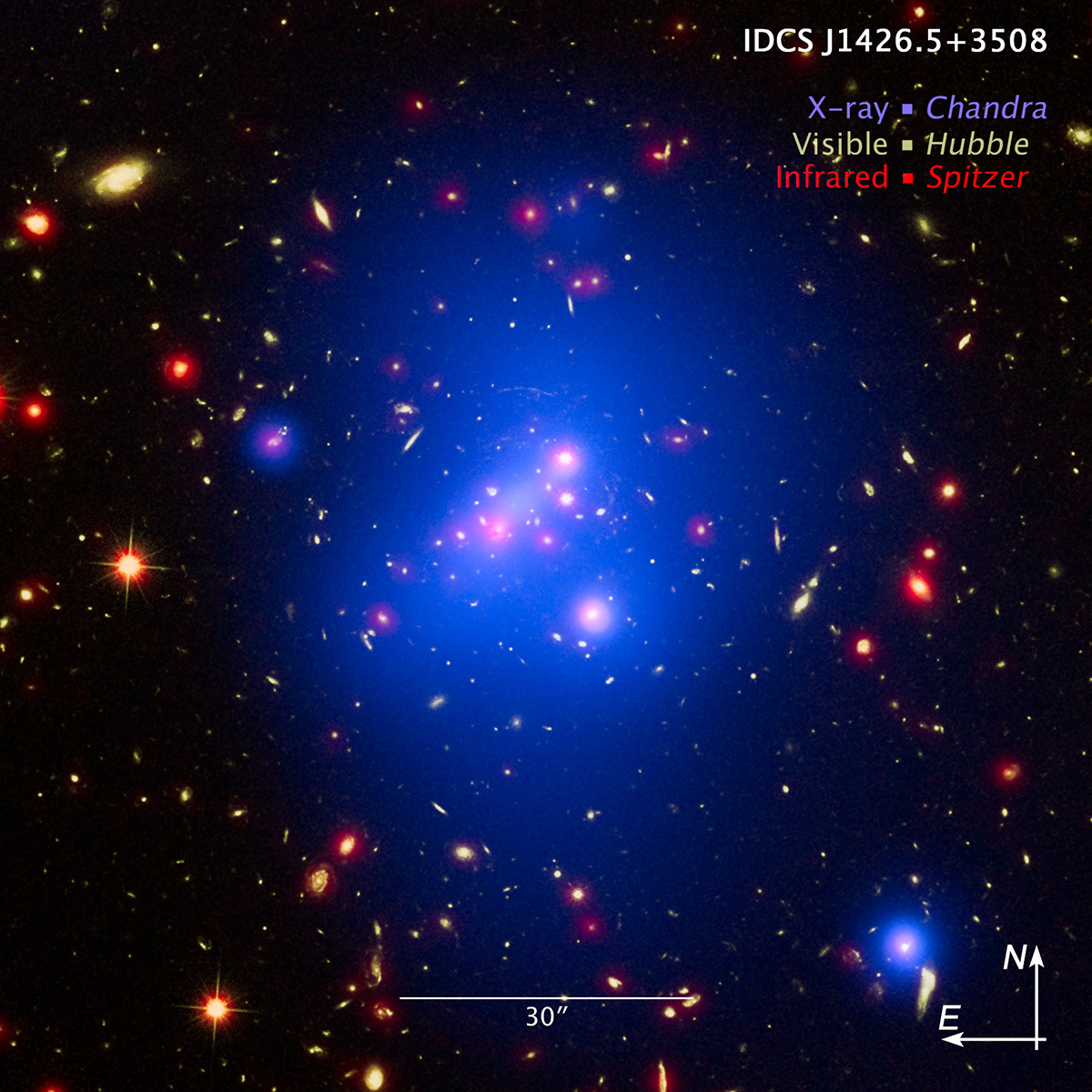
Compass and Scale
Compass and ScaleAn astronomical image with a scale that shows how large an object is on the sky, a compass that shows how the object is oriented on the sky, and the filters with which the image was made.
Related Images & Videos

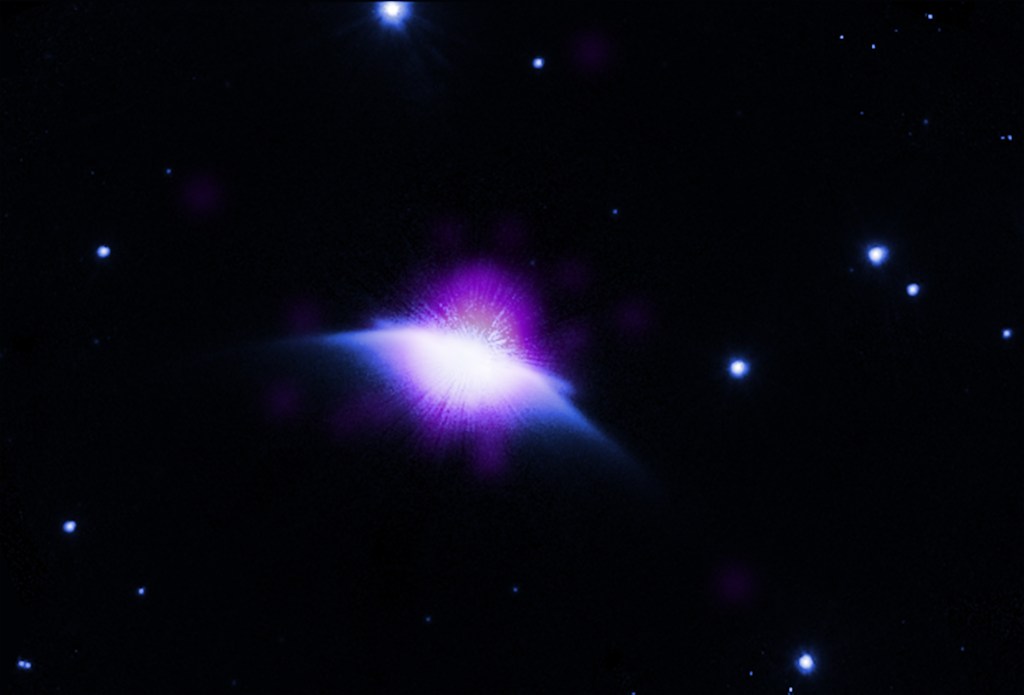
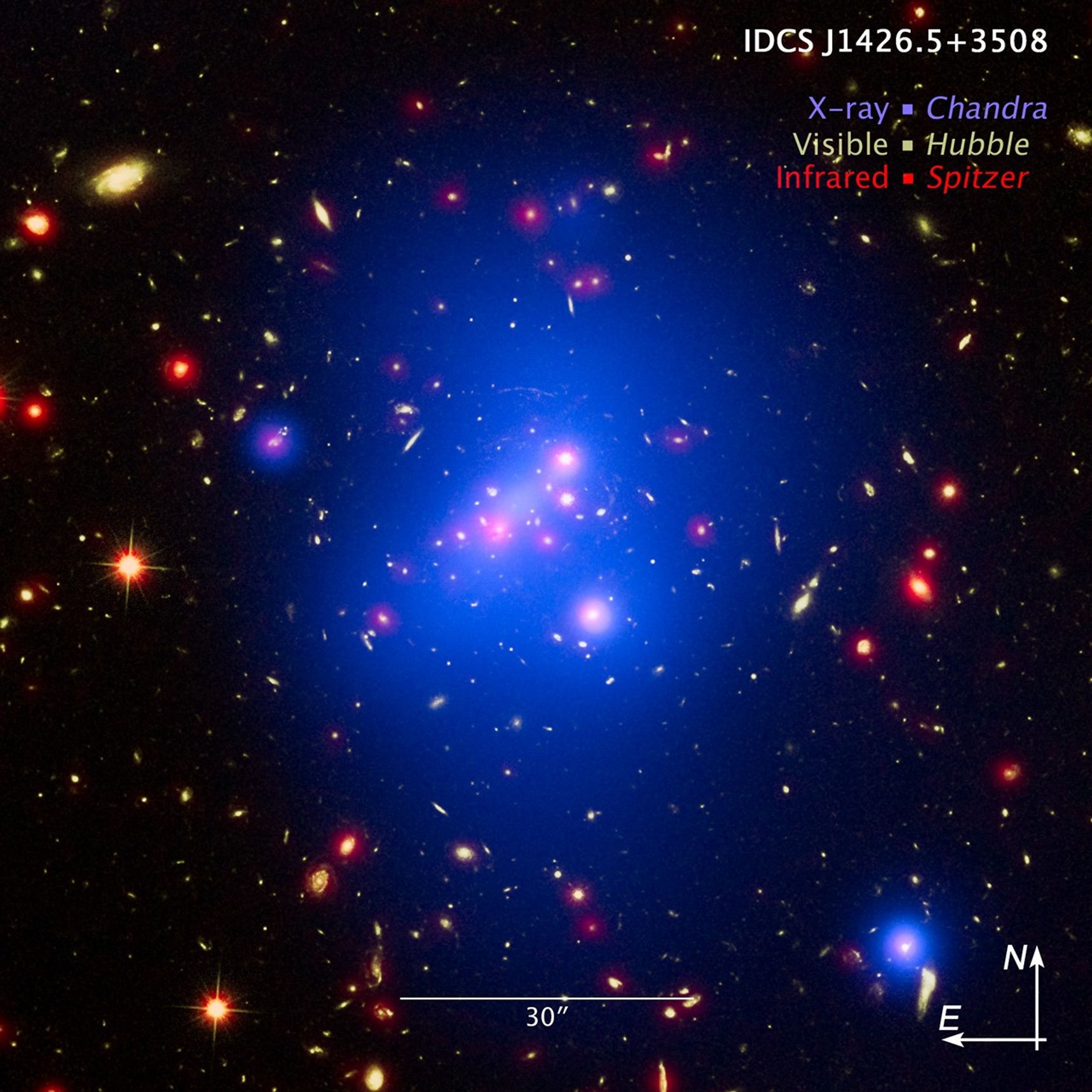
Hubble, Chandra, Spitzer Composite of Massive Galaxy Cluster IDCS J1426.5+3508
Astronomers have made the most detailed study yet of an extremely massive young galaxy cluster using three of NASA's Great Observatories. This multiwavelength image shows this galaxy cluster, called IDCS J1426.5+3508 (IDCS 1426 for short), in X-rays recorded by the Chandra X-ray...
Share
Details
Last Updated
Aug 17, 2025
Contact
Media
Claire Andreoli
NASA’s Goddard Space Flight Center
Greenbelt, Maryland
claire.andreoli@nasa.gov