




















1 min read
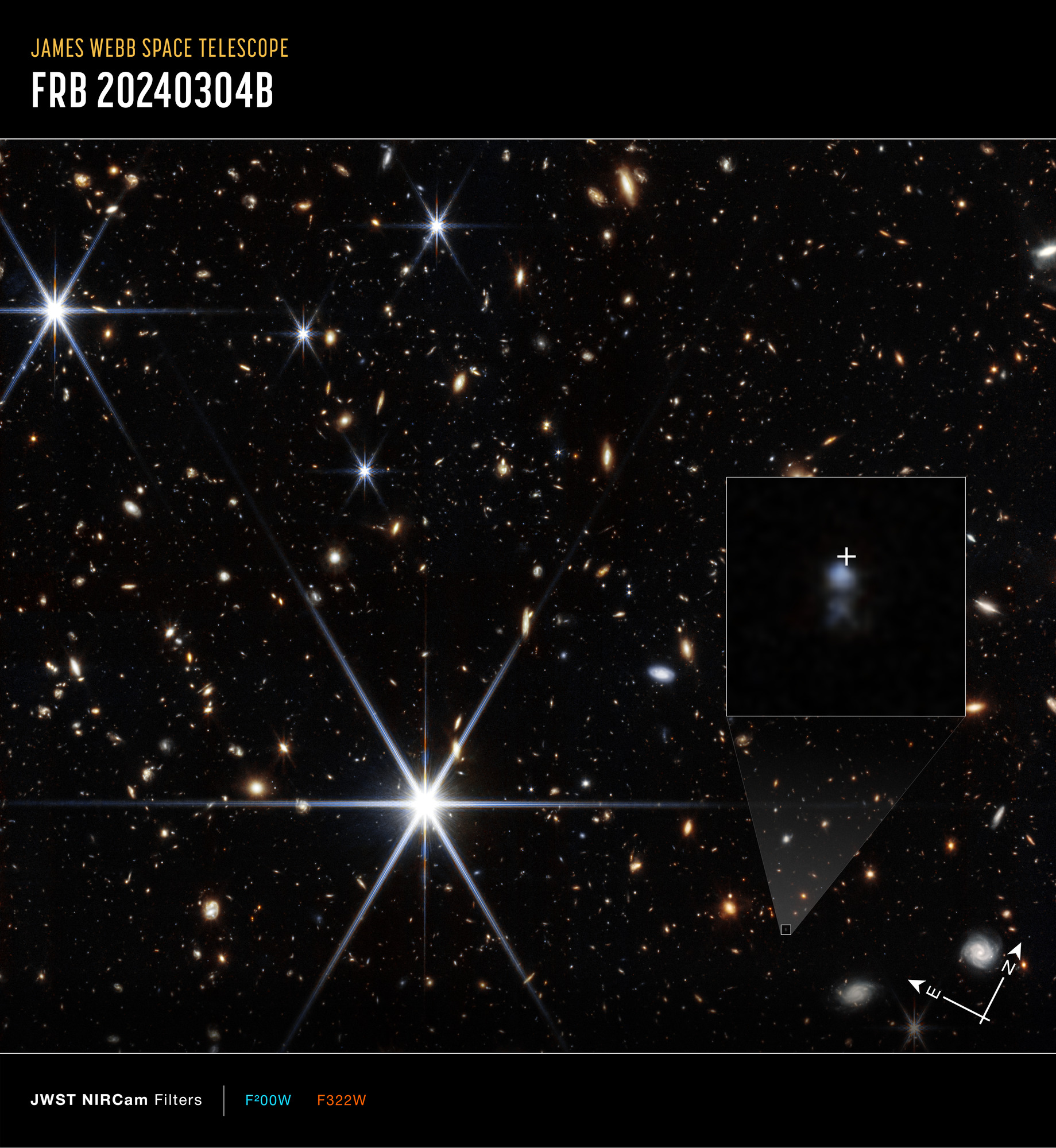
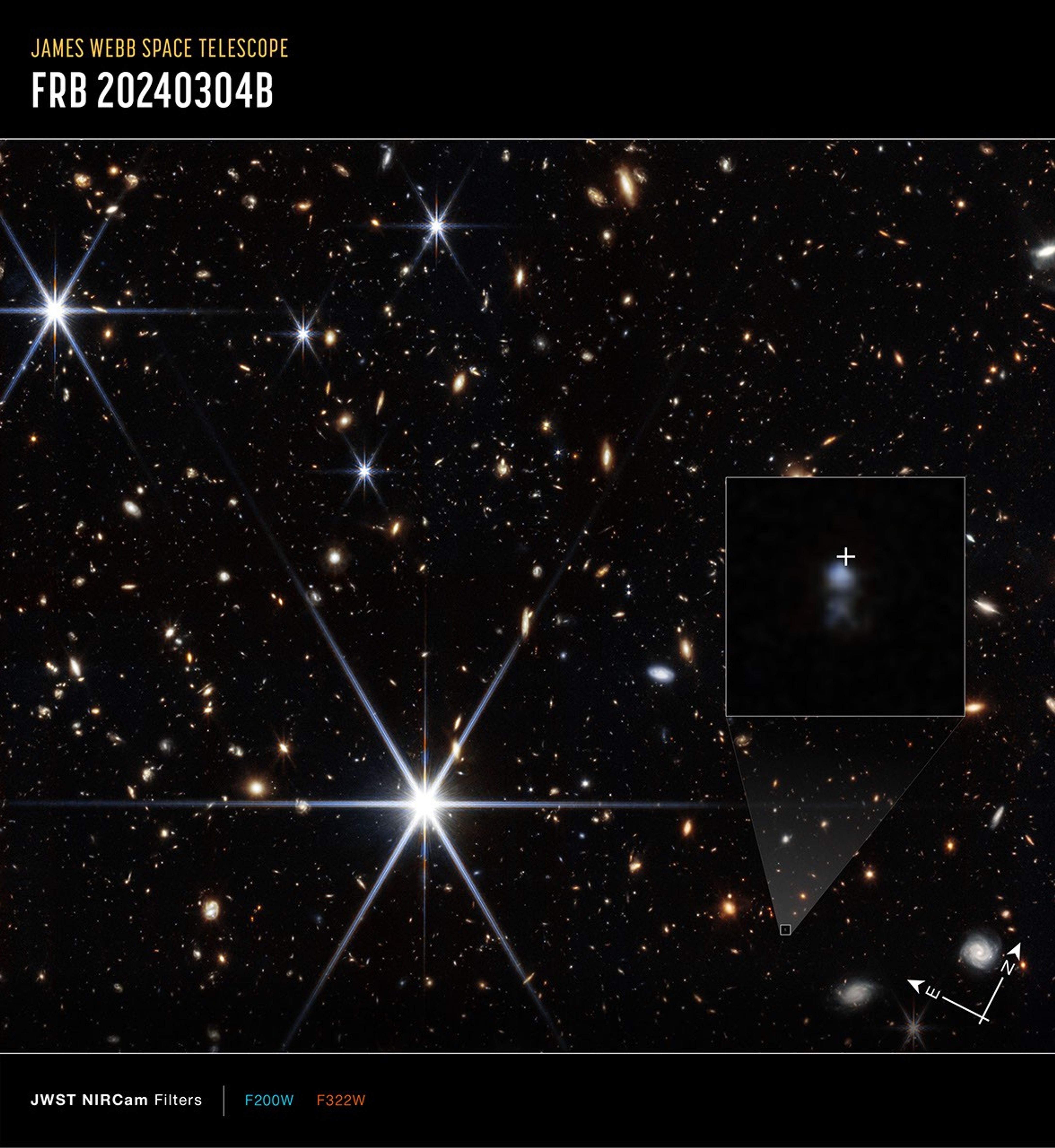
FRB 20240304B (NIRCam Image)
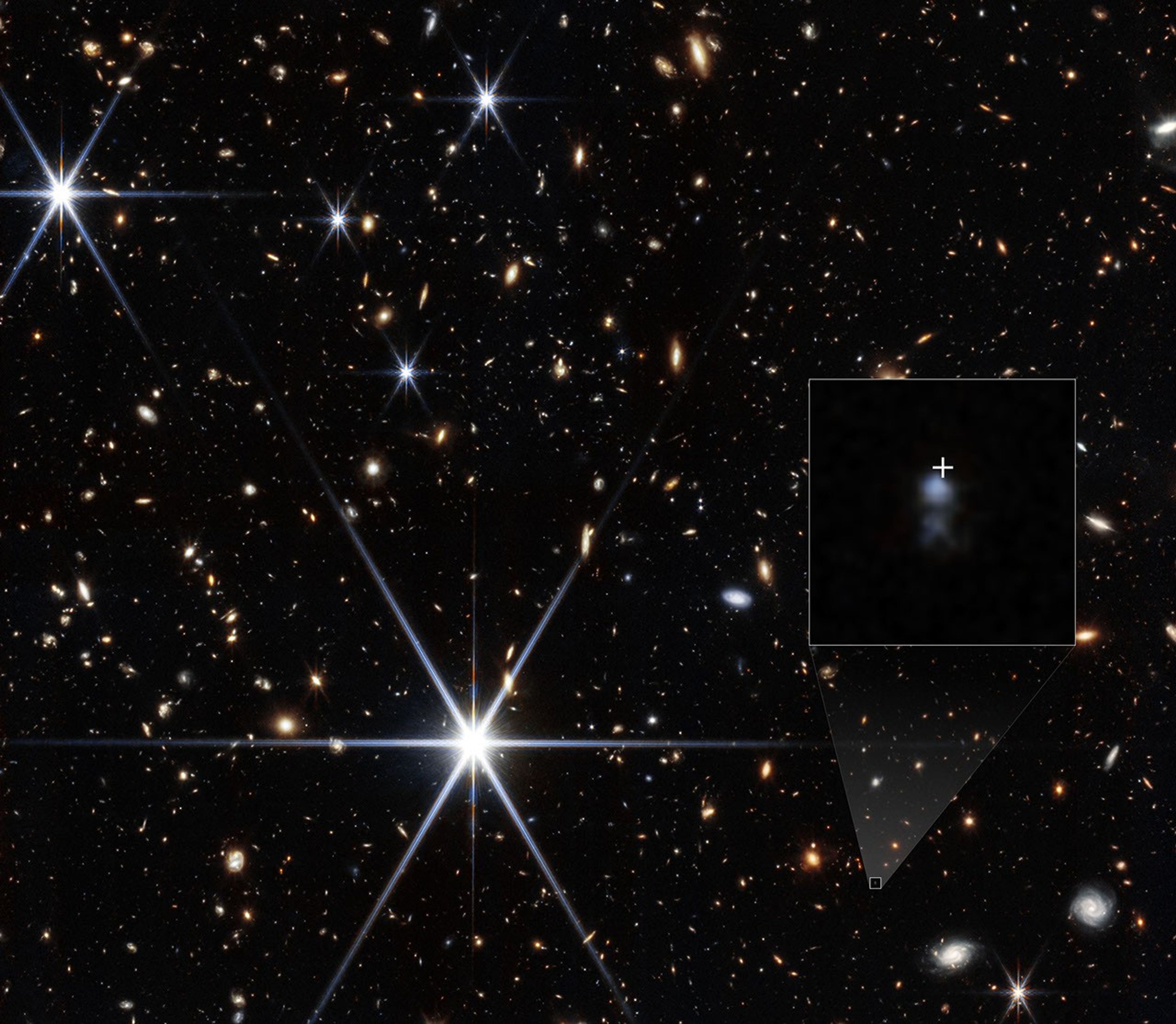
NASA’s James Webb Space Telescope’s NIRCam (Near-Infrared Camera) was able to detect the host galaxy of the fast radio burst called FRB 20240304B, whose location is shown by the white cross. They found it is a small dwarf galaxy actively forming stars.
About the Object
- R.A. PositionR.A. PositionRight ascension – analogous to longitude – is one component of an object's position.12:11:59.294
- Dec. PositionDec. PositionDeclination – analogous to latitude – is one component of an object's position.+11:48:46.830
- ConstellationConstellationOne of 88 recognized regions of the celestial sphere in which the object appears.Virgo
- DistanceDistanceThe physical distance from Earth to the astronomical object. Distances within our solar system are usually measured in Astronomical Units (AU). Distances between stars are usually measured in light-years. Interstellar distances can also be measured in parsecs.10.63 billion light-years (z=2.148)
About the Data
- Data DescriptionData DescriptionProposal: A description of the observations, their scientific justification, and the links to the data available in the science archive.
Science Team: The astronomers who planned the observations and analyzed the data. "PI" refers to the Principal Investigator.This image was created with Webb data from proposal: 6779 (M. Caleb).
- InstrumentInstrumentThe science instrument used to produce the data.NIRCam
- Exposure DatesExposure DatesThe date(s) that the telescope made its observations and the total exposure time.December 26, 2024
- FiltersFiltersThe camera filters that were used in the science observations.F200W, F322W
- Object NameObject NameA name or catalog number that astronomers use to identify an astronomical object.FRB 20240304B
- Object DescriptionObject DescriptionThe type of astronomical object.Fast Radio Burst, millisecond-duration radio pulse
- Release DateOctober 8, 2026
- Science ReleaseWebb Measures Distance to Farthest Fast Radio Burst, Suggesting Origin
- CreditImage: NASA, ESA, CSA, STScI, Themiya Nanayakkara (USYD); Image Processing: Joseph DePasquale (STScI)
Downloads
This image is a composite of separate exposures acquired by the James Webb Space Telescope using the NIRCam instrument. Two filters were used to sample specific wavelength ranges. The color results from assigning different hues (colors) to each monochromatic (grayscale) image associated with an individual filter. In this case, the assigned colors are: Cyan: F200W, Orange: F322W
Related Images & Videos
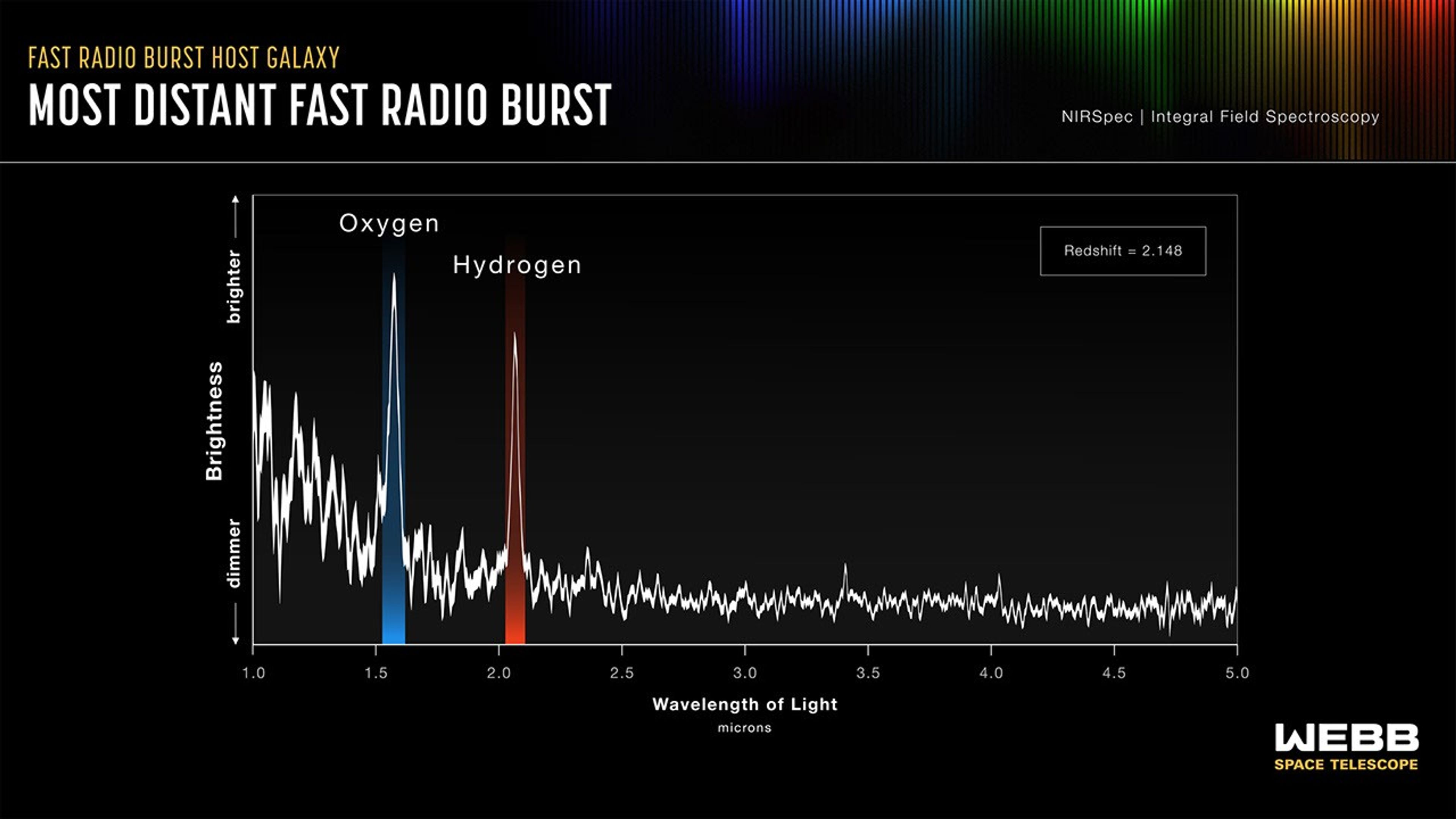
Farthest Fast Radio Burst Host Galaxy Spectrum
Astronomers using NASA’s James Webb Space Telescope were able to study the host galaxy of the most distant known fast radio burst (FRB). They confirmed it has a cosmological redshift of 2.148 and that the FRB occurred just 3 billion years after the big bang.
Share
Details
Laura Betz
NASA’s Goddard Space Flight Center
Greenbelt, Maryland
laura.e.betz@nasa.gov