















1 min read
Lion Nebula (MIRI Image)
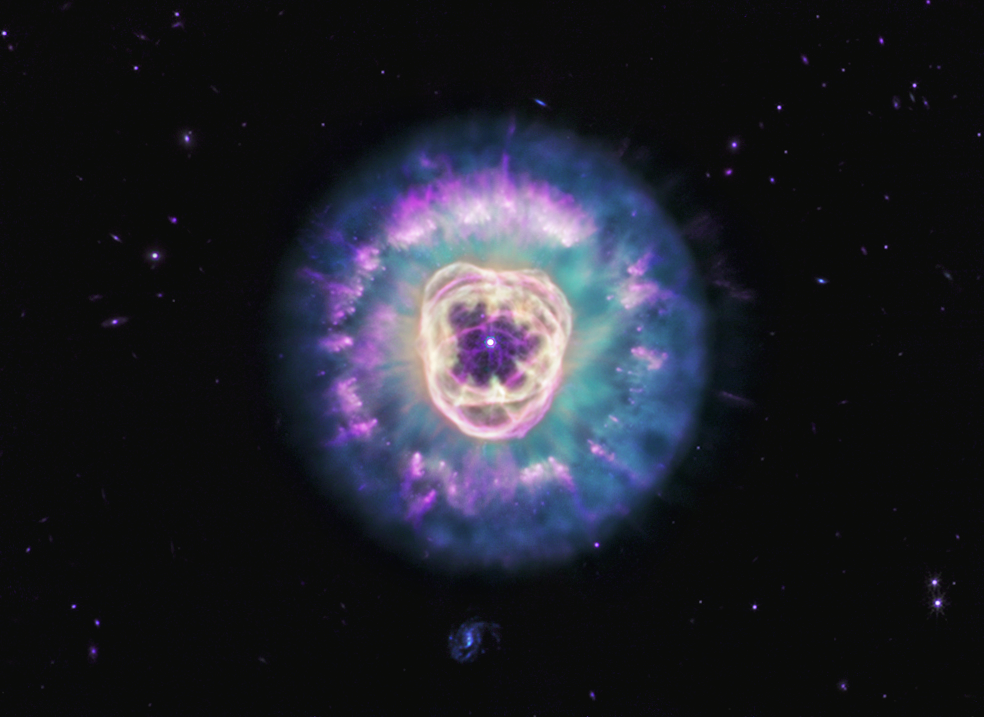
NASA’s James Webb Space Telescope observed planetary nebula NGC 2392 with its MIRI (Mid Infrared Instrument) instrument, revealing the presence of dust and its varying structures within this tumultuous environment. Nicknamed the Lion Nebula due to its appearance, this collection of gas and dust is created and sculpted by the remains of a dying star, which is in the center and resembles the button nose of the lion.
While some dust is being destroyed by the bubble of ionized gas that forms the lion’s face, most of the gas is being ejected and migrating away from the star due to its radiation. In this image, cyan highlights the lion’s mane, which is the interior of a dust shell that is being illuminated by the central star. Within the mane, toward its edges, are purple clumps that look like they have cometary tails. These fluffy structures are also dust, which have managed to survive so far and protect the structures behind them.
About the Object
- R.A. PositionR.A. PositionRight ascension – analogous to longitude – is one component of an object's position.07:29:10.76
- Dec. PositionDec. PositionDeclination – analogous to latitude – is one component of an object's position.+20:54:42.49
- ConstellationConstellationOne of 88 recognized regions of the celestial sphere in which the object appears.Gemini
- DistanceDistanceThe physical distance from Earth to the astronomical object. Distances within our solar system are usually measured in Astronomical Units (AU). Distances between stars are usually measured in light-years. Interstellar distances can also be measured in parsecs.About 5,000 light-years away
- DimensionsDimensionsThe physical size of the object or the apparent angle it subtends on the sky.This image is about 1.8 arcminutes across (2.6 light-years)
About the Data
- Data DescriptionData DescriptionProposal: A description of the observations, their scientific justification, and the links to the data available in the science archive.
Science Team: The astronomers who planned the observations and analyzed the data. "PI" refers to the Principal Investigator.This image was created with Webb data from proposal: 9548 (M. Garcia Marin).
- InstrumentInstrumentThe science instrument used to produce the data.MIRI
- Exposure DatesExposure DatesThe date(s) that the telescope made its observations and the total exposure time.19 Nov. 2025
- FiltersFiltersThe camera filters that were used in the science observations.F115W, F187N, F212N, F335M, F1000W
- Object NameObject NameA name or catalog number that astronomers use to identify an astronomical object.Lion Nebula, NGC 2392, Caldwell 39
- Object DescriptionObject DescriptionThe type of astronomical object.Planetary nebula
- Release DateAugust 10, 2026
- Science ReleaseLion Nebula Roars to Life With NASA’s Webb
- CreditImage: NASA, ESA, CSA, STScI; Image Processing: Alyssa Pagan (STScI)
These images were acquired by the MIRI instruments on the Webb Space Telescope. Several filters were used to sample wide wavelength ranges. The color results from assigning different hues (colors) to each monochromatic (grayscale) image associated with an individual filter. In this case, the assigned colors are: Blue: F770W, Green: F1000W, Red: F1500W
Related Images & Videos
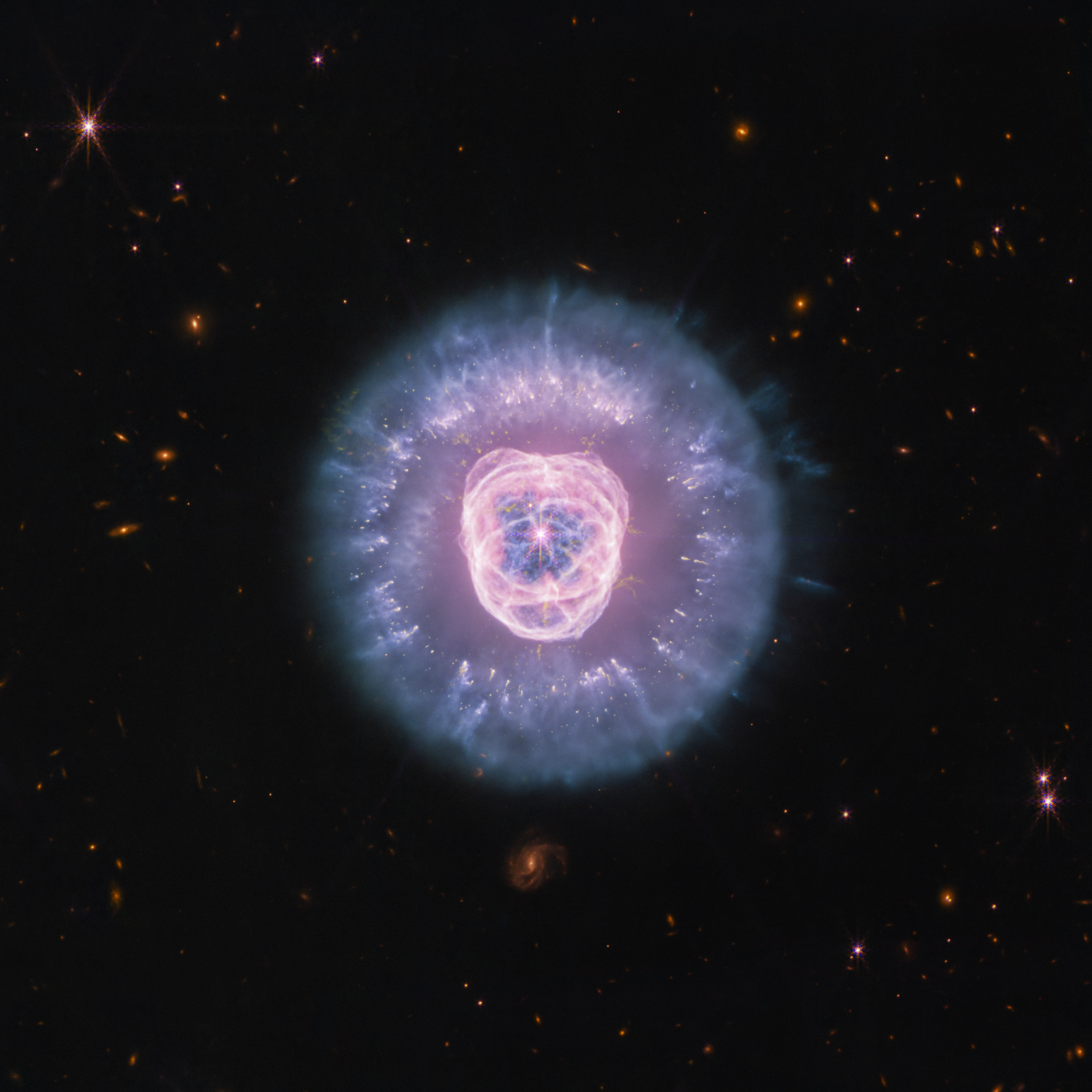
Lion Nebula (NIRCam and MIRI Image)
NASA’s James Webb Space Telescope imaged the planetary nebula NGC 2392, the Lion Nebula, using the observatory’s NIRCam and MIRI instruments. The central star’s remains are responsible for the nebula’s structure, including a lion face-shaped bubble of ionized gas and dust “mane.”
Share
Details
Laura Betz
NASA’s Goddard Space Flight Center
Greenbelt, Maryland
laura.e.betz@nasa.gov