
















1 min read
Orion Bar Collage (NIRCam and MIRI Images)
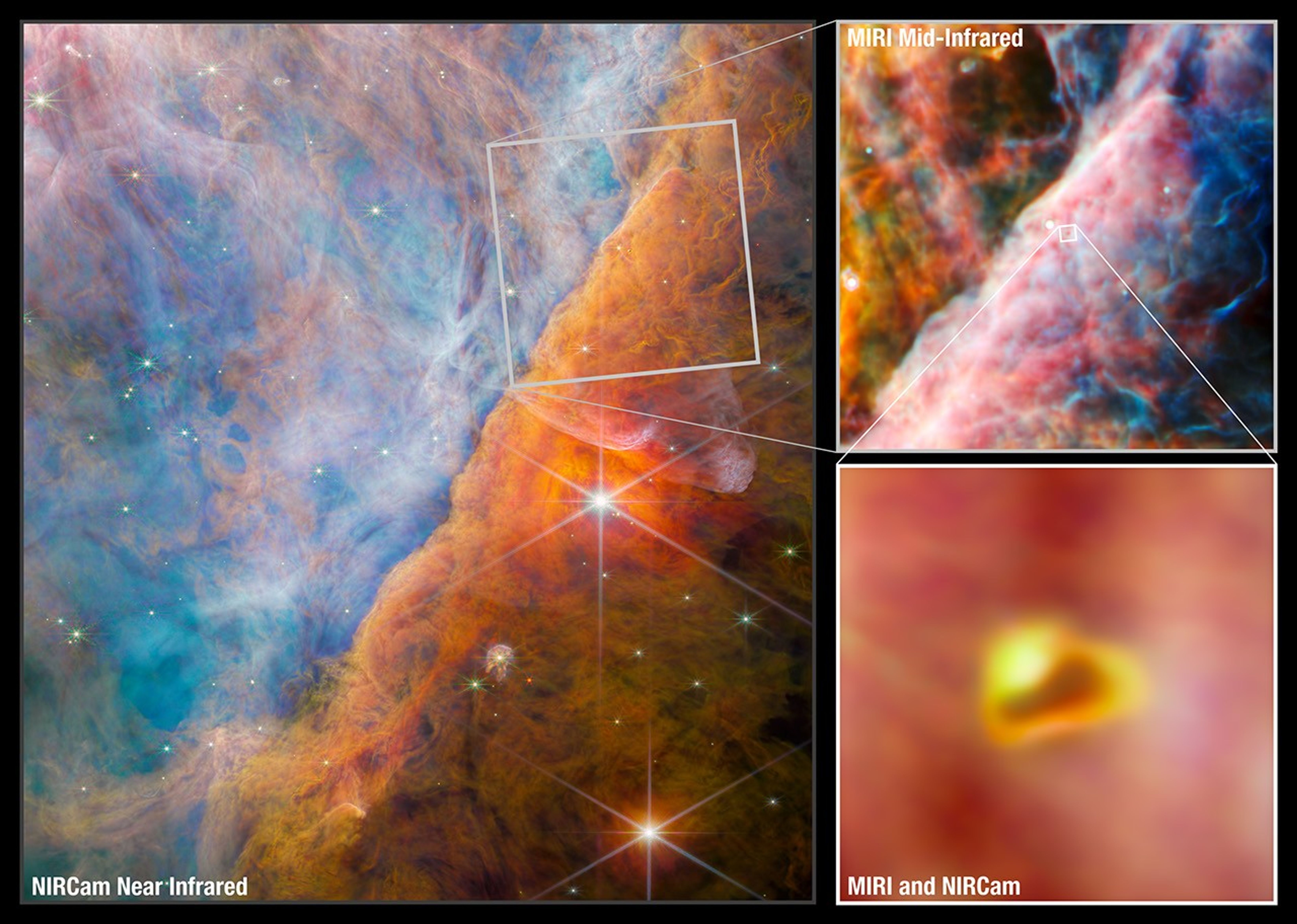
These Webb images show a part of the Orion Nebula known as the Orion Bar. It is a region where energetic ultraviolet light from the Trapezium Cluster — located off the upper-left corner — interacts with dense molecular clouds. The energy of the stellar radiation is slowly eroding the Orion Bar, and this has a profound effect on the molecules and chemistry in the protoplanetary disks that have formed around newborn stars here.
The largest image, on the left, is from Webb’s NIRCam (Near-Infrared Camera) instrument. At upper right, the telescope is focused on a smaller area using Webb’s MIRI (Mid-Infrared Instrument). A total of eighteen filters across both the MIRI and NIRCam instruments were used in these images, covering a range of wavelengths from 1.4 microns in the near-infrared to 25.5 microns in the mid-infrared.
At the very center of the MIRI area is a young star system with a planet-forming disk named d203-506. The pullout at the bottom right displays a combined NIRCam and MIRI image of this young system. Its extended shape is due to pressure from the harsh ultraviolet radiation striking it. An international team of astronomers detected a new carbon molecule known as methyl cation for the first time in d203-506.
About the Object
- ConstellationConstellationOne of 88 recognized regions of the celestial sphere in which the object appears.Orion
- DistanceDistanceThe physical distance from Earth to the astronomical object. Distances within our solar system are usually measured in Astronomical Units (AU). Distances between stars are usually measured in light-years. Interstellar distances can also be measured in parsecs.1,350 light-years
About the Data
- Data DescriptionData DescriptionProposal: A description of the observations, their scientific justification, and the links to the data available in the science archive.
Science Team: The astronomers who planned the observations and analyzed the data. "PI" refers to the Principal Investigator.This image was created with Webb data from proposal: 1288 (O. Berné)
- Object NameObject NameA name or catalog number that astronomers use to identify an astronomical object.Orion Bar
- Release DateJune 26, 2023
- Science ReleaseWebb Makes First Detection of Crucial Carbon Molecule
- CreditImage: ESA/Webb, NASA, CSA, PDRs4ALL ERS Team, Mahdi Zamani (ESA/Webb)
Related Images & Videos
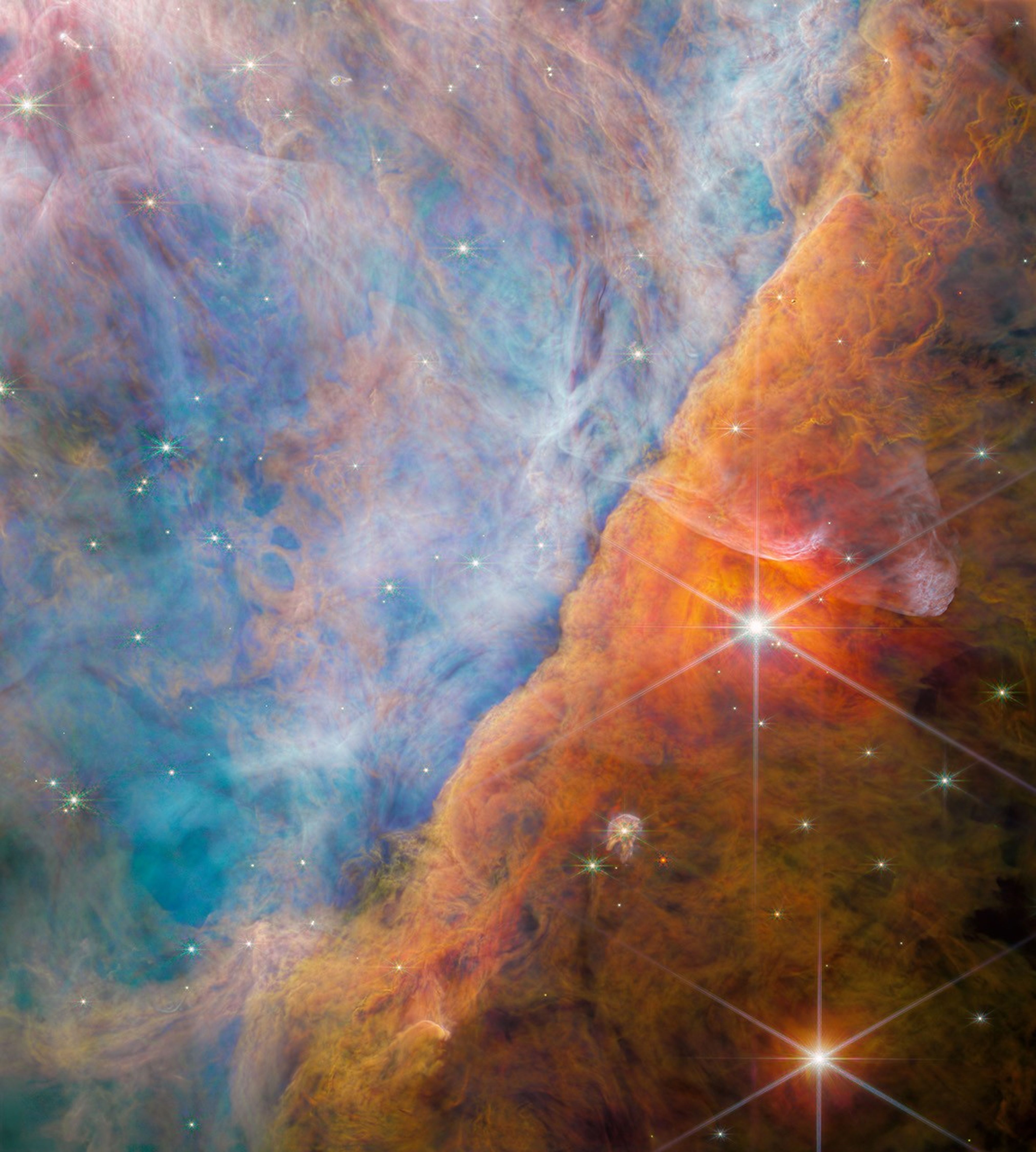
Orion Bar (NIRCam Image)
This image taken by Webb’s NIRCam (Near-Infrared Camera) shows a part of the Orion Nebula known as the Orion Bar. It is a region where energetic ultraviolet light from the Trapezium Cluster — located off the upper-left corner — interacts with dense molecular clouds. The energy...
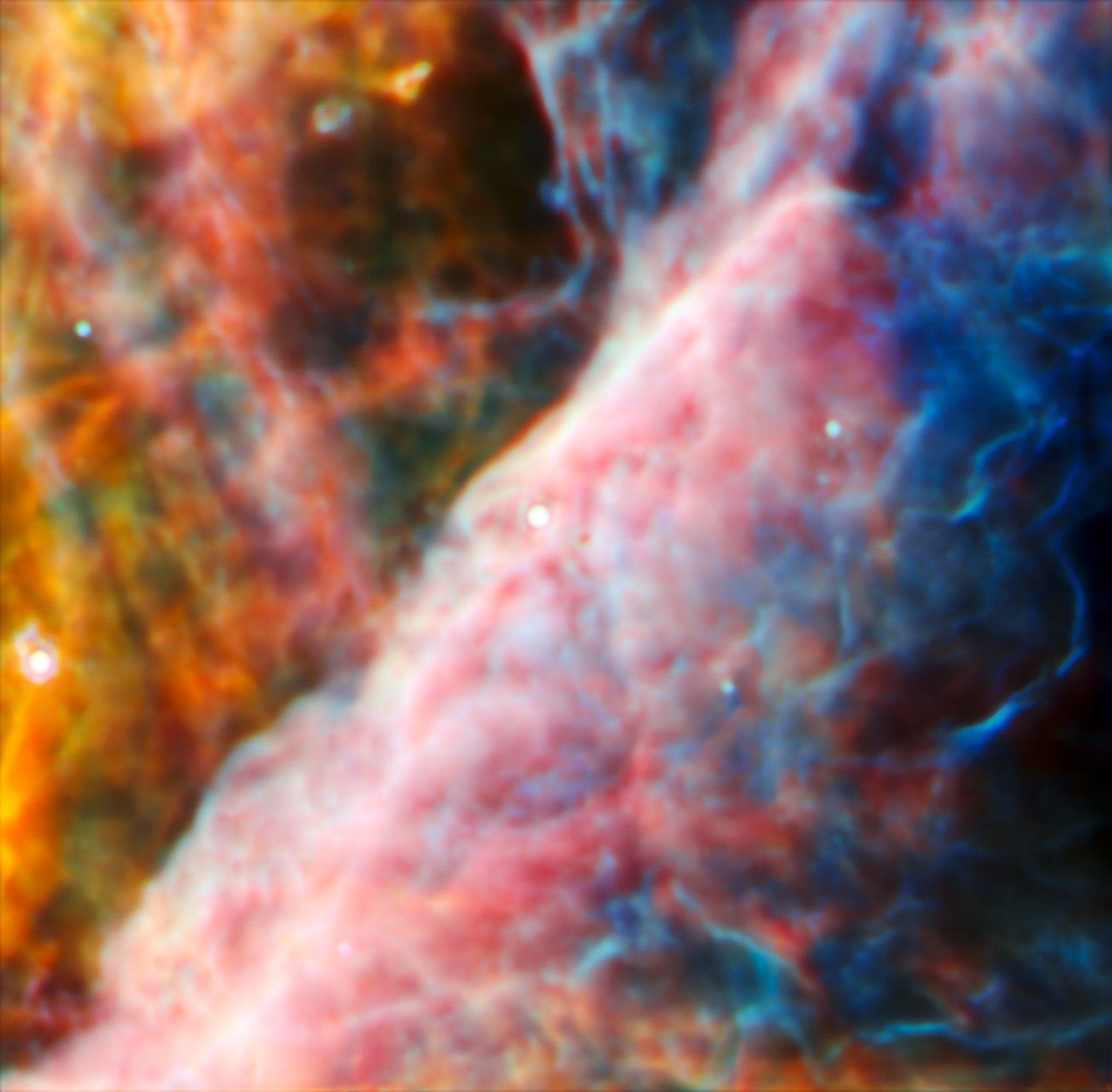
Orion Bar (MIRI Image)
This image from Webb’s MIRI (Mid-Infrared Instrument) shows a small region of the Orion Nebula. At the center of this view is a young star system with a protoplanetary disk named d203-506. An international team of astronomers detected a new carbon molecule known as methyl cation...
Share
Details
Laura Betz
NASA’s Goddard Space Flight Center
Greenbelt, Maryland
laura.e.betz@nasa.gov
ESA/Webb, NASA, CSA, PDRs4ALL ERS Team, Mahdi Zamani (ESA/Webb)