












Suggested Searches

Messier 101

Messier 101 is a classic, face-on, pinwheel spiral galaxy.

Distance

25 million light-years

Apparent Magnitude

7.9

constellation

Ursa Major

object type

Spiral Galaxy
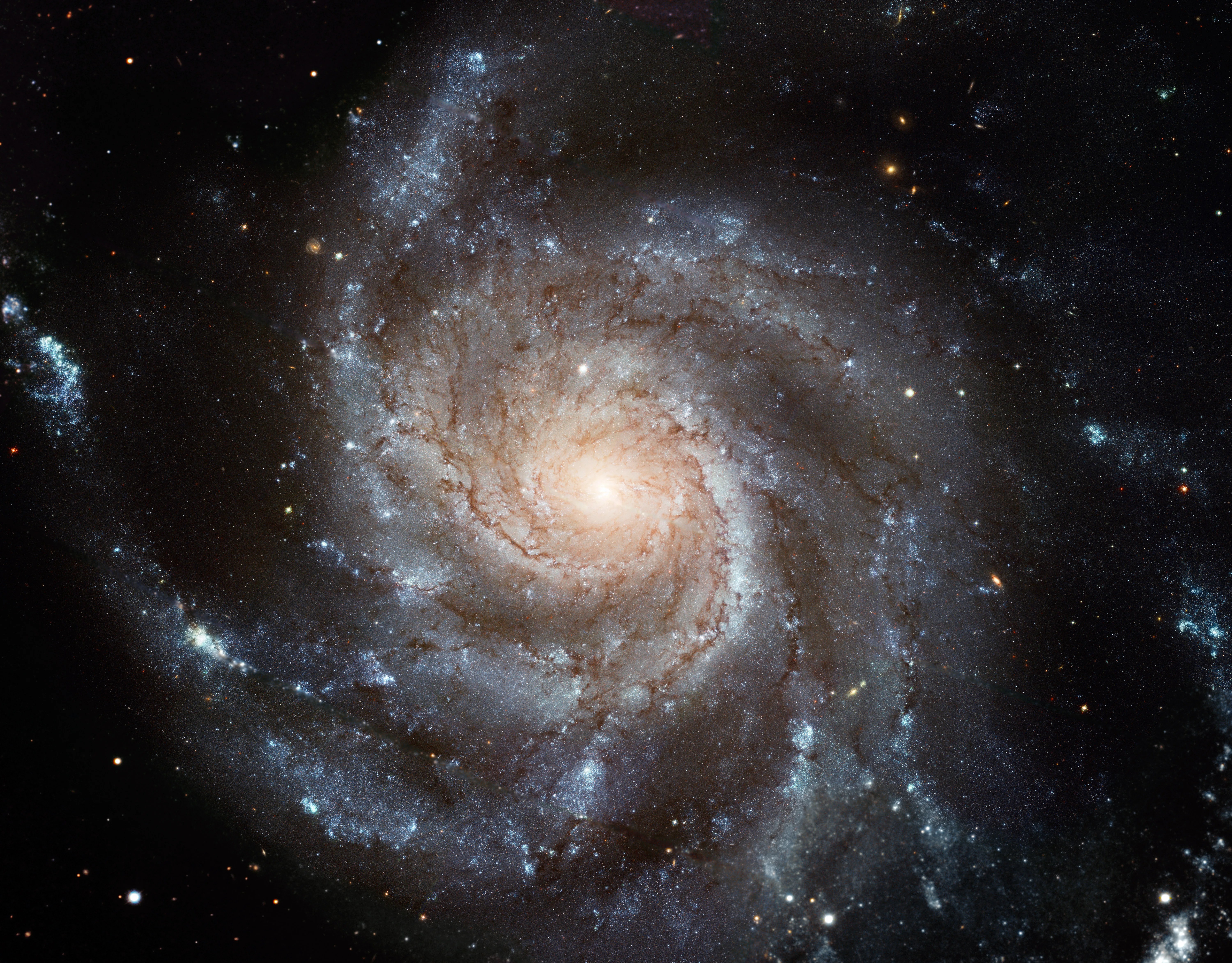
Messier 101 (The Pinwheel Galaxy)
NASA, ESA, K. Kuntz (JHU), F. Bresolin (University of Hawaii), J. Trauger (Jet Propulsion Lab), J. Mould (NOAO), Y.-H. Chu (University of Illinois, Urbana) and STScI; CFHT Image: Canada-France-Hawaii Telescope/J.-C. Cuillandre/Coelum; NOAO Image: G. Jacoby, B. Bohannan, M. Hanna/NOAO/AURA/NSF

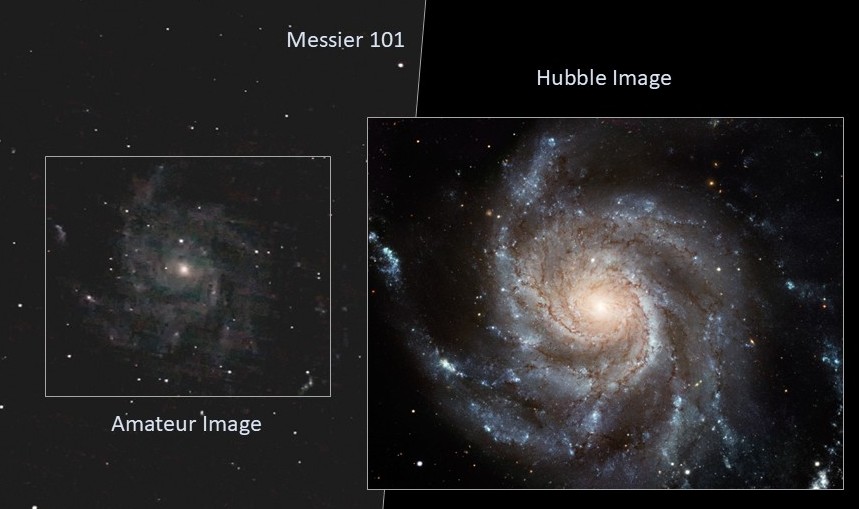
This stunning view of M101, also known as the Pinwheel galaxy, is one of the largest images Hubble has captured of a spiral galaxy. Assembled from 51 exposures taken during various studies over nearly ten years, this infrared and visible-light image measures 16,000 by 12,000 pixels. Ground-based images were used to fill in the portions of the galaxy that Hubble did not observe.

The giant spiral disk of stars, dust, and gas is 170,000 light-years across — nearly twice the diameter of our galaxy, the Milky Way. Astronomers estimate that M101 contains at least one trillion stars. The galaxy’s spiral arms are sprinkled with large regions of star-forming nebulas. These nebulas are areas of intense star formation within giant molecular hydrogen clouds. Brilliant, young clusters of hot, blue, newborn stars trace out the spiral arms.

Pierre Méchain, one of Charles Messier’s colleagues, discovered the Pinwheel galaxy in 1781. Located 25 million light-years away from Earth in the constellation Ursa Major, M101 has an apparent magnitude of 7.9. It can be spotted through a small telescope and is most easily observed during June.

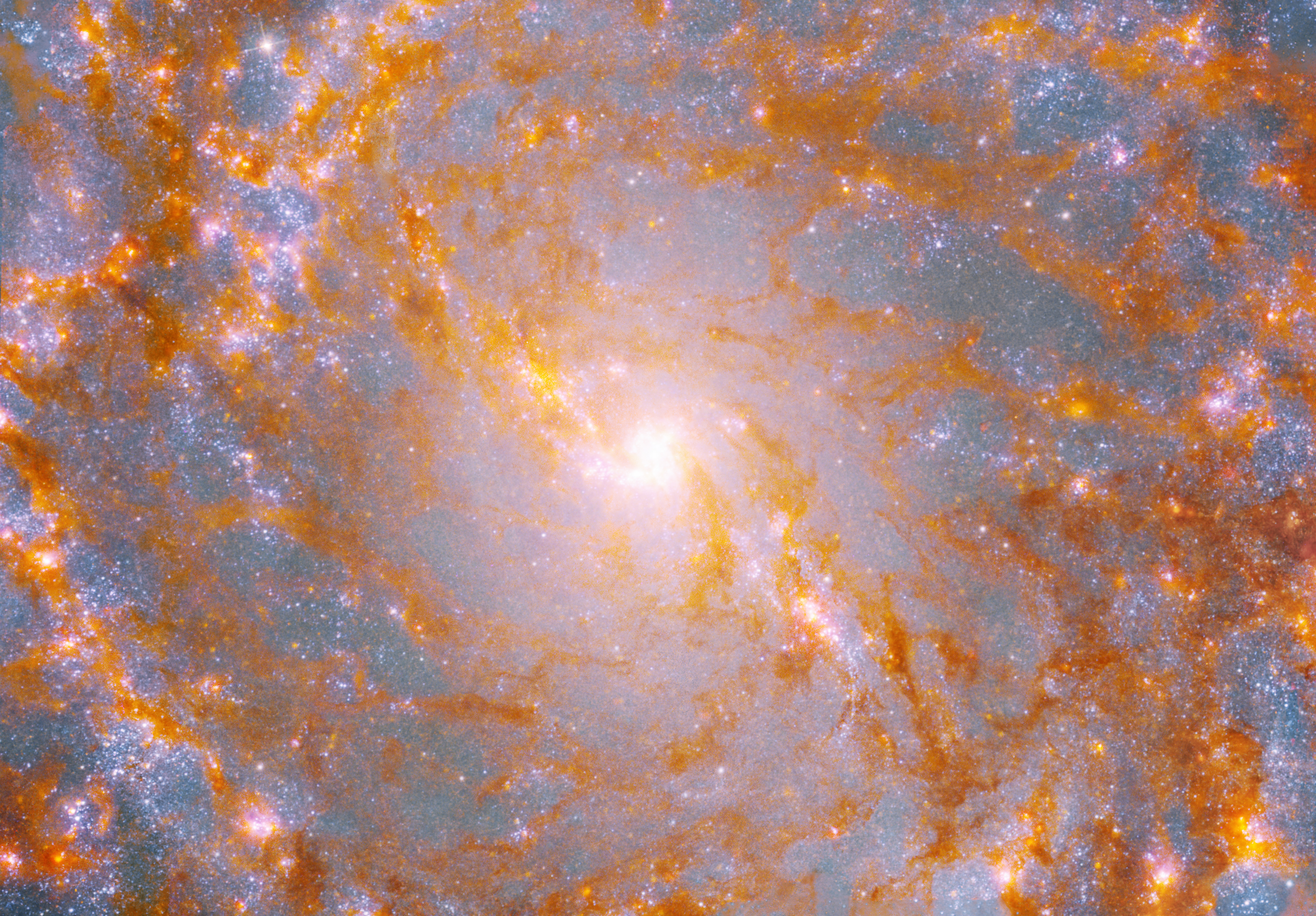
A close-up view shows a galaxy’s bright, yellow center, surrounded by patches of glowing orange-brown dust and pink stars.
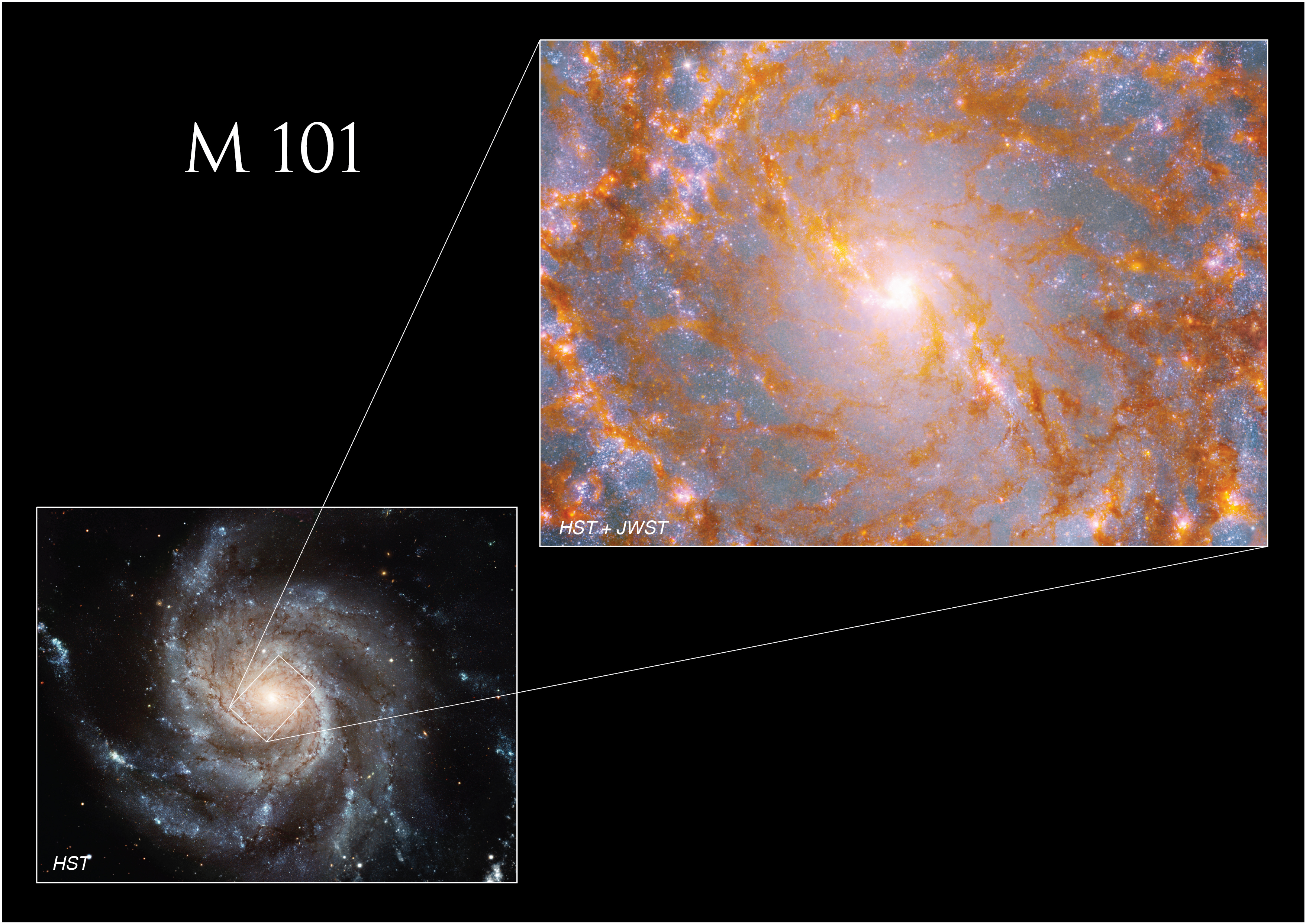
The heart of Messier 101, or the Pinwheel Galaxy, shines in this image that combines data from NASA’s Hubble Space Telescope and James Webb Space Telescope. At 25 million light-years away, M101 is one of the closest “face-on” spiral galaxies to us. With that in mind, Hubble’s ultraviolet, visible, and near-infrared data were taken as part of studies to find out more about its stellar population and galactic structure. Webb’s near- and mid-infrared observations helped astronomers study the formation and evolution of polycyclic aromatic hydrocarbons – which are complex, carbon-based molecules, and the smallest dust grains that glow in infrared light.
NASA, CSA, ESA, D. Calzetti (University of Massachusetts - Amherst), C. Clark (Space Telescope Science Institute - ESA - JWST), K. Kuntz (The John Hopkins University), and B. Shappee (University of Hawaii) ; Processing: Gladys Kober (NASA/Catholic University of America)
At lower left, an image shows a spiral galaxy with a yellow core and winding arms full of brown dust and blue star formation. A rectangle graphic outlines the core, and lines extend to a larger image at upper right, showing a closer view of the galaxy’s center, surrounded by patches of glowing orange-brown dust and pink stars.
HST Image: NASA, ESA, K. Kuntz (JHU), F. Bresolin (University of Hawaii), J. Trauger (Jet Propulsion Lab), J. Mould (NOAO), Y.-H. Chu (University of Illinois, Urbana) and STScI; CFHT Image: Canada-France-Hawaii Telescope/J.-C. Cuillandre/Coelum; NOAO Image: G. Jacoby, B. Bohannan, M. Hanna/NOAO/AURA/NSF; HST + JWST Image: NASA, CSA, ESA, D. Calzetti (University of Massachusetts - Amherst), C. Clark (Space Telescope Science Institute - ESA - JWST), K. Kuntz (The John Hopkins University), and B. Shappee (University of Hawaii); Processing: Gladys Kober (NASA/Catholic University of America)

For more information about Hubble’s observations of M101, see:

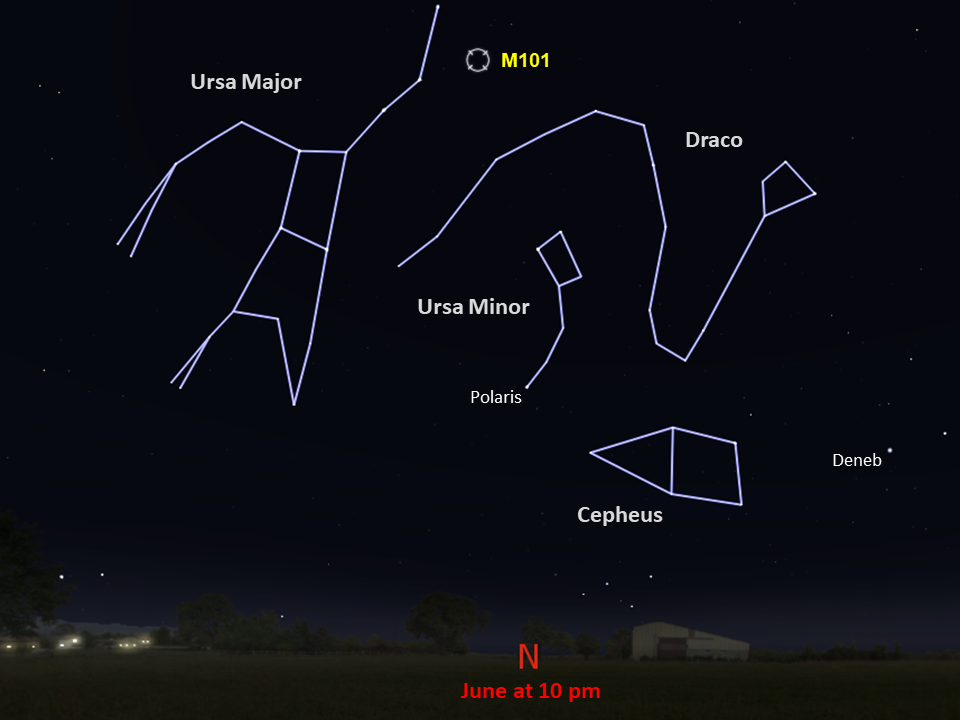
This star chart for M101 represents the view from mid-northern latitudes for the given month and time.
Image courtesy of Stellarium

Explore Hubble's Messier Catalog

The following pages contain some of Hubble’s best images of Messier objects.
Hubble’s Messier Catalog

Overview The Messier catalog, begun by astronomer Charles Messier in the 18th Century and revised over the years, includes some…

Messier 1 (The Crab Nebula)

Better known as the Crab Nebula, Charles Messier originally mistook Messier 1 for Halley’s Comet, which inspired him to create…
Messier 2

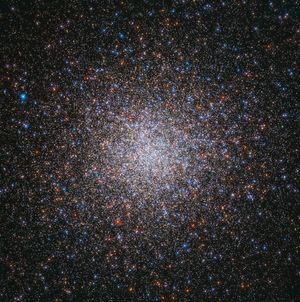
Hubble's image of Messier 2 is comprised of visible and infrared wavelengths of light.