


























Webb’s Star Formation Discoveries
Contents
- Identifying what’s in molecular clouds and detailing stars in the process of forming.
- How Do Stars Form?
- Video: Exploring Star and Planet Formation
- Analyzing the Contents of Molecular Clouds
- Studying Individual Young Stars in Detail
- Scrutinizing the Environments Around New Stars
- Most Revent Discoveries
- What’s Next for Webb
- Keep Up to Date with Webb Science
Identifying what’s in molecular clouds and detailing stars in the process of forming.
In just a few years, the James Webb Space Telescope has delivered invaluable details that are reshaping researchers’ understanding of how young stars form. It has identified ices and many other complex organic molecules in the clouds where stars begin gathering mass. This includes new details about their histories of gobbling up and ejecting material. Webb has also pinpointed clear evidence of how water begins as ice and becomes vapor as it travels closer to a young star, creating a rich environment where Earth-like planets may take shape.
How Do Stars Form?
Stars form in super cold environments, known as molecular clouds over millions of years. These clouds are as cold as 10 kelvin (negative 260 Celsius or negative 440 Fahrenheit), and are filled with gas and dust. Denser areas of these clouds collapse gravitationally into clumps, which then collapse into many cores. Those cores further collapse into individual protostars. As they form, protostars will continue to pull in surrounding gas. Some molecular clouds are dominated by massive stars, and others have a greater number of smaller stars.
Video: Exploring Star and Planet Formation
Download the video captions (VTT), and transcript of the audio description (Word Doc, 19 KB).
Let’s consider the “heavyweights” first. Massive young stars form and accumulate their mass over tens of thousands of years. As they take shape, these stars inject an incredible amount of energy into their environments. For example, massive stars send out stellar winds and emit ultraviolet light, which disrupt the bulk of the surrounding molecular cloud and limit how many other stars — and planets — can form near them. The reverse is also true: These same processes can compact surrounding dense gas, and can trigger new star formation.
In contrast, smaller young stars (like our Sun once was) form more slowly, over a few million years. During this process, smaller stars periodically shoot out jets and outflows, but do not influence their local environments as significantly as massive stars. Over time, a flattened circumstellar disk forms around these smaller stars, where planets may eventually take shape.
Analyzing the Contents of Molecular Clouds
Stars form in molecular clouds that are seeded with dust grains, elements, and molecules that may end up in the stars themselves — or near them, where planets may eventually form. Thanks to Webb’s sensitive near- and mid-infrared instruments, researchers can now better identify materials that exist in molecular clouds and the stars within them.
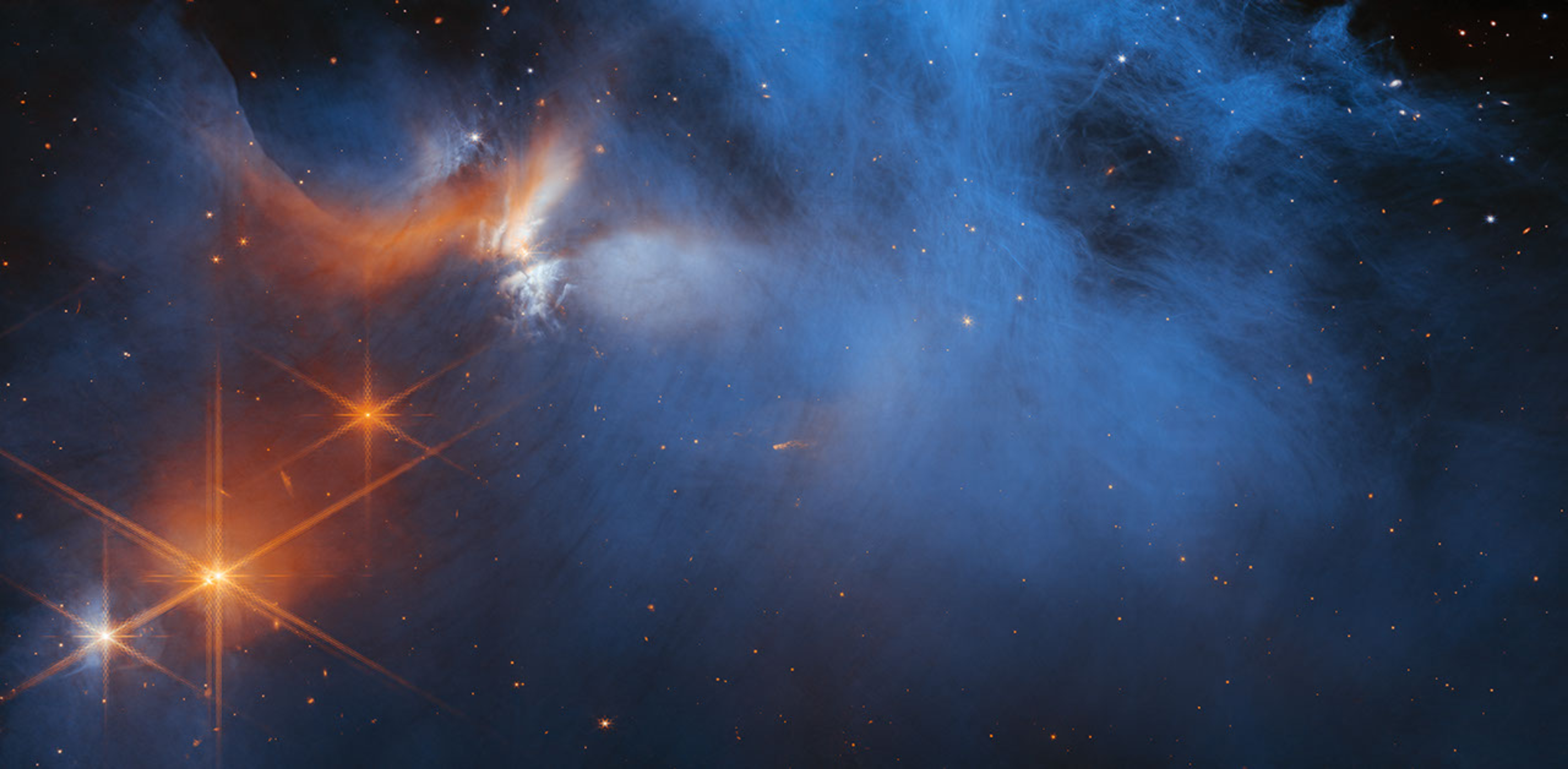
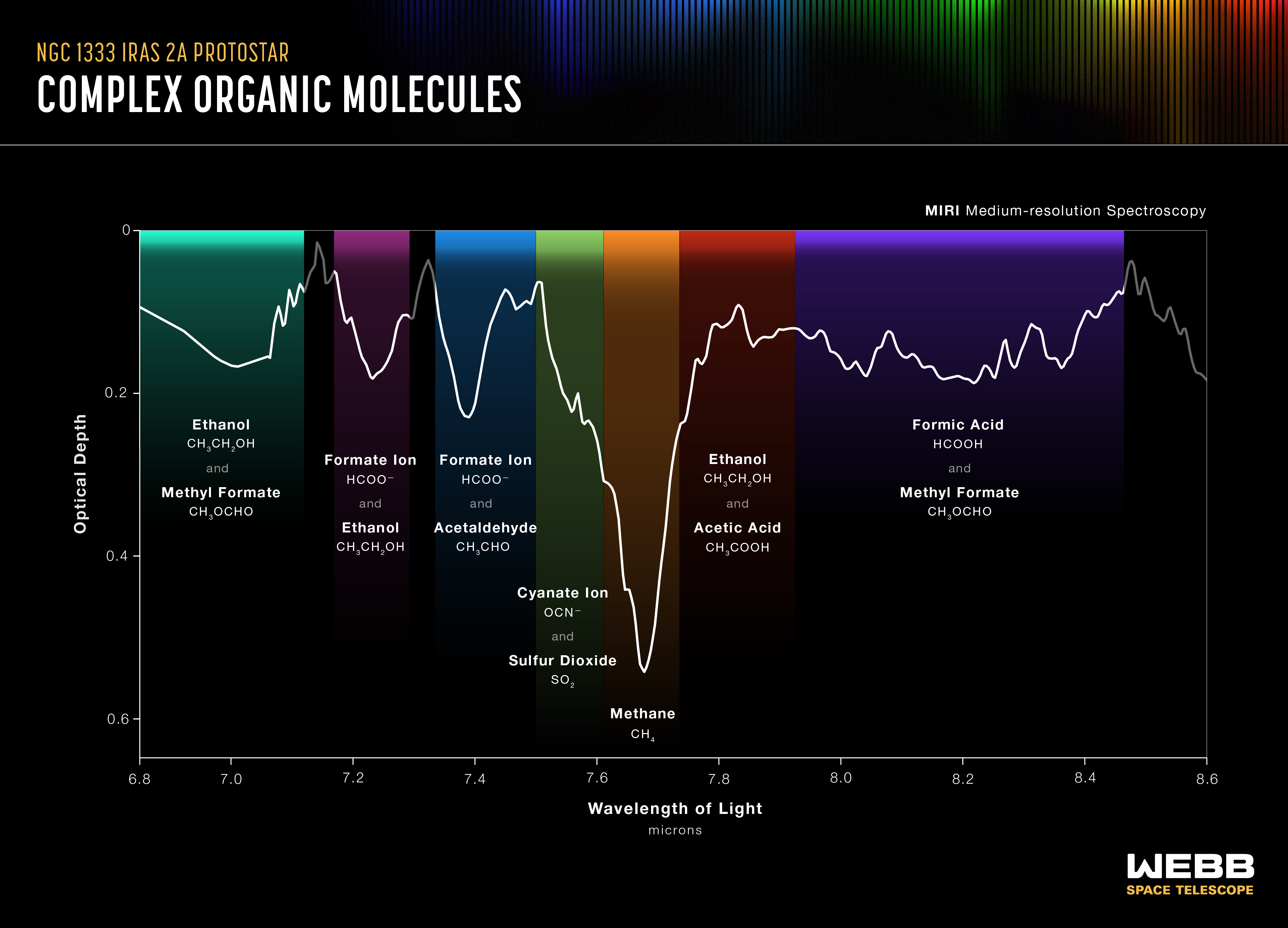
In the Chamaeleon I molecular cloud, Webb obtained an in-depth inventory of the deepest, coldest ices measured to date in any molecular cloud. The telescope identified simple ices like water, along with frozen forms of a wide range of molecules, from carbonyl sulfide, ammonia, and methane to the simplest complex organic molecule, methanol. These detections are crucial, since ices are vital ingredients for habitable planets and are the main sources of several key elements, including carbon, hydrogen, oxygen, nitrogen, and sulfur.
Studying Individual Young Stars in Detail
Researchers using Webb found new evidence of the growth cycles of smaller stars, including the shape and history of their ejections. First up: Webb’s tight view of the protostar within the molecular cloud L1527. Observations were taken in two types of light, near-infrared and mid-infrared, which revealed the star’s once-hidden features, like its past outbursts that form an hourglass shape. Look first at the dark regions that form a rough bowtie shape along the sides of the bright hourglass, and the small edge-on disk at the center. These darker areas are remnants of the molecular cloud that led to the star’s formation, and they block light from distant stars and galaxies. Now, focus on the center and the brightly lit regions: As the forming star gathers mass from the disk, it also ejects some material in outflows. The star’s light shines through these areas.
Not all ejections are alike. Sometimes, a star builds mass in periodic bursts, and later “burps” or ejects material. This star’s activities are also visible in these outflows — look for bubble-like shapes. Not only can researchers use the shapes of the outflows to trace the history of the star’s activity, they can also search for specific molecules and elements throughout the scene.
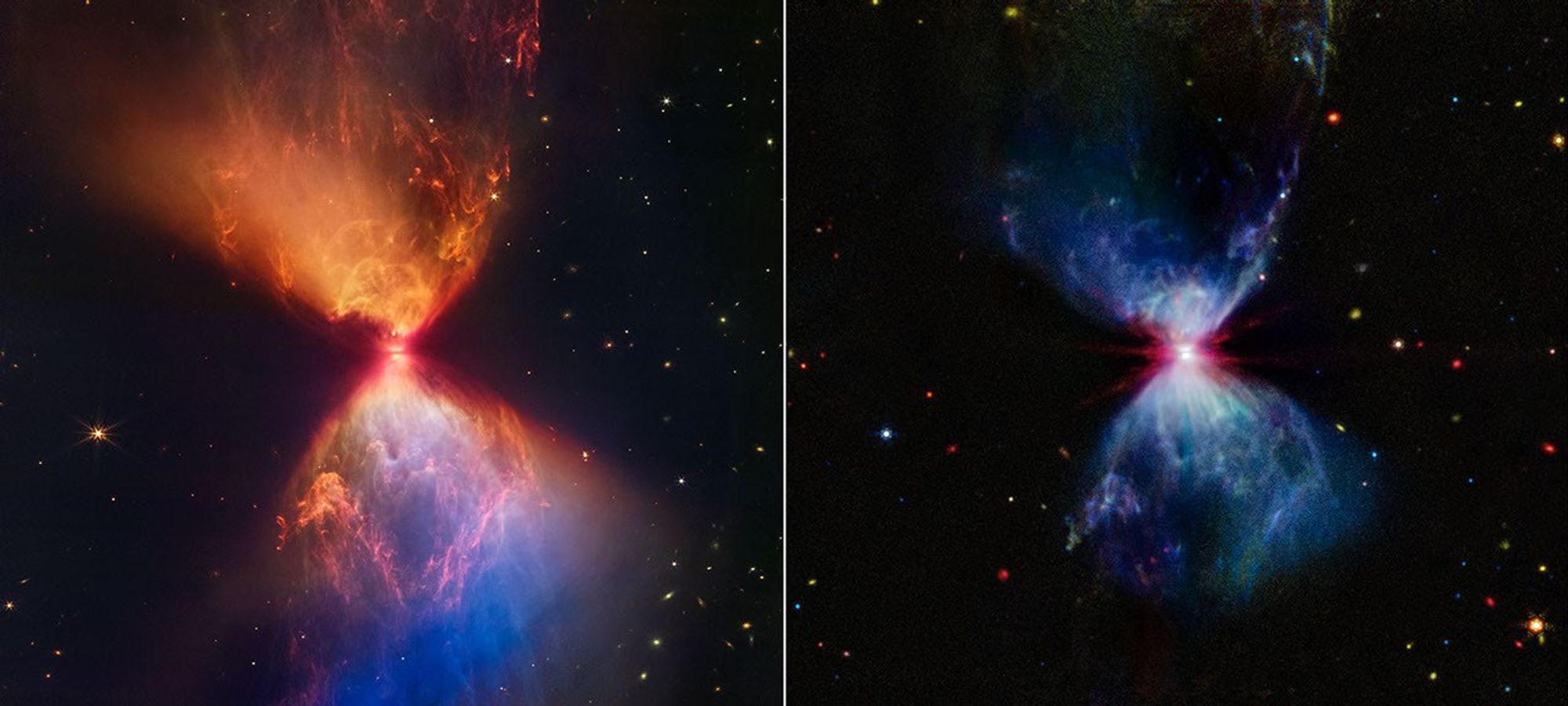
Webb recently studied Herbig-Haro 211, ejections around another small, actively forming star. In the telescope’s near-infrared image, its outflows play the starring role. (The star itself is covered by its circumstellar disk at the center.) The protostar has repeatedly spewed stellar winds and jets, which cause high-speed shock waves that bend when they encounter nearby gas and dust, known as bow shocks. Webb’s highly detailed observations have helped researchers map the star’s outflows and show that the inner jet “wiggles” with mirror symmetry on either side of the central protostar.
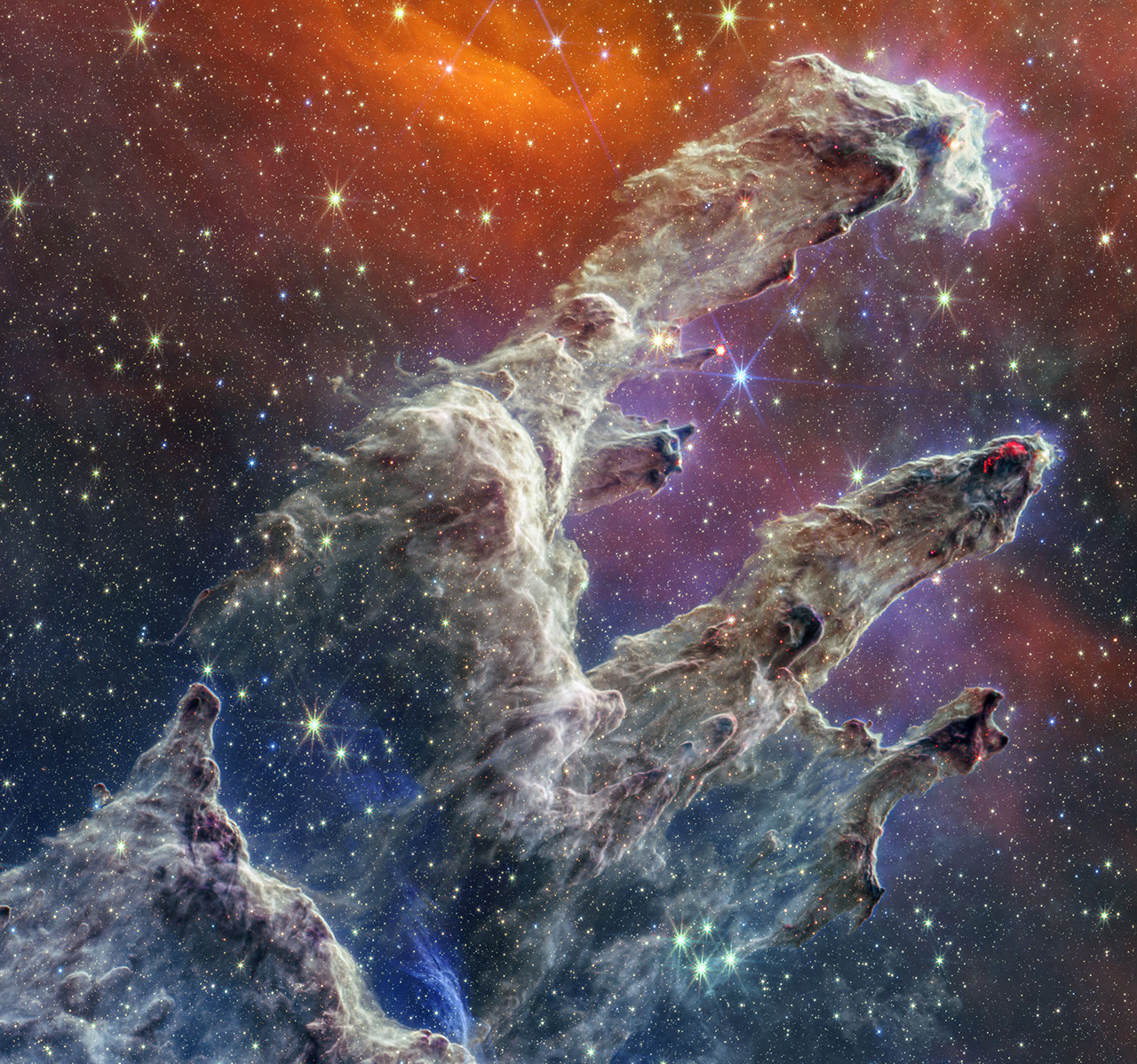
The telescope has also surveyed wider areas of star formation, including the iconic Pillars of Creation. The Hubble Space Telescope made these pillars famous decades ago, showing them to be huge columns of gas and dust that have not yet been eroded by nearby hot, massive stars. Webb’s near-infrared observations allow it to peer inside the pillars, revealing additional and complex star formation. Webb’s mid-infrared light view shows even more, including that the stars in the red tips are slowly eroding the dust immediately around them. Want to see this scene in greater detail? Learn how massive young stars just off frame are also eroding the pillars.
Scrutinizing the Environments Around New Stars
As smaller stars finish forming, leftover material known as circumstellar disks orbit them. This is where planets can form over millions of years. Before Webb, researchers theorized that pebbles and rocks delivered molecules and elements as they drifted from the outer to the inner disk around the star. Webb’s observations confirmed this prediction, definitively proving that icy pebbles can drift toward the inner disk, subsequently warming to release cold water vapor into the disk.
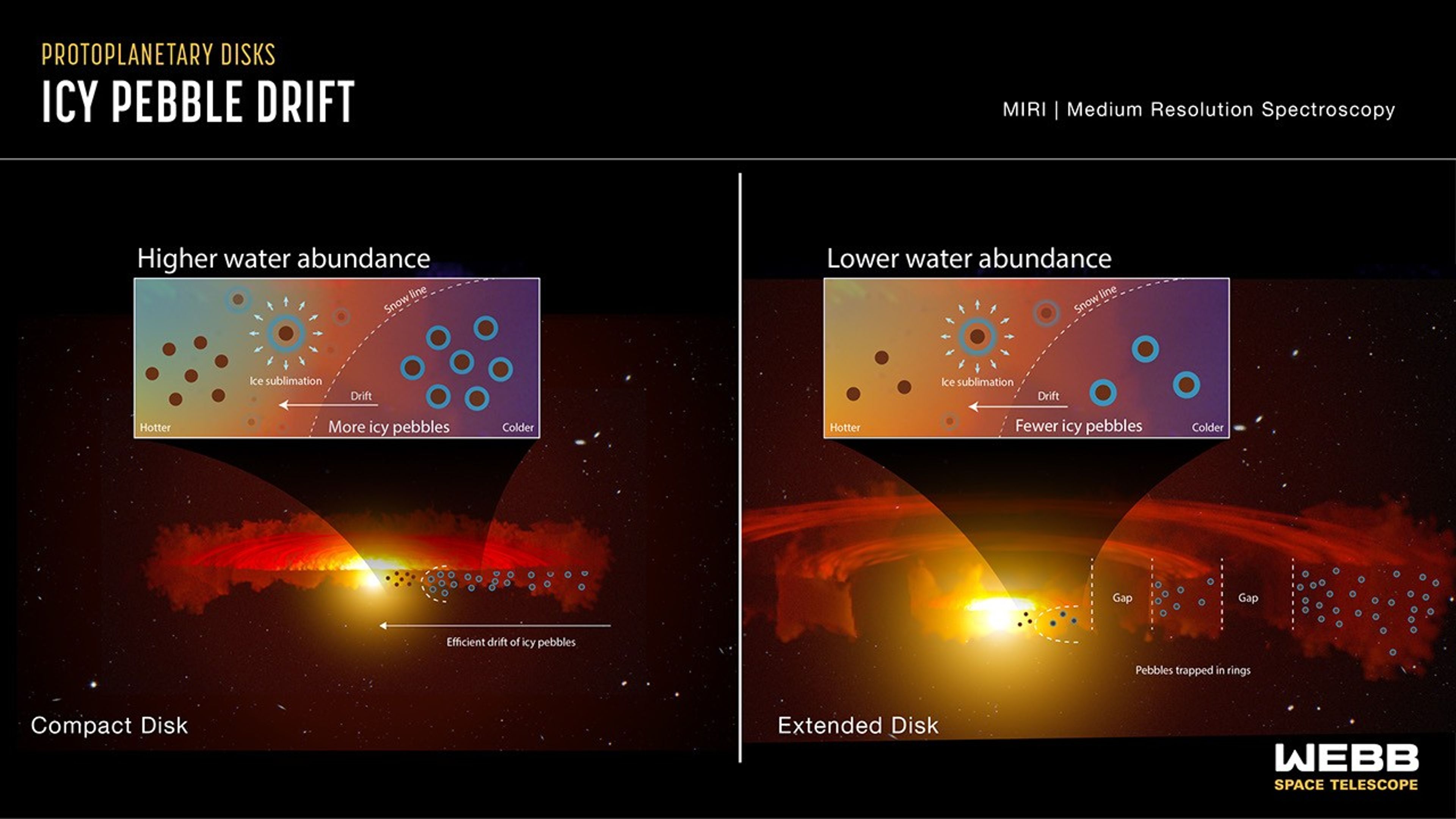
Webb has identified water elsewhere, too. The telescope also confirmed water in the inner disk of planetary system PDS 70. Where the telescope located water is critical. At less than 100 million miles (160 million kilometers) from the star, water was found where rocky, terrestrial protoplanets may be gathering mass, which means that if planets do form there, water is immediately available.
Within the Orion Bar, Webb identified a crucial carbon molecule known as methyl cation (pronounced cat-eye-on) for the first time. This complex molecule has been long theorized to aid the formation of additional complex carbon-based molecules. Webb’s detection confirms the importance of methyl cation in the chemical reactions that happen on the surface of cold dust grains. These reactions can build up additional complex molecules, which may also lead to the production of amino acids and the building blocks of life — exciting news that will help researchers update models of star and planet formation.
Webb isn’t doing this work alone. Its observations of circumstellar disks are supported by ongoing, extensive observations from the Atacama Large Millimeter/submillimeter Array (ALMA) in Chile. ALMA has delivered detailed information in radio light about the cooler, outer regions of circumstellar disks for over a decade, while Webb specializes in observing warm gas and dust their inner disks. Now that Webb has proven material can migrate from the outer to the inner disk, researchers will establish a more complete picture of actively developing planetary systems.
Most Revent Discoveries
Below is a list of Webb's most recent findings and discoveries in the Star Lifecycle science theme.
Key Findings / Discoveries : Star Lifecycle
-
01
Locating a Former Star That Exploded as a Supernova
Astronomers looked through Webb (as well as Hubble) data of Galaxy NGC 1637, and were able to pinpoint a single red supergiant star located exactly where the supernova was spotted in June of 2025. This is the first time Webb data has been used to find a supernova progenitor, though scientists had been waiting for a chance to look for a supernova to explode in a galaxy Webb had already observed.
-
02
New views of the Helix planetary nebula, formed by a dying Sun-like star
Webb captured a new close-up of an old favorite, the Helix Nebula. We've seen this region before, but Webb zooms into this dying star with a deeper, more detailed view of blistering winds of hot gas crashing into colder shells of dust and gas that were shed earlier in the star's life.
-
03
Identifying the Earliest Supernova to Date
Teamwork makes the dream work! Webb confirmed the earliest supernova to date; this dying star exploded when the universe was only 730 million years old. Webb’s sharp infrared capability also allowed astronomers to locate the supernova’s very faint and distant host galaxy. Webb supported a whole chain of observations of international telescopes which began when a rare and super bright flash of light, called a gamma-ray burst (GRB), occurred in mid-March.
-
04
Defining structure in the chaos
Webb refined our view of a star system called Apep, named after the Egyptian god of chaos. Apep was thought to consist solely of two Wolf-Rayet stars, which are a rare class of massive, evolved, luminous stars. Only 1000 are estimated to exist in our galaxy, out of hundreds of billions. To have found a system with two of them is exceedingly rare, and it’s the only known one in our galaxy. Adding to the chaos, Webb confirmed that there is actually a third star in this system, a massive supergiant, which is slicing holes into the dusty shells the Wolf-Rayet stars are creating.
-
05
Better understanding massive star formation
Webb caught enormous jets of seething gases erupting from a monster baby star (10 times more massive than our Sun) moving at hundreds of thousands of miles per hour, stretching across 8 light-years of space, approximately twice the distance between our Sun and the next-nearest stars in the Alpha Centauri system. Newly forming stars can build up infalling gas, which is then blasted out along the star’s spin axis, likely due to the influence of its magnetic fields. We’ve observed this phenomenon before in lower mass stars, but spotting a star and jet of this scale is rare. Astronomers disagree on how massive stars form. This star seems to support the theory that massive stars have a stable disk of material around them, as evidenced by the jets being 180 degrees apart from each other.
-
06
Starbirth in the Pismis 24 star cluster
In the center of this cluster, newborn stars form within clouds of dust and gas, shining through the nebula in the infrared. Two massive stars at the center are blasting out scorching radiation and stellar winds that are carving a cavity into the wall of the star-forming nebula clouds, their fierce forces shaping and compressing spires in the glowing gas at the bottom of the scene causing new stars to form. Pismis 24 is one of the closest sites of massive star birth, giving scientists rare insight into the properties of hot young stars and how they evolve
-
07
Unprecedented views of the detail and structure of ejections of gas and dust from actively forming stars
High-resolution near-infrared light captured by Webb showed incredible new detail and structure within the lobes of the ejections emitted by two actively forming stars, including asymmetrical lines that appear to run into one another. L483 is 650 light-years away in the constellation Serpens.
-
08
Finding the lower mass limits of so-called “failed stars” found in star-forming regions
Webb recently observed brown dwarfs in the Flame Nebula. Decades of Hubble data were crucial in identifying brown dwarf candidates for further study, essentially handing the baton to Webb to take an in-depth look at this region. Scientists using Webb were looking for the lower mass limit of brown dwarfs, and think they have found it, at 2-3 times the mass of Jupiter. Webb is powerful enough that it can observe objects at even lower masses, down to 0.5 Jupiter masses, but it didn’t find any objects of smaller mass. The value of 2-3 Jupiter masses could potentially be the lower mass limit of objects formed by stellar mechanisms and thus the lowest mass limit of brown dwarfs.
-
09
The effects of strong magnetic fields on star-formation in the central part of our galaxy
Follow-up research on a 2023 image of the Sagittarius C stellar nursery in the heart of our Milky Way galaxy, captured by Webb, has revealed ejections from still-forming protostars and insights into the impact of strong magnetic fields on interstellar gas and the life cycle of stars.

What’s Next for Webb
Webb’s discoveries about star-forming regions have only begun. Researchers are poring over copious images and datasets in both near- and mid-infrared light to continue advancing what we know. Expect to learn a lot more about fitful, actively forming stars along with the elements and molecules that surround them. We will continue to see high-resolution portraits of star forming regions throughout our Milky Way galaxy and also learn about star formation in nearby galaxies, including those already observed. Webb will also gather information about star formation where there are fewer elements other than hydrogen and helium, helping researchers better theorize how stars formed in the early universe. Soon, researchers using Webb will improve models of star formation, and more accurately trace the star formation process from start to finish.
Keep Up to Date with Webb Science
Keep an eye on the news and follow Webb on Facebook, X, and Instagram.