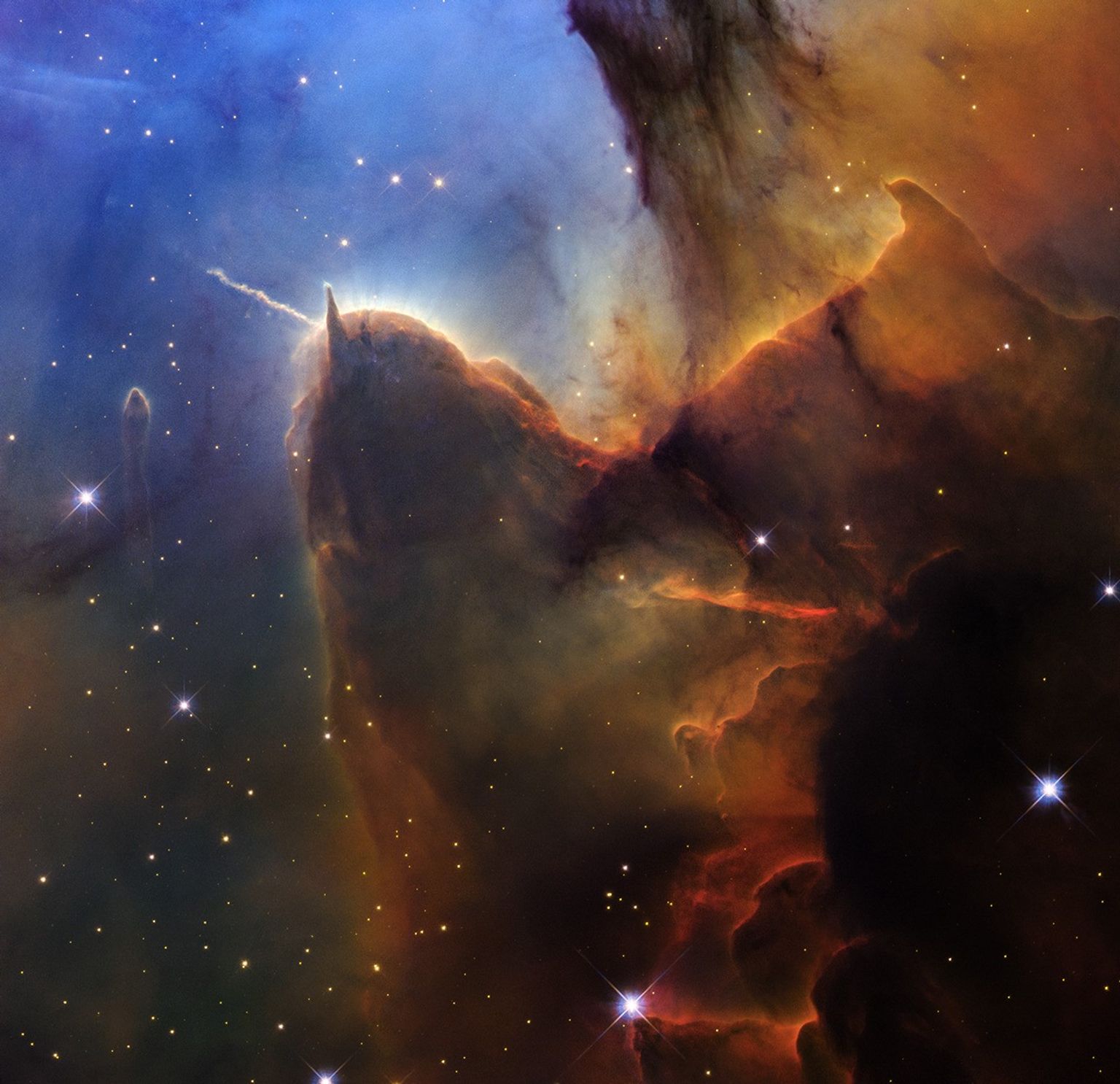
























A disparate collection of young stellar objects bejewels a cosmic panorama in the star-forming region NGC 1333 in this new image from NASA’s Hubble Space Telescope. To the left, an actively forming star called a protostar casts its glow on the surrounding gas and dust, creating a reflection nebula. Two dark stripes on opposite sides of the bright point (upper left) are its protoplanetary disk, a region where planets could form, and the disk’s shadow, cast across the large envelope of material around the star. Material accumulates onto the protostar through this rotating disk of gas and dust, a product of the collapsing cloud of gas and dust that gave birth to the star. Where the shadow stops and the disk begins is presently unknown.
To the center right, an outflow cavity reveals a fan-shaped reflection nebula. The two stars at its base, HBC 340 (lower) and HBC 341 (upper), unleash stellar winds, or material flowing from the surface of the star, that clear out the cavity from the surrounding molecular cloud over time. A reflection nebula like this one is illuminated by light from nearby stars that is scattered by the surrounding gas and dust.
This reflection nebula fluctuates in brightness over time, which researchers attribute to variations in brightness of HBC 340 and HBC 341. HBC 340 is the primary source of the fluctuation as the brighter and more variable star.
HBC 340 and HBC 341 are Orion variable stars, a class of forming stars that change in brightness irregularly and unpredictably, possibly due to stellar flares and ejections of matter from their surfaces. Orion variable stars, so named because they are associated with diffuse nebulae like the Orion Nebula, eventually evolve into non-variable stars.
In this image, the four beaming stars near the bottom of the image and one in the top right corner are also Orion variable stars. The rest of the cloudscape is studded with other young stellar objects.
NGC 1333 lies about 950 light-years away in the Perseus molecular cloud, and was imaged by Hubble to learn more about young stellar objects, such as properties of circumstellar disks and outflows in the gas and dust created by these stars.
New images added every day between January 12-17, 2026! Follow @NASAHubble on social media for the latest Hubble images and news and see Hubble's Stellar Construction Zones for more images of young stellar objects.
Explore More
Media Contact:
Claire Andreoli
NASA's Goddard Space Flight Center, Greenbelt, MD
claire.andreoli@nasa.gov