

















1 min read
Fomalhaut cs2
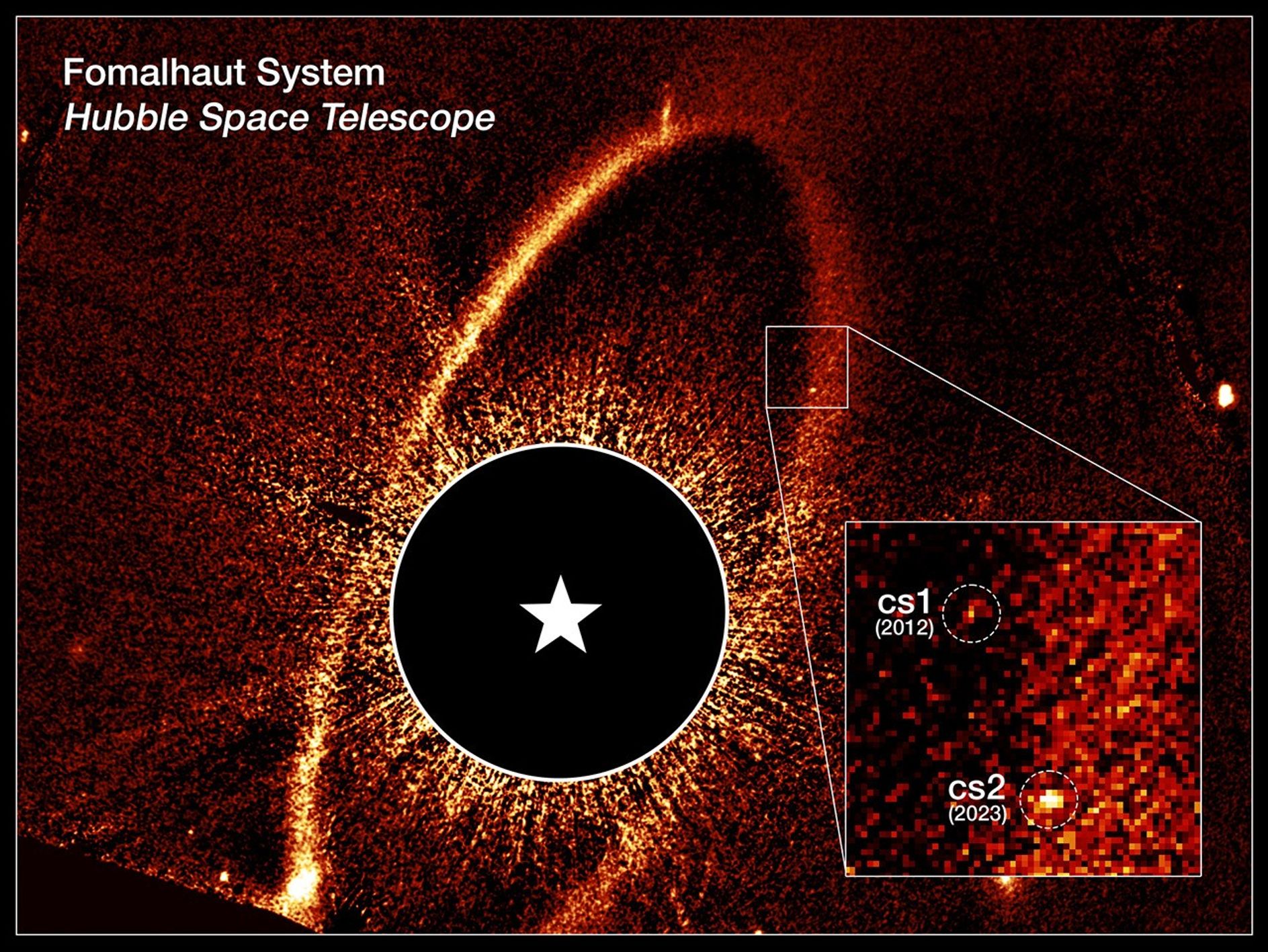
This composite Hubble Space Telescope image shows the debris ring and dust clouds cs1 and cs2 around the star Fomalhaut. For comparison, dust cloud cs1, imaged in 2012, is pictured with dust cloud cs2, imaged in 2023. The dashed circles mark the location of these clouds. When dust cloud cs2 suddenly appeared, astronomers quickly realized they had witnessed the violent collision of two massive objects. Previously thought to be a planet, cs1 is now classified as a similar debris cloud. In this image, Fomalhaut itself is masked out to allow the fainter features to be seen. Its location is marked by the white star.
About the Object
- R.A. PositionR.A. PositionRight ascension – analogous to longitude – is one component of an object's position.22:57:39.04
- Dec. PositionDec. PositionDeclination – analogous to latitude – is one component of an object's position.-29:37:20.04
- ConstellationConstellationOne of 88 recognized regions of the celestial sphere in which the object appears.Piscis Austrinus
- DistanceDistanceThe physical distance from Earth to the astronomical object. Distances within our solar system are usually measured in Astronomical Units (AU). Distances between stars are usually measured in light-years. Interstellar distances can also be measured in parsecs.25 light-years
About the Data
- Data DescriptionData DescriptionProposal: A description of the observations, their scientific justification, and the links to the data available in the science archive.
Science Team: The astronomers who planned the observations and analyzed the data. "PI" refers to the Principal Investigator.This image was created from HST data from proposal 17139 (P. Kalas)
- InstrumentInstrumentThe science instrument used to produce the data.STIS/CCD
- Object NameObject NameA name or catalog number that astronomers use to identify an astronomical object.Fomalhaut System
- Object DescriptionObject DescriptionThe type of astronomical object.Stellar debris disk
- Release DateDecember 18, 2025
- Science ReleaseNASA’s Hubble Sees Asteroids Colliding at Nearby Star for First Time
- CreditImage: NASA, ESA, Paul Kalas (UC Berkeley); Image Processing: Joseph DePasquale (STScI)
Downloads
This image is a composite of many separate exposures made by the STIS instrument on the Hubble Space Telescope. This image was originally black and white and recorded only overall brightness. These brightness values were translated into a range of reddish hues. Such color "maps" can be useful in helping to distinguish subtly varying brightness in an image. Red: STIS/CCD
Related Images & Videos
Fomalhaut cs2 Video
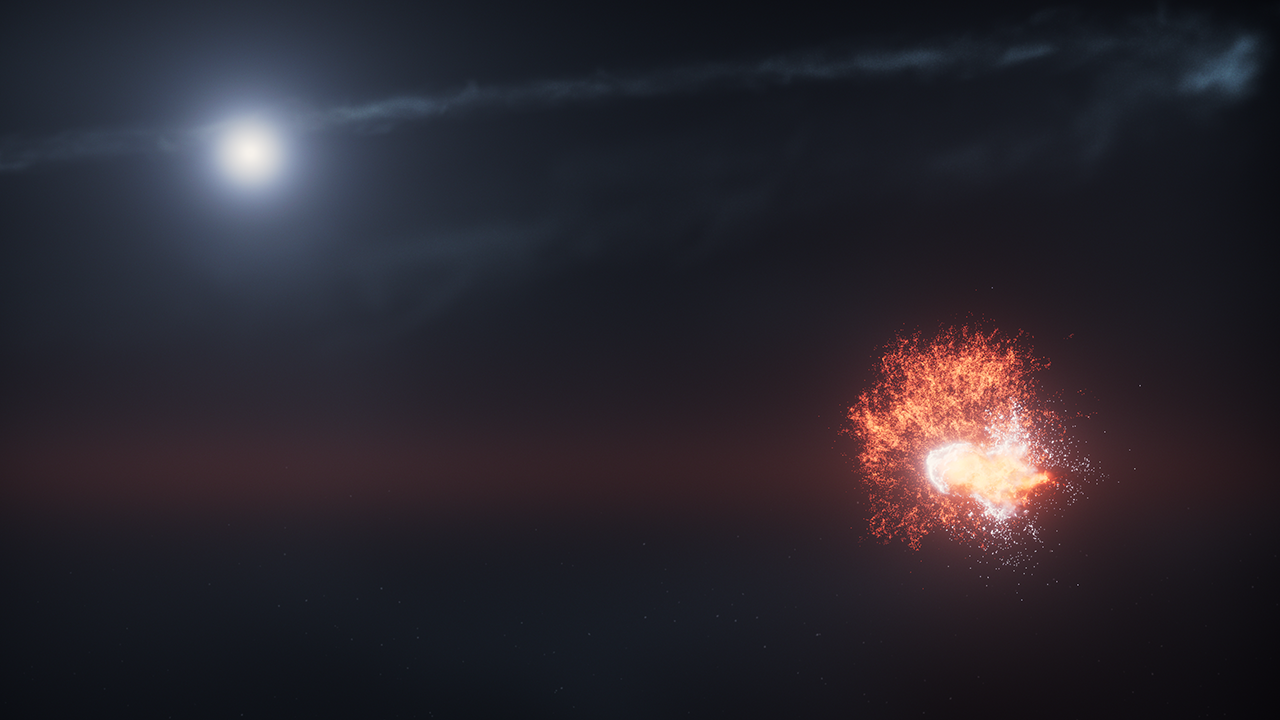
Hubble captured the violent collision of two massive objects around the star Fomalhaut. This extraordinary event is unlike anything in our own present-day solar system. The video shows the sequence of events leading up to the creation of dust cloud cs2 around the star Fomalhaut. ...
Share
Details
Claire Andreoli
NASA’s Goddard Space Flight Center
Greenbelt, Maryland
claire.andreoli@nasa.gov