











1 min read
COSMOS Field MoM-z14 Galaxy (NIRCam Compass Image)
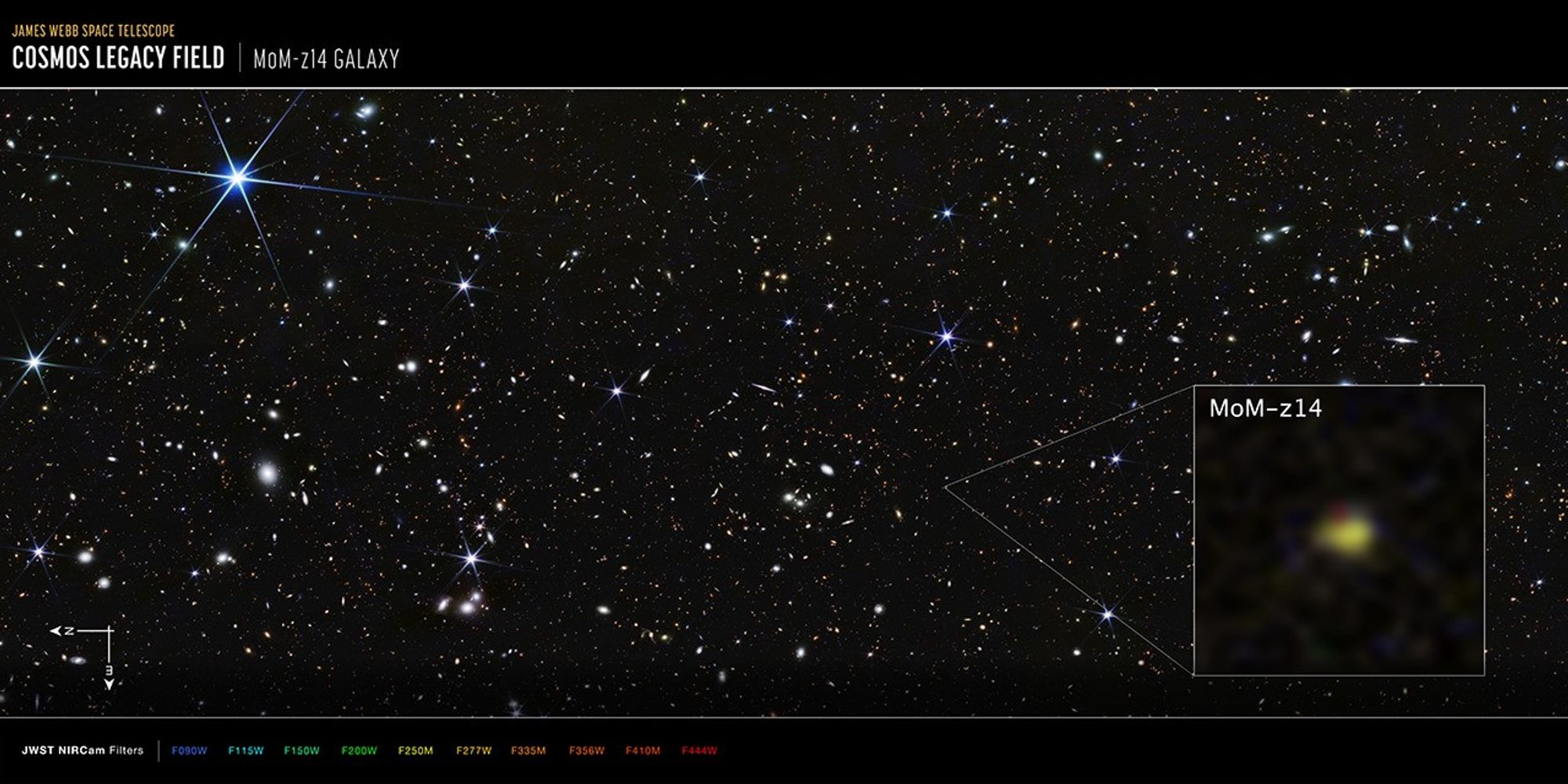
This image of the COSMOS Legacy Field captured by Webb’s NIRCam (Near-Infrared Camera) highlights the galaxy MoM-z14, with compass arrows and color key for reference. MoM-z14 is currently the farthest galaxy Webb has detected.
The north and east compass arrows show the orientation of the image on the sky. Note that the relationship between north and east on the sky (as seen from below) is flipped relative to direction arrows on a map of the ground (as seen from above).
This image shows near-infrared wavelengths of light that have been translated into visible-light colors. The color key shows which NIRCam filters were used. The color of each filter name is the visible-light color used to represent the infrared light that passes through that filter.
About the Object
- R.A. PositionR.A. PositionRight ascension – analogous to longitude – is one component of an object's position.10:00:22.45
- Dec. PositionDec. PositionDeclination – analogous to latitude – is one component of an object's position.+02:16:23.70
- ConstellationConstellationOne of 88 recognized regions of the celestial sphere in which the object appears.Sextans
- DimensionsDimensionsThe physical size of the object or the apparent angle it subtends on the sky.Image is about 16 arcmin across
About the Data
- Data DescriptionData DescriptionProposal: A description of the observations, their scientific justification, and the links to the data available in the science archive.
Science Team: The astronomers who planned the observations and analyzed the data. "PI" refers to the Principal Investigator.This image was created with data from the DAWN JWST Archive; Image Processing: Joseph DePasquale (STScI)
- InstrumentInstrumentThe science instrument used to produce the data.NIRCam
- FiltersFiltersThe camera filters that were used in the science observations.F090W, F115W, F150W, F200W, F250M, F277W, F335M, F356W, F410M, F444W
- Object NameObject NameA name or catalog number that astronomers use to identify an astronomical object.MoM-z14 in the COSMOS Legacy Field
- Object DescriptionObject DescriptionThe type of astronomical object.High redshift galaxy
- Release DateJanuary 28, 2026
- Science ReleaseNASA Webb Pushes Boundaries of Observable Universe Closer to Big Bang
- CreditImage: NASA, ESA, CSA, STScI, Rohan Naidu (MIT); Image Processing: Joseph DePasquale (STScI)
These images are a composite of separate exposures acquired by the James Webb Space Telescope using the NIRCam instrument. Several filters were used to sample specific wavelength ranges. The color results from assigning different hues (colors) to each monochromatic (grayscale) image associated with an individual filter. In this case, the assigned colors are: Blue: F090W, Cyan: F115W, Blue-Green: F150W, Green: F200W, Yellow: F250M, Yellow-Orange: F277W, Orange: F335M, Orange-Red: F356W, Red: F410M, Red: F444W
Share
Details
Laura Betz
NASA’s Goddard Space Flight Center
Greenbelt, Maryland
laura.e.betz@nasa.gov