












1 min read
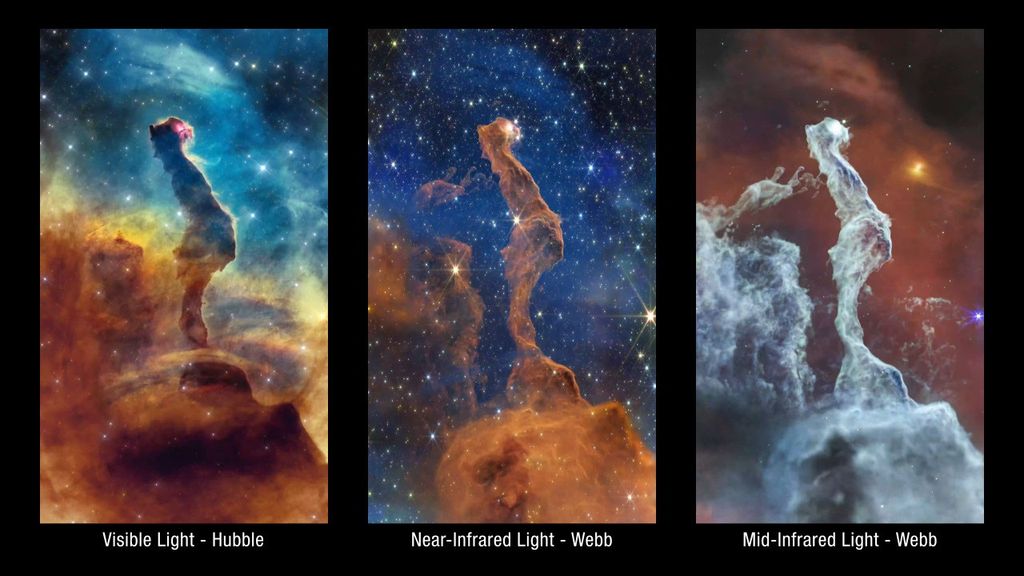
Cat’s Head Nebula (Webb MIRI Image)

In NASA’s James Webb Space Telescope’s mid-infrared image, emission from warm dust and carbon-based molecules excited by starlight outlines intricate structures within the nebula. Changes in local conditions and compositions cause variations in color and brightness. Fine strands and globules are especially apparent to the left of the main pillar.
To the right of the pillar, a bright yellow light source is seen against reddish mid-infrared emission, probably an infant star embedded in dust. A narrow filament appears to cross the likely star, although its physical relationship to the star is not established. Several blue stars are scattered throughout, some with Webb’s characteristic diffraction spikes.
Deep Zoom Image
Dive deeper into this image.
About the Object
- R.A. PositionR.A. PositionRight ascension – analogous to longitude – is one component of an object's position.10:45:59.76
- Dec. PositionDec. PositionDeclination – analogous to latitude – is one component of an object's position.-60:06:23.76
- ConstellationConstellationOne of 88 recognized regions of the celestial sphere in which the object appears.Carina
- DistanceDistanceThe physical distance from Earth to the astronomical object. Distances within our solar system are usually measured in Astronomical Units (AU). Distances between stars are usually measured in light-years. Interstellar distances can also be measured in parsecs.7,500 - 8,500 light-years
- DimensionsDimensionsThe physical size of the object or the apparent angle it subtends on the sky.Image is about 5.3 arcmin across (about 12.3 light-years)
About the Data
- Data DescriptionData DescriptionProposal: A description of the observations, their scientific justification, and the links to the data available in the science archive.
Science Team: The astronomers who planned the observations and analyzed the data. "PI" refers to the Principal Investigator.This image was created with Webb data from proposal: 12591 (M. Garcia Marin).
- InstrumentInstrumentThe science instrument used to produce the data.MIRI
- Exposure DatesExposure DatesThe date(s) that the telescope made its observations and the total exposure time.May 27, 2026
- FiltersFiltersThe camera filters that were used in the science observations.F770W, F1130W, F1500W
- Object NameObject NameA name or catalog number that astronomers use to identify an astronomical object.NGC 3372; HH 903; Cat's Head Nebula; Carina Nebula
- Object DescriptionObject DescriptionThe type of astronomical object.Star forming region; Emission Nebula; HII region
- Release DateOctober 29, 2026
- Science ReleaseGhostly Cat’s Head Nebula Lurks Within Sight of NASA’s Hubble, Webb
- CreditImage: NASA, ESA, CSA, STScI; Image Processing: Joseph DePasquale (STScI)
These images were acquired by the MIRI instrument on the Webb Space Telescope. Several filters were used to sample varying wavelength ranges. The color results from assigning different hues (colors) to each monochromatic (grayscale) image associated with an individual filter. In this case, the assigned colors are: Blue=F770W, Green=F1130W, Red=F1500W
Deep Zoom Image
Related Multimedia


Video: Multiwavelength Flight into the Cat's Head Nebula
This tour glides through imagery from NASA’s Hubble and James Webb Space Telescopes of the Cat’s Head Nebula. The dust filament broadly remains the same in shape across the different wavelengths of light, but each view contains different details.
Share
Details
Claire Andreoli
NASA’s Goddard Space Flight Center
Greenbelt, Maryland
claire.andreoli@nasa.gov