













1 min read
Andromeda Star Merger (Artist’s Concept)
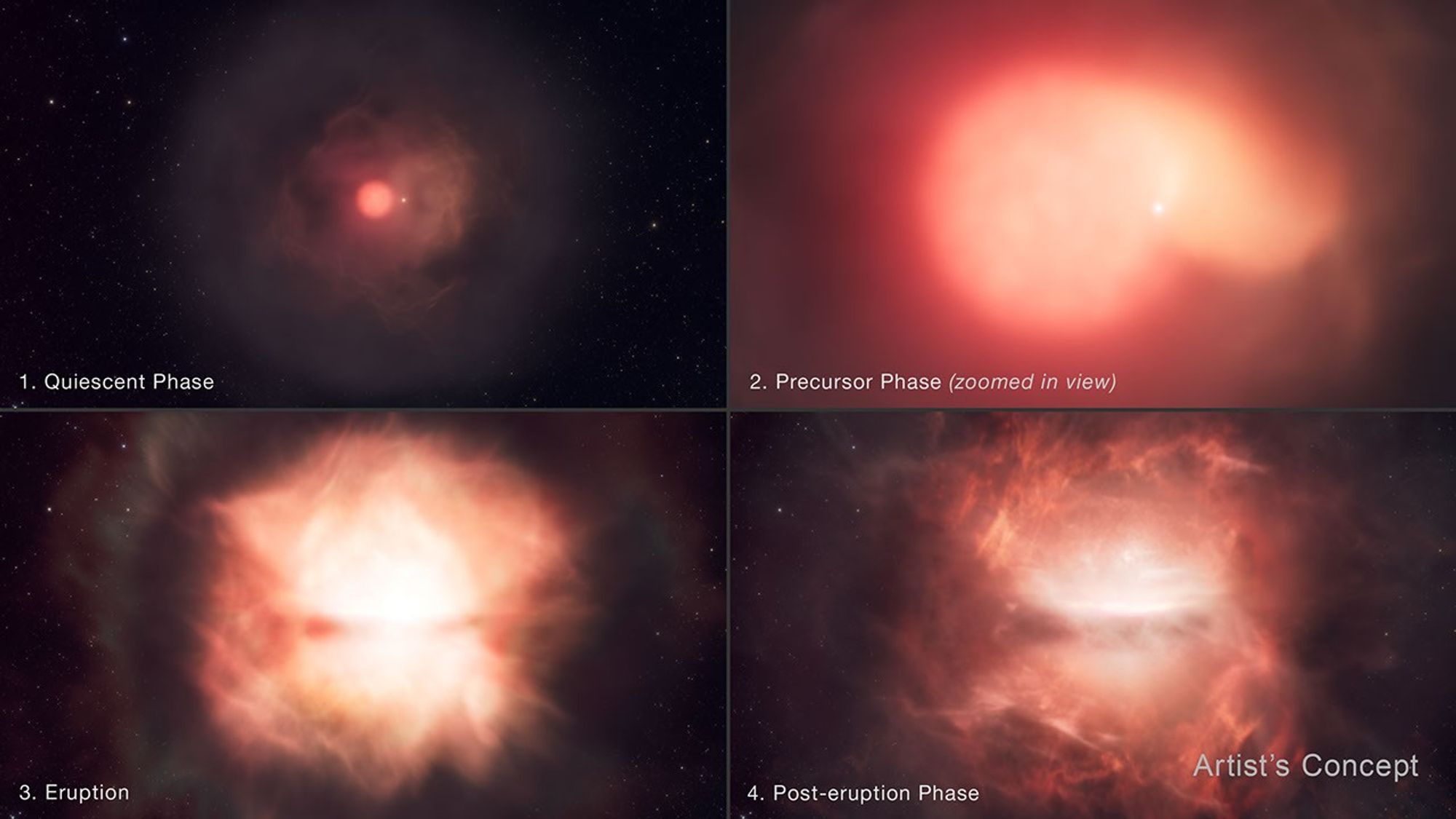
It took a lot of data and modeling to accurately reconstruct the events that led to the eruption of two tightly orbiting stars nicknamed Bao in the outskirts of the Andromeda galaxy. This illustration shows the four major events of a process known as common envelope evolution explained by a team of researchers led by Viraj Karambelkar, a NASA Hubble Fellow at Columbia University in New York.
Top left: The stars had a consistent brightness from 1989 to 2018, reflected in observations taken by many telescopes on the ground and in space. The stars are shown surrounded by an extended dust shell that had been ejected over time by the more massive primary star. This is known as the quiescent phase.
Top right: The stars slowly brightened from 2018 to 2025, during what’s known as the precursor phase. The less massive companion star’s orbit began to slow as it encountered gas that was part of the hefty primary star’s atmosphere, and the companion started to spiral into the supergiant’s core.
Bottom left: A sudden, bright eruption occurred October 17, 2025. By leveraging mid-infrared data from NASA’s James Webb Space Telescope, the researchers were later able to demonstrate that the companion star rapidly spiraled into the core of the primary star, which led to the ejection of their shared layers of gas and dust, known as a common envelope.
Bottom right: In the months after the eruption, gas from the star’s ejected envelope freely expanded at the poles, but not at the equator, where previous ejecta from the more massive star was concentrated. Webb’s data allowed the researchers to precisely track where the dust ended up and how much material was ejected during the eruption versus before the merger began. Observations of the post-eruption phase currently date from October 2025 through February 2026.
Extended Description and Image Alt Text
Extended Description
Four-part illustration depicting a stellar merger.
The top left depicts the quiescent phase, and shows the widest view. A large red star and a tiny yellow dot-like star at its right edge appear on the black background of space. A hazy region of semi-transparent red dust looks like it’s wafting off the larger star’s surface, forming a larger circular shell that extends to the top and bottom of the frame.
The top right shows a zoomed-in view and is labeled precursor phrase. An incredibly large, bright orange star with a glowing red edge is centered. Its bright red dust takes up the entire frame, slightly fading near the edges. The smaller yellow star is in the same place as panel 1, near 3 o’clock, with a wide yellow arc floating up and into the top of the red star. It looks like the two stars are beginning to blend.
The bottom left shows the eruption in the same field of view. The star appears as one, with a slightly smaller brighter region than the previous panel, that is now yellow. It is surrounded by darker, fluffy light orange and pink dust that extends to the top and bottom, but is no longer perfectly circular. Two areas of dark dust appear at its waist but do not touch, like a belt that is too small to fasten.
The bottom right depicts the post-eruption phase. The scene is similar, with the central star appearing encased in thicker, darker brown dust layouers that extend to almost every edge. The "belt" touches at center.
Image Alt Text
Four-part illustration. Top left, labeled quiescent phase shows the widest view. A large red star and a tiny yellow dot-like star at its right edge appear on a black background amidst a wide area of hazy dust. The top right shows a zoomed-in view, labeled precursor phrase. A large, bright orange star with a glowing red edge is centered. Its bright red dust takes up the entire frame. The smaller yellow star at 3 o’clock has an arc of yellow floating up into the top of the red star. The bottom left shows the eruption. The star appears as one, with a slightly smaller brighter region than the previous panel that is now yellow. It is surrounded by darker, fluffy dust that extends to the top and bottom. Bottom right, labeled post-eruption phase. The scene is similar, with the central star appearing encased in more and thicker darker brown dusty layers that extend to almost every edge.
- Release DateNovember 18, 2026
- Science ReleaseNASA Data Clinches First-of-Its-Kind Stellar Merger
- CreditIllustration: NASA, ESA, CSA, STScI, Leah Hustak (STScI); Science: Viraj Karambelkar (Columbia)
Downloads
Related Multimedia
Share
Details
Laura Betz
NASA’s Goddard Space Flight Center
Greenbelt, Maryland
laura.e.betz@nasa.gov