
















1 min read
Fragmentation of Comet C/2025 K1
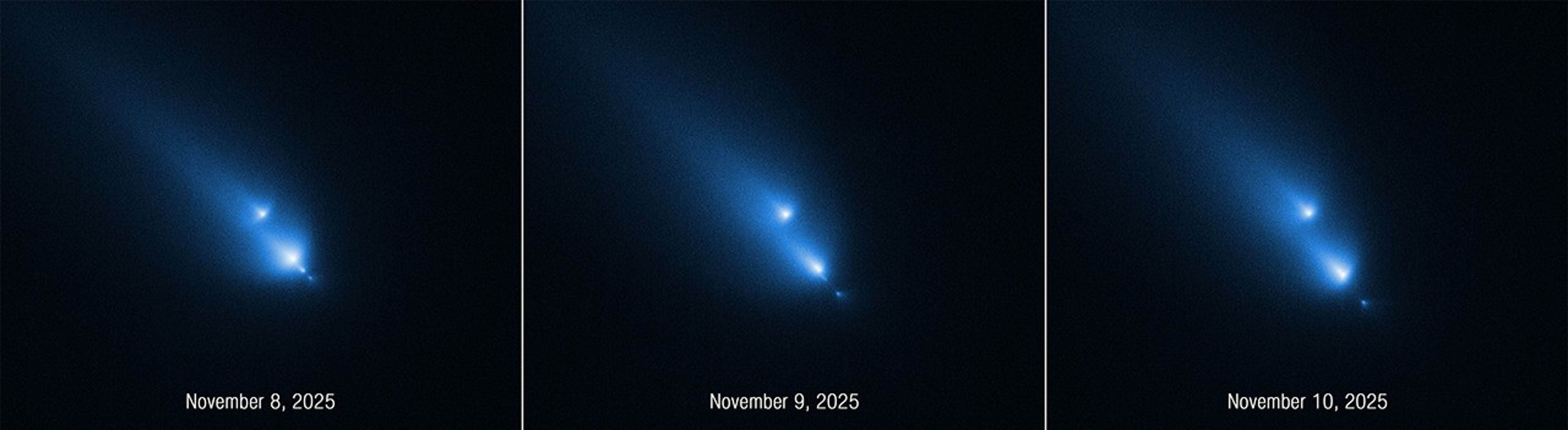
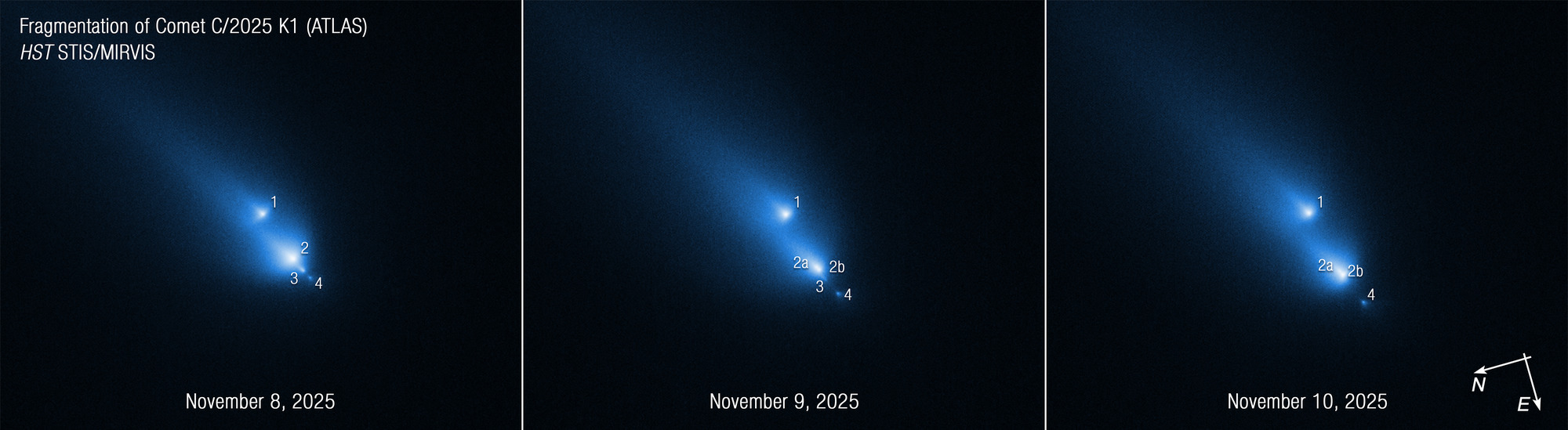
This series of images from NASA’s Hubble Space Telescope of the fragmenting comet C/2025 K1 (ATLAS), or K1 for short, was taken over the course of three consecutive days: Nov. 8, 9, and 10, 2025. Captured by Hubble’s STIS (Space Telescope Imaging Spectrograph) instrument, the sequence shows the progressive disintegration of the comet over this brief period. This is the first time Hubble has witnessed a comet so early in the process of breaking up.
Hubble caught K1 fragmenting into at least five pieces, each with a distinct coma, the fuzzy envelope of gas and dust that surrounds a comet’s icy nucleus. Hubble cleanly resolved the fragments, but from the ground they only appeared as barely distinguishable, bright blobs.
About the Data
- Data DescriptionData DescriptionProposal: A description of the observations, their scientific justification, and the links to the data available in the science archive.
Science Team: The astronomers who planned the observations and analyzed the data. "PI" refers to the Principal Investigator.The Hubble observations include those from program 18135 (D. Bodewits)
- InstrumentInstrumentThe science instrument used to produce the data.STIS/CCD
- Exposure DatesExposure DatesThe date(s) that the telescope made its observations and the total exposure time.November 8-10, 2025
- FiltersFiltersThe camera filters that were used in the science observations.MIRVIS
- Object NameObject NameA name or catalog number that astronomers use to identify an astronomical object.C/2025 K1 (ATLAS)
- Object DescriptionObject DescriptionThe type of astronomical object.Comet
- Release DateMarch 18, 2026
- Science ReleaseNASA’s Hubble Unexpectedly Catches Comet Breaking Up
- CreditImage: NASA, ESA, Dennis Bodewits (AU); Image Processing: Joseph DePasquale (STScI)
This image is a composite of many separate exposures made by the STIS instrument on the Hubble Space Telescope. This image was originally black and white and recorded only overall brightness. These brightness values were translated into a range of blueish hues. Such color "maps" can be useful in helping to distinguish subtly varying brightness in an image. Blue: STIS/CCD
Related Images & Videos

Comet C/2025 K1 Orbit Illustration
This diagram shows the path Comet C/2025 K1 (ATLAS), or K1, took as it swung past the Sun and began its journey out of the solar system. NASA’s Hubble Space Telescope captured the inset image of the fragmenting comet just a month after K1’s closest approach to the Sun.


Share
Details
Claire Andreoli
NASA’s Goddard Space Flight Center
Greenbelt, Maryland
claire.andreoli@nasa.gov