

























1 min read
Galaxy NGC 1512 in Visible Light
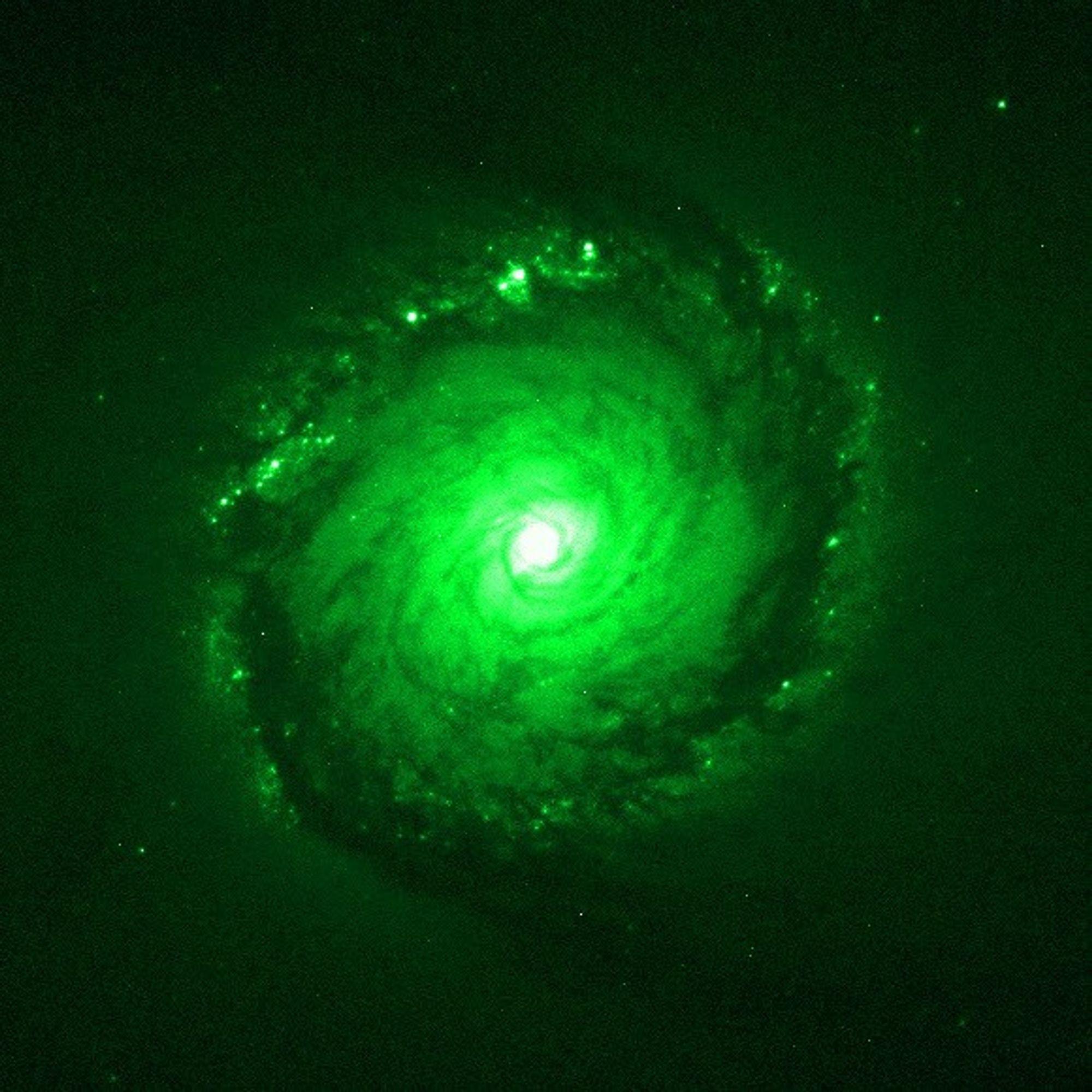
The green (5454 Å) is visible light. Image taken by HST's Wide Field and Planetary Camera 2.
About the Object
- R.A. PositionR.A. PositionRight ascension – analogous to longitude – is one component of an object's position.04h 3m 54.29s
- Dec. PositionDec. PositionDeclination – analogous to latitude – is one component of an object's position.-43° 20' 56.0"
- ConstellationConstellationOne of 88 recognized regions of the celestial sphere in which the object appears.Horologium
- DistanceDistanceThe physical distance from Earth to the astronomical object. Distances within our solar system are usually measured in Astronomical Units (AU). Distances between stars are usually measured in light-years. Interstellar distances can also be measured in parsecs.9.2 million pc (30 million light-years)
- DimensionsDimensionsThe physical size of the object or the apparent angle it subtends on the sky.The galaxy is 70,000 light-years across. The circumnuclear starburst ring is 2,400 light-years wide.
About the Data
- Data DescriptionData DescriptionProposal: A description of the observations, their scientific justification, and the links to the data available in the science archive.
Science Team: The astronomers who planned the observations and analyzed the data. "PI" refers to the Principal Investigator.Principal Astronomers: D. Maoz (Tel-Aviv University/Columbia University), A. J. Barth (Harvard CfA), L. C. Ho (Carnegie Obs.), A. Sternberg (Tel-Aviv University and A. V. Filippenko (UC Berkeley). Members of the group of scientists involved in these observations are: Dan Maoz (Tel-Aviv University, Israel and Columbia University, USA), Aaron J. Barth (Harvard-Smithsonian Center for Astrophysics, USA), Luis C. Ho (The Observatories of the Carnegie Institution of Washington, USA), Amiel Sternberg (Tel-Aviv University, Israel) and Alexei V. Filippenko (University of California, Berkeley, USA). - InstrumentInstrumentThe science instrument used to produce the data.HST>WFPC2
- Exposure DatesExposure DatesThe date(s) that the telescope made its observations and the total exposure time.March 5, 1999
- FiltersFiltersThe camera filters that were used in the science observations.F336W (U), F658N (redshifted Ha), F547M (Strömgren y), and F814W (I)
- Object NameObject NameA name or catalog number that astronomers use to identify an astronomical object.NGC 1512
- Object DescriptionObject DescriptionThe type of astronomical object.Barred spiral galaxy
- Release DateMay 31, 2001
- Science ReleaseHubble Unveils a Galaxy in Living Color
- Credit