

























1 min read
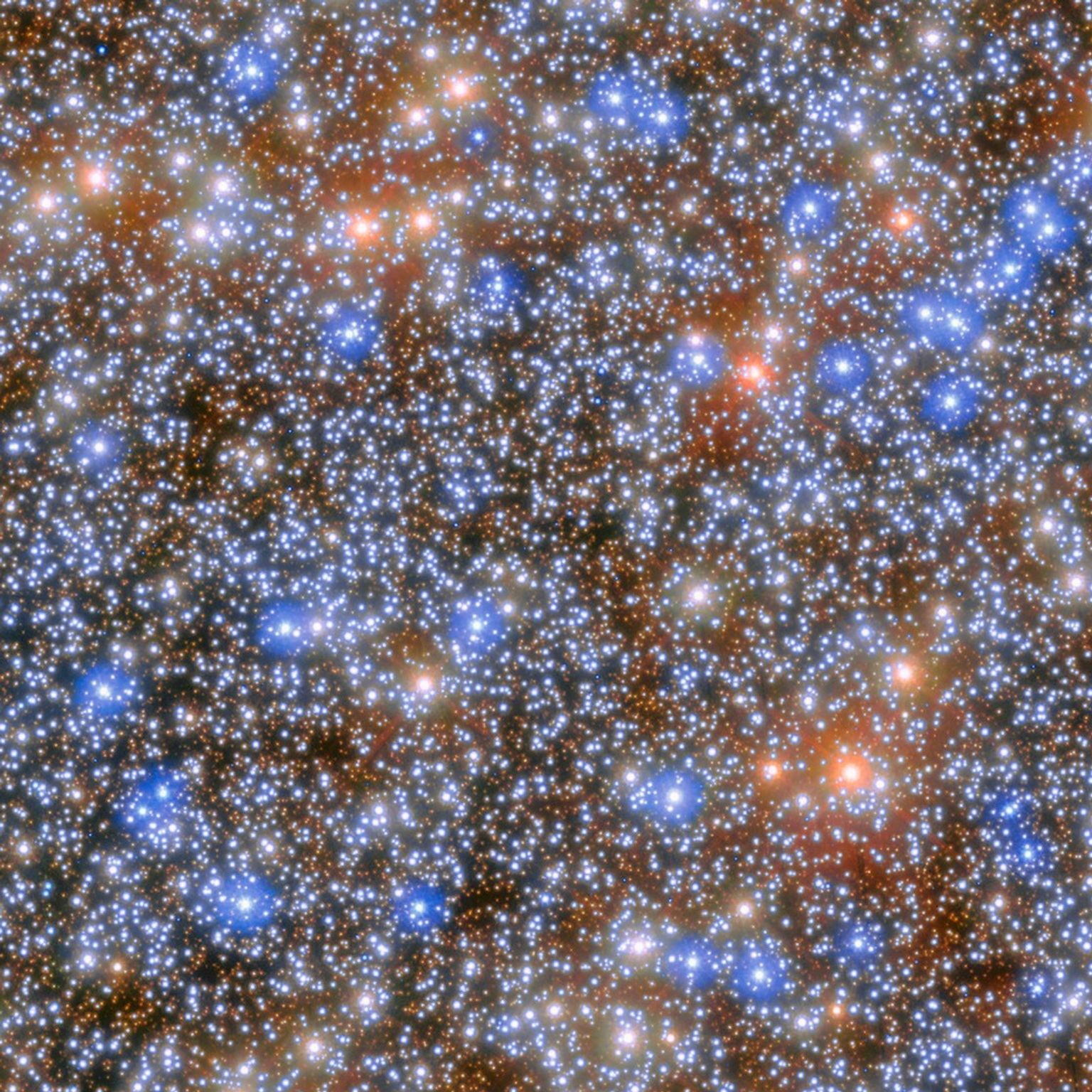
Omega Centauri Context Image

Although models suggest globular star cluster Omega Centauri should contain approximately 10,000 stellar-mass black holes, observational evidence of their existence has remained scarce.
A team of astronomers recently tracked the position of stars on the sky over more than 20 years using a robust multi-mission dataset of archival data from NASA’s Hubble Space Telescope as well as recent data from NASA’s James Webb Space Telescope. Based on their analysis, the science team detected a visible main sequence star orbiting a stellar-mass black hole. The main sequence star companion is encircled and shown in greater detail in the pullout in the top-right corner. The stellar-mass black hole, called oMEGACat BH-2, is the first of its kind found in Omega Centauri.
Its discovery sparks many questions surrounding the physics and formation of stellar-mass black holes within globular star clusters, and strengthens the need for follow-up studies of Omega Centauri and investigations into similar environments.
About the Object
- R.A. PositionR.A. PositionRight ascension – analogous to longitude – is one component of an object's position.13:26:46.27
- Dec. PositionDec. PositionDeclination – analogous to latitude – is one component of an object's position.-47:28:25.51
- ConstellationConstellationOne of 88 recognized regions of the celestial sphere in which the object appears.Centaurus
- DistanceDistanceThe physical distance from Earth to the astronomical object. Distances within our solar system are usually measured in Astronomical Units (AU). Distances between stars are usually measured in light-years. Interstellar distances can also be measured in parsecs.17000 light-years
About the Data
- InstrumentInstrumentThe science instrument used to produce the data.WFC3; ACS
- FiltersFiltersThe camera filters that were used in the science observations.WFC3: F275W, F336W, F438W, F606W, F625W, F658N, F814W ACS: F435W, F606W, F814W
- Object NameObject NameA name or catalog number that astronomers use to identify an astronomical object.Omega Centauri
- Object DescriptionObject DescriptionThe type of astronomical object.Globular Cluster
- Release DateJuly 13, 2026
- Science ReleaseNASA’s Hubble Discovers First of Star Cluster’s Missing Black Holes
- CreditImage: ESA, NASA, Maximilian Häberle (MPIA), Joseph DePasquale (STScI)
Downloads
These images were acquired by the ACS and WFC3 instruments on Hubble. Several filters were used to sample varying wavelength ranges. The color results from assigning different hues (colors) to each monochromatic (grayscale) image associated with an individual filter. In this case, the assigned colors are: Blue: F275W, F336W, 435W, F438W Green: F606W, F625W Red: F814W, F658N

Share
Details
Claire Andreoli
NASA’s Goddard Space Flight Center
Greenbelt, Maryland
claire.andreoli@nasa.gov