


















1 min read
NGC 5584 (Webb NIRCam + Hubble WFC3)
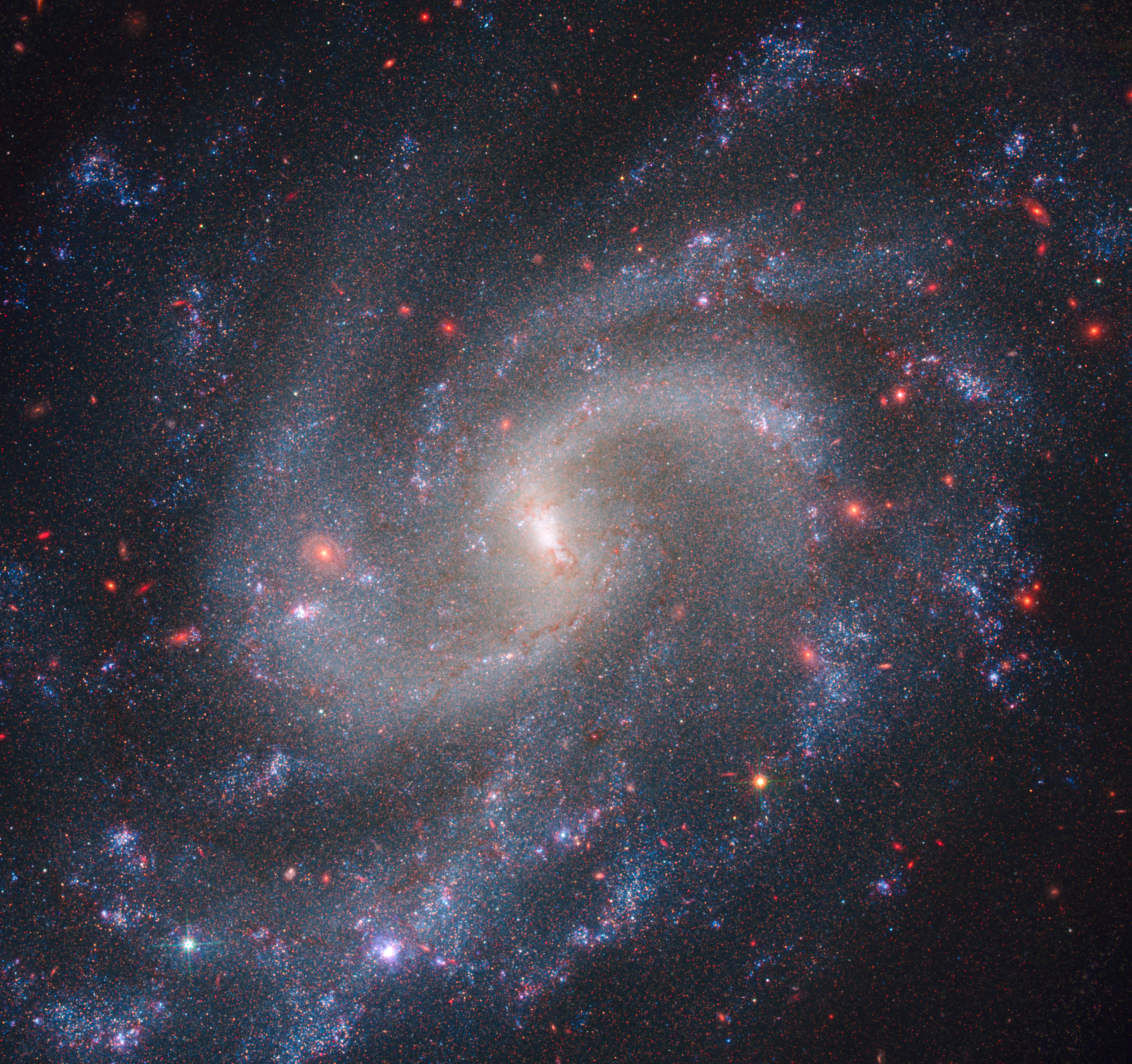
Combined observations from NASA’s NIRCam (Near-Infrared Camera) and Hubble’s WFC3 (Wide Field Camera 3) show spiral galaxy NGC 5584, which resides 72 million light-years away from Earth. Among NGC 5584’s glowing stars are pulsating stars called Cepheid variables and Type Ia supernova, a special class of exploding stars. Astronomers use Cepheid variables and Type Ia supernovae as reliable distance markers to measure the universe’s expansion rate.
About the Object
- R.A. PositionR.A. PositionRight ascension – analogous to longitude – is one component of an object's position.14:22:23.76
- Dec. PositionDec. PositionDeclination – analogous to latitude – is one component of an object's position.00:23:15.61
- ConstellationConstellationOne of 88 recognized regions of the celestial sphere in which the object appears.Virgo
- DistanceDistanceThe physical distance from Earth to the astronomical object. Distances within our solar system are usually measured in Astronomical Units (AU). Distances between stars are usually measured in light-years. Interstellar distances can also be measured in parsecs.About 72 million light-years (22 million parsecs)
About the Data
- Data DescriptionData DescriptionProposal: A description of the observations, their scientific justification, and the links to the data available in the science archive.
Science Team: The astronomers who planned the observations and analyzed the data. "PI" refers to the Principal Investigator. - InstrumentInstrumentThe science instrument used to produce the data.Hubble>WFC3/UVIS Webb>NIRCam
- Exposure DatesExposure DatesThe date(s) that the telescope made its observations and the total exposure time.2 February 2023, Janurary-April 2011
- FiltersFiltersThe camera filters that were used in the science observations.Hubble> F555W, F814W Webb> F277W
- Object NameObject NameA name or catalog number that astronomers use to identify an astronomical object.NGC 5584
- Object DescriptionObject DescriptionThe type of astronomical object.Spiral galaxy, cepheids host galaxy
- Release DateSeptember 12, 2023
- CreditImage: NASA, ESA, CSA, Adam Riess (JHU, STScI); Image Processing: Alyssa Pagan (STScI)
This image is a composite of separate exposures acquired by the Hubble Space Telescope using the WFC3 instrument and the James Webb Space Telescope using the NIRCam instrument. Several filters were used to sample wide wavelength ranges. The color results from assigning different hues (colors) to each monochromatic (grayscale) image associated with an individual filter. In this case, the assigned colors are: Blue: F555W, Green: F814W, Red: F277W
Share
Details
Laura Betz
NASA’s Goddard Space Flight Center
Greenbelt, Maryland
laura.e.betz@nasa.gov
NASA, ESA, CSA, Adam Riess (JHU, STScI)
Alyssa Pagan (STScI)