














1 min read
NGC 7129 Side-by-Side (Spitzer and Webb Image)
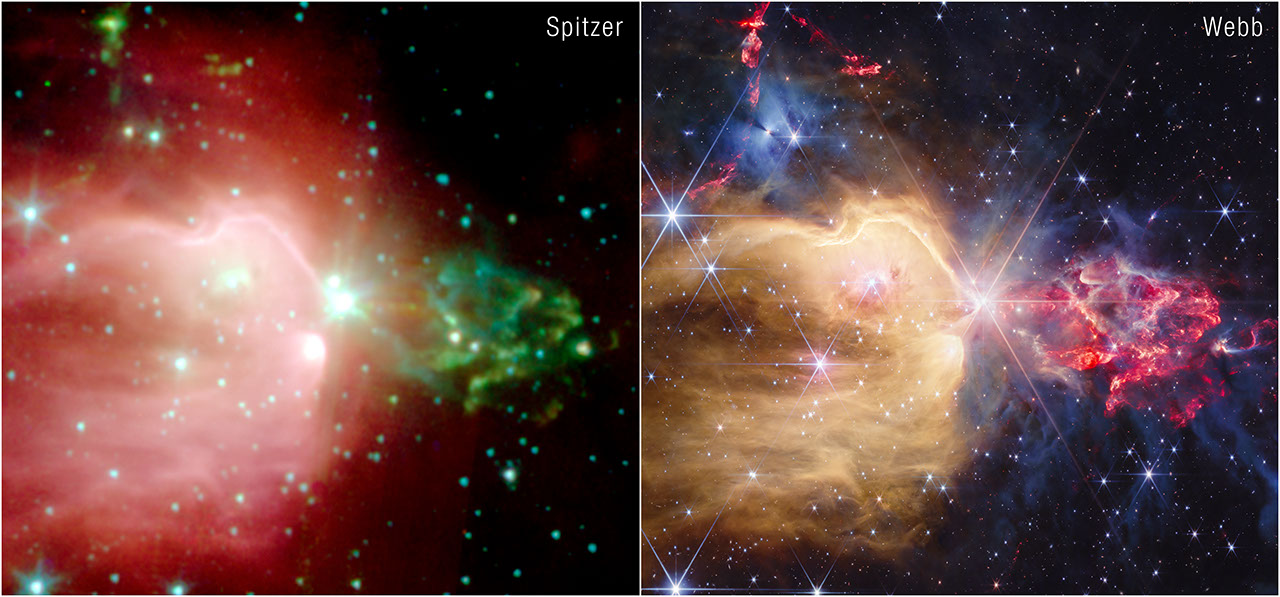
NASA’s retired Spitzer Space Telescope observed the hot gas and dust within NGC 7129, managing to identify numerous protostars within the dense material. However, resolving certain details, like the impact of those protostars on their surroundings, proved to be difficult.
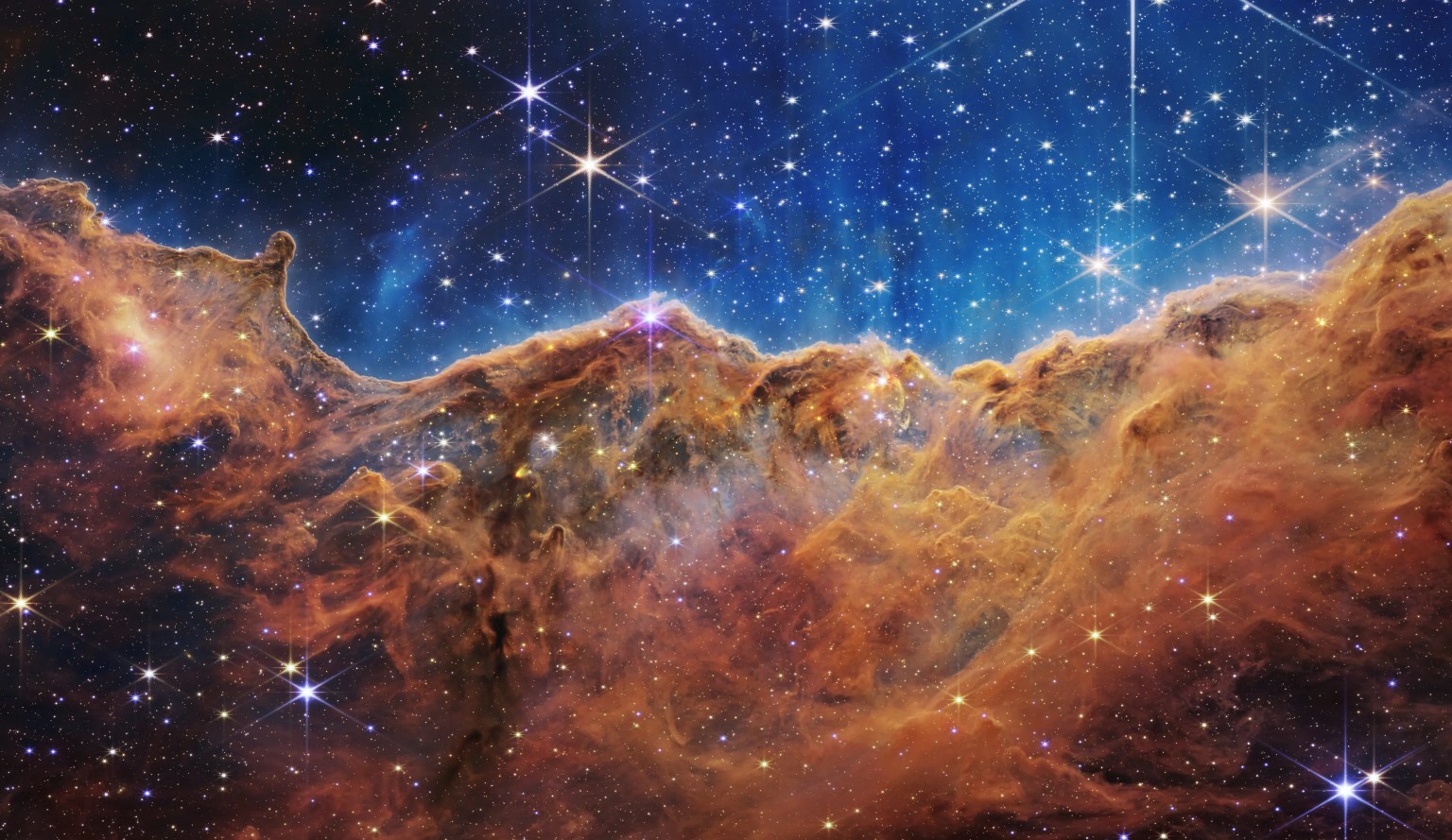
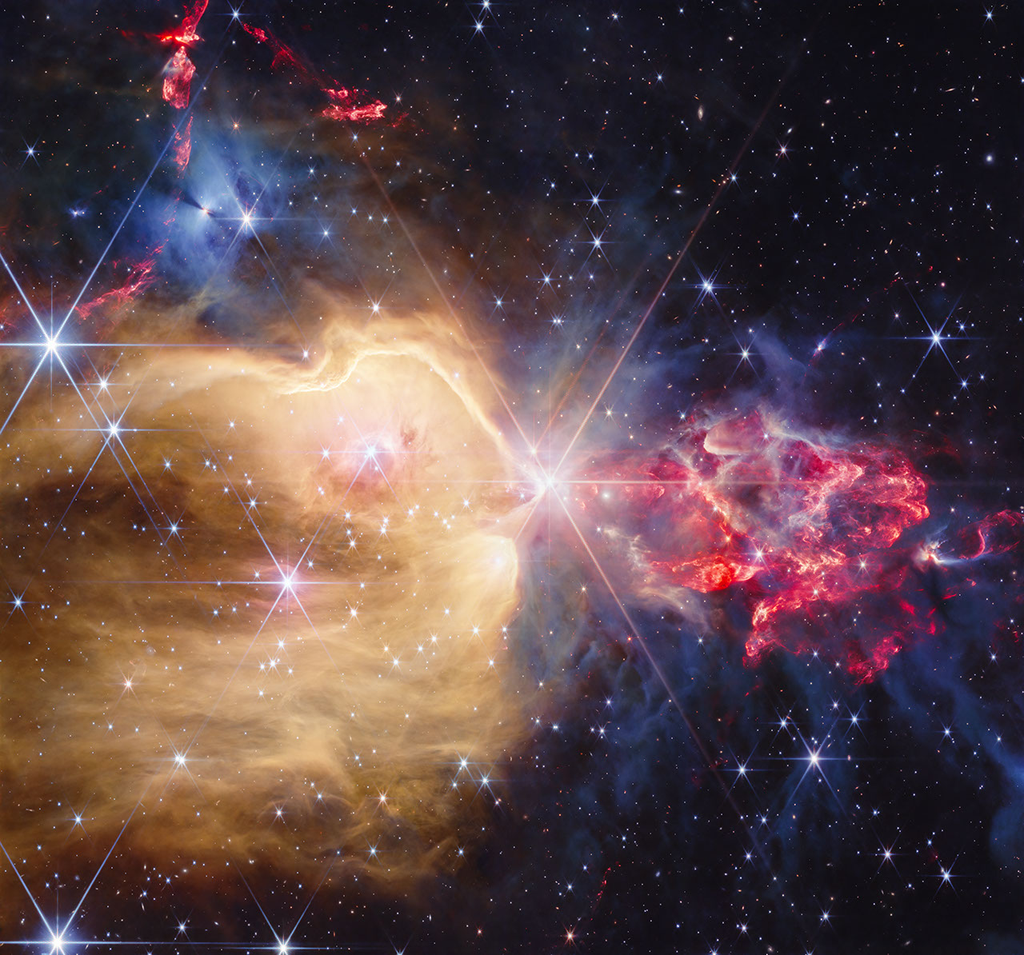
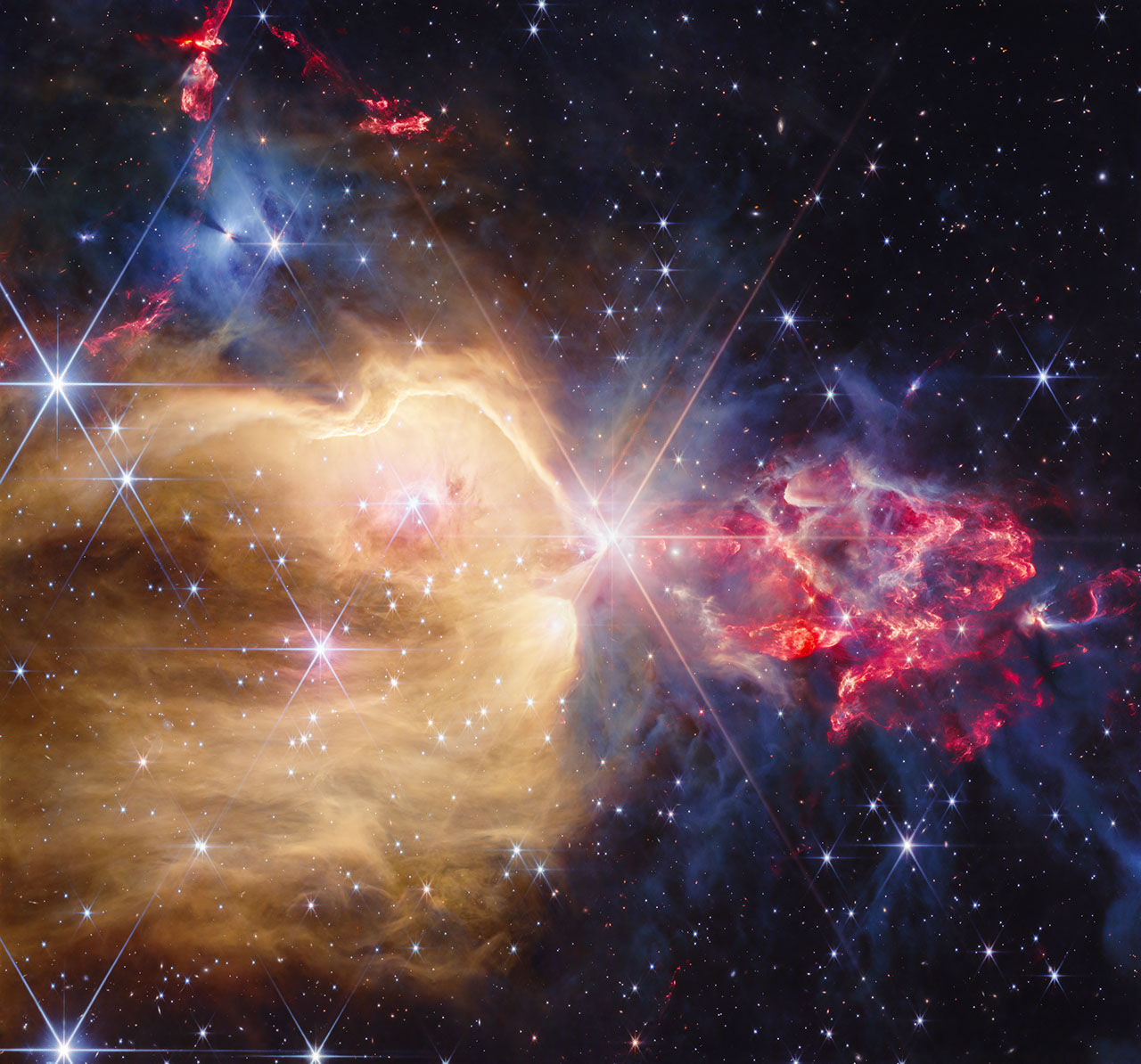
NASA’s James Webb Space Telescope adds to Spitzer’s observation, showing bow shocks, stars, and protostars within the golden cavity and the effects of protostar outflows in the dense red clouds. Webb’s sensitivity also picks up the faint infrared emissions of the cold, gray gas where protostars have yet to form and many distant background galaxies.
About the Object
- R.A. PositionR.A. PositionRight ascension – analogous to longitude – is one component of an object's position.21:43:05.02
- Dec. PositionDec. PositionDeclination – analogous to latitude – is one component of an object's position.+66:06:45.83
- ConstellationConstellationOne of 88 recognized regions of the celestial sphere in which the object appears.Cepheus
- DistanceDistanceThe physical distance from Earth to the astronomical object. Distances within our solar system are usually measured in Astronomical Units (AU). Distances between stars are usually measured in light-years. Interstellar distances can also be measured in parsecs.About 3,300 light-years away
- DimensionsDimensionsThe physical size of the object or the apparent angle it subtends on the sky.This image is about 6 arcminutes (5.7 light-years) across
About the Data
- Data DescriptionData DescriptionProposal: A description of the observations, their scientific justification, and the links to the data available in the science archive.
Science Team: The astronomers who planned the observations and analyzed the data. "PI" refers to the Principal Investigator.This image was created with Webb data from proposal: 12491 (M. Garcia Marin).
- InstrumentInstrumentThe science instrument used to produce the data.Webb>NIRCam Spitzer> IRAC
- Exposure DatesExposure DatesThe date(s) that the telescope made its observations and the total exposure time.17 Dec 2025
- FiltersFiltersThe camera filters that were used in the science observations.Webb> F115W, F187N, F200W, F335M, F444W, F470N Spitzer> IRAC1 (3.6 microns), IRAC2 (4.5 microns), IRAC3 (5.8 microns), IRAC4 (8 microns)
- Object NameObject NameA name or catalog number that astronomers use to identify an astronomical object.NGC 7129
- Object DescriptionObject DescriptionThe type of astronomical object.Star-forming region with protostellar jets
- Release DateOctober 6, 2026
- Science ReleaseNASA’s Webb Captures Commotion From Nebula’s Stellar Jets
- CreditImage: NASA, ESA, CSA, STScI, NASA-JPL; Image Processing: Alyssa Pagan (STScI)
Left> These images were acquired by the Spitzer Space Telescope. Several filters were used to sample varying wavelength ranges. The color results from assigning different hues (colors) to each monochromatic (grayscale) image associated with an individual filter. In this case, the assigned colors are: Blue= IRAC1, Green= IRAC2, Orange= IRAC3, Red= IRAC4 Right> These images were acquired by the NIRCam instrument on the Webb Space Telescope. Several filters were used to sample varying wavelength ranges. The color results from assigning different hues (colors) to each monochromatic (grayscale) image associated with an individual filter. In this case, the assigned colors are: Blue= F115W, F187N Cyan= F200W, Yellow= F335M, Red= F444W, F470N
Related Images & Videos
Share
Details
Laura Betz
NASA’s Goddard Space Flight Center
Greenbelt, Maryland
laura.e.betz@nasa.gov