












Suggested Searches

Messier 20

Look for Messier 20, better known as the Trifid Nebula, in August.

Distance

5,000 light-years

Apparent Magnitude

6.3

constellation

Sagittarius

object type

Nebula

A tightly cropped Hubble view of a vast star-forming region known as the Trifid Nebula. The top left is bright blue. Brown and amber colors run from top right through the center in irregular, overlapping lines to the bottom-center. At bottom right, the view is almost black. Tiny, amber-colored stars appear throughout the scene. Toward the left there is a prominent brown shape that looks like a head with two horns. The left horn points left and is wavy. The right horn is triangular and points up. The brown dust continues, flowing down, as if along a back, and up toward the top right. A prominent line, about the same length as the left horn, appears below the middle of the body, and changes from orange to red. A small, separate semi-transparent pillar is left of the head. A few slightly larger, blue foreground stars with four diffraction spikes appear throughout.
This Hubble image of the Trifid Nebula was taken with Wide Field Camera 3 in 2026 to mark Hubble’s 36th anniversary. Astronomers compared the image to Hubble's 1997 image (seen below) revealing changes in the nebula on human time scales.
Image: NASA, ESA, STScI; Image Processing: Joseph DePasquale (STScI)

Discovered by Charles Messier in 1764, M20 is a star-forming nebula located 5,000 light-years away from Earth in the constellation Sagittarius. Also known as the Trifid Nebula, M20 has an apparent magnitude of 6.3 and can be spotted with a small telescope. It is best observed during August.
Sit back and relax as Hubble Senior Project Scientist, Dr. Jennifer Wiseman takes us on a tour of this beautiful image. Credit: NASA; Lead Producer: Paul Morris
Trifid Nebula
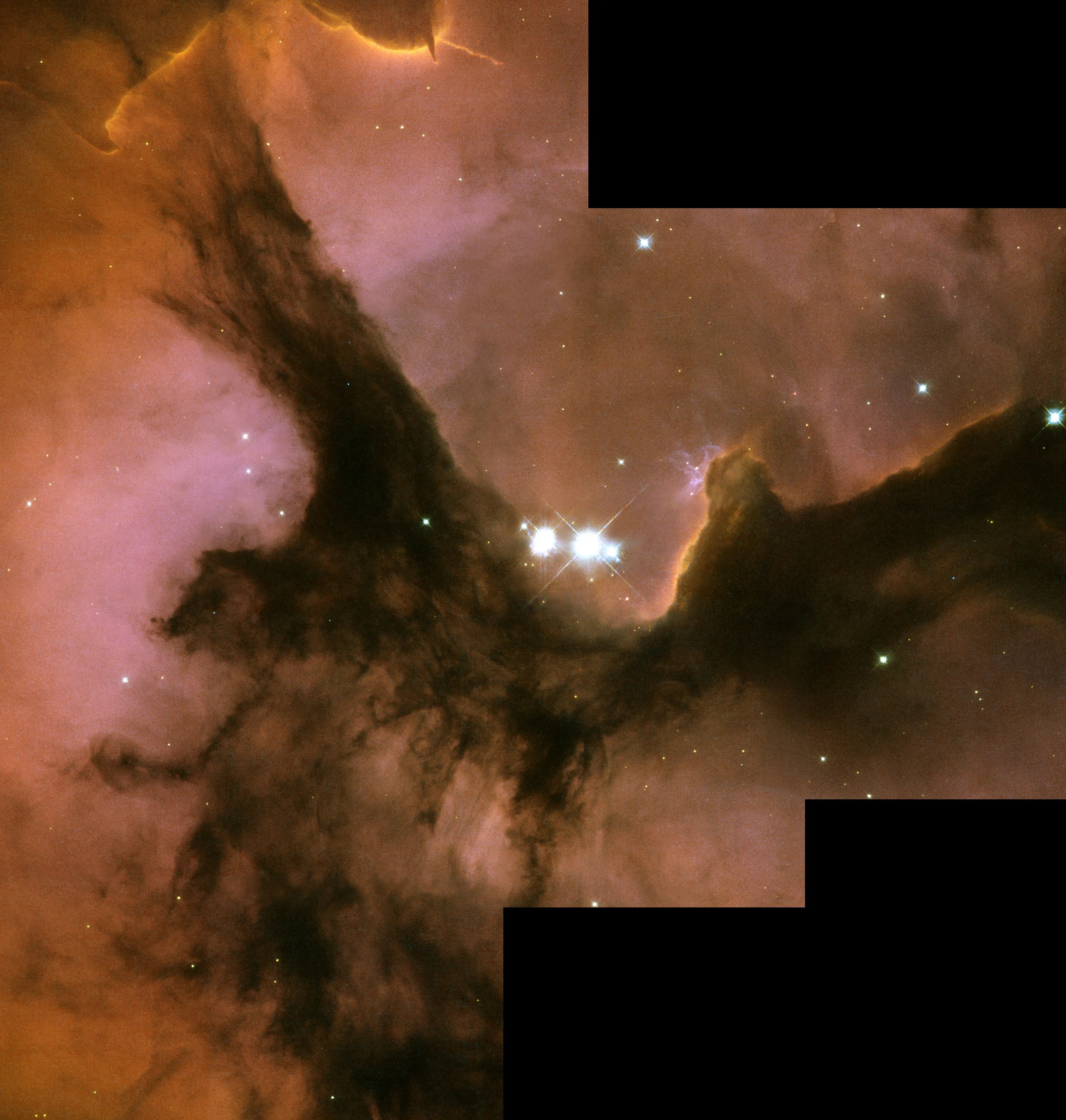
This eerie Hubble image features the center of the Trifid Nebula and the three wing-like bands of thick dust for which the nebula was named. A group of recently formed, massive, bright stars toward the center of the nebula is easily visible. These stars are releasing a flood of ultraviolet radiation that dramatically influences the structure and evolution of the surrounding nebula. Star formation is no longer occurring in the immediate vicinity of this group of bright stars because their intense radiation has blown away the gas and dust from which new stars are made.
NASA, ESA and the Hubble Heritage Team (AURA/STScI); Acknowledgment: F. Yusef-Zadeh (Northwestern Univ.)
star-forming cloud of gas and dust in M20
This 1997 Hubble image taken with Hubble's Wide Field and Planetary Camera 2 reveals a star-forming cloud of gas and dust in M20 being torn apart by radiation from a massive nearby star, just beyond the top of the frame. Two thin, finger-like jets protrude from the head of a dense cloud in the upper left of the image, which might be forming new stars at their tips. The jets, each roughly three-quarters of a light-year long, are being eroded by the radiation from the massive star. The red in this image represents hydrogen and sulfur, while green represents oxygen. This Hubble image of M20 was colorized to indicate the presence of oxygen, sulfur and hydrogen.
NASA/ESA and Jeff Hester (Arizona State University)

The stair-step appearance of Hubble's older images results from the design of the camera used to take the exposures. The camera consisted of four light detectors, one of which provided a higher resolution but had a smaller field of view than the other three. Because the detector with the higher resolution did not cover as much area as the others, black regions were left when the images from all four detectors were combined into one picture.
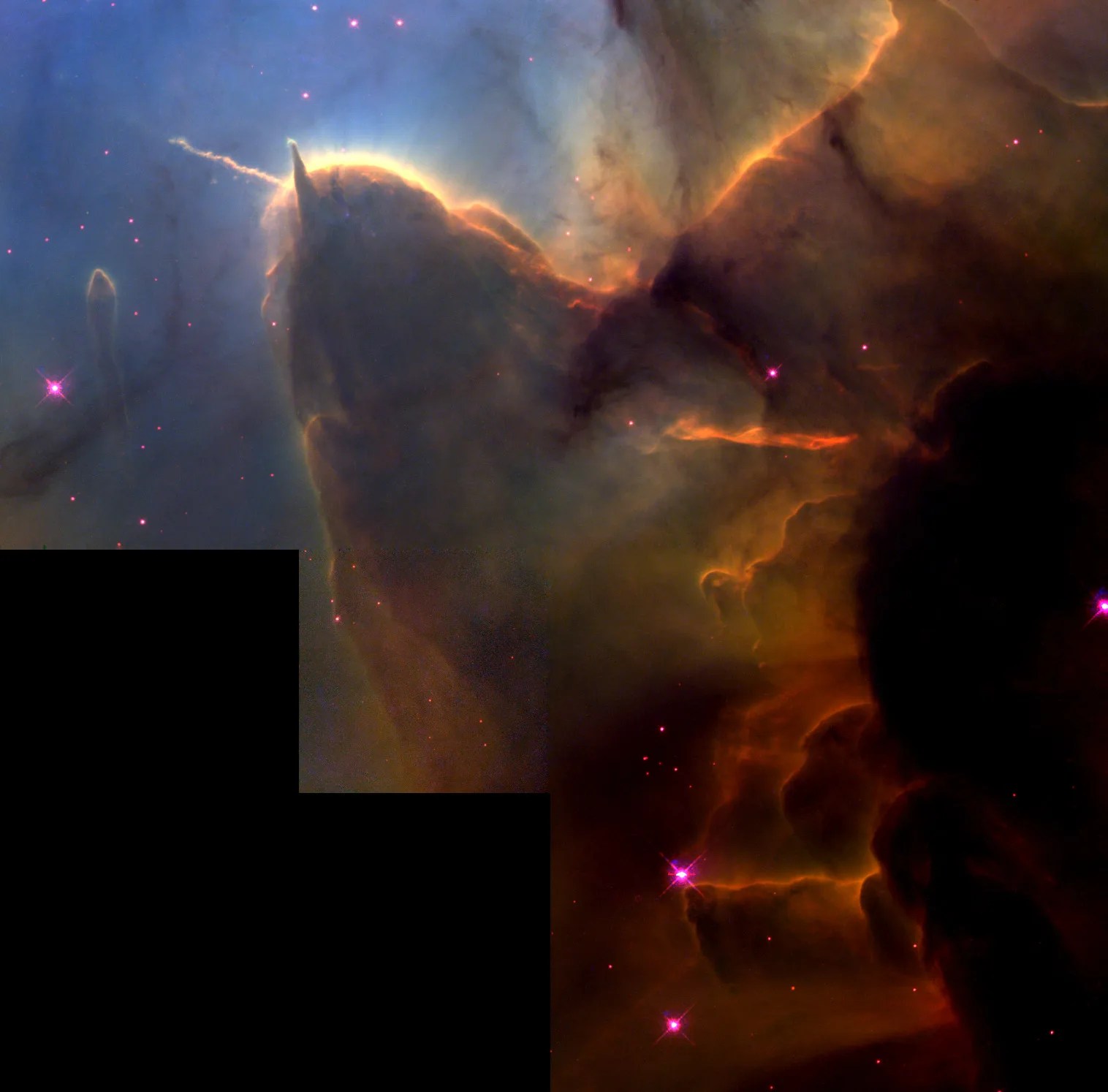
Compare Hubble’s two observations of a portion of the Trifid Nebula, one taken in 2026 with the telescope’s current Wide Field Camera 3 and the other in 1997 with an earlier instrument (the Wide Field and Planetary Camera 2). This portrait of star formation spotlights Herbig-Haro 399, a jet of plasma periodically ejected by an actively forming star to produce the long, wiggling line pointing to the top left. The 29 years between these observations show how the jet has expanded. Its counter jet is within the dark brown dust, and shows up as jagged orange and red lines where a natural V appears in the brown dust.<br>Other changes are evident near the bottom right, specifically the rippling angled line that begins in bright orange and ends in blazing red. The newer observation shows it has expanded toward the right.<br>The pinker stars in the scene also appear to twinkle or move. This is because stars' positions change from our line of sight, ever so slightly, over decades. This effect is known as proper motion.
Video: NASA, ESA, STScI, Joseph DePasquale (STScI)

For more information about Hubble’s observations of M20, see:

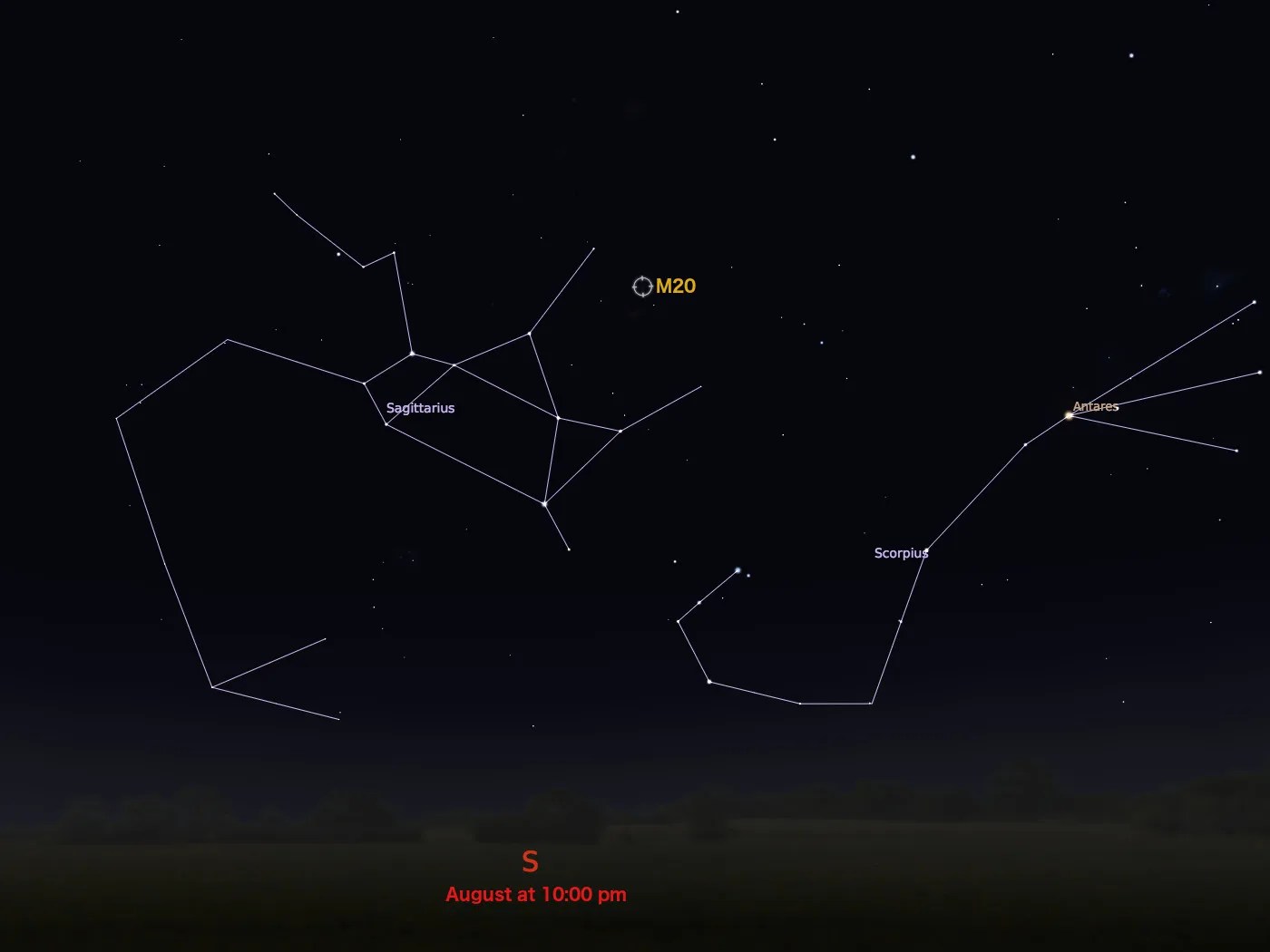
locator star chart for M20
This star chart for M20 represents the view from mid-northern latitudes for the given month and time.
Image courtesy of Stellarium
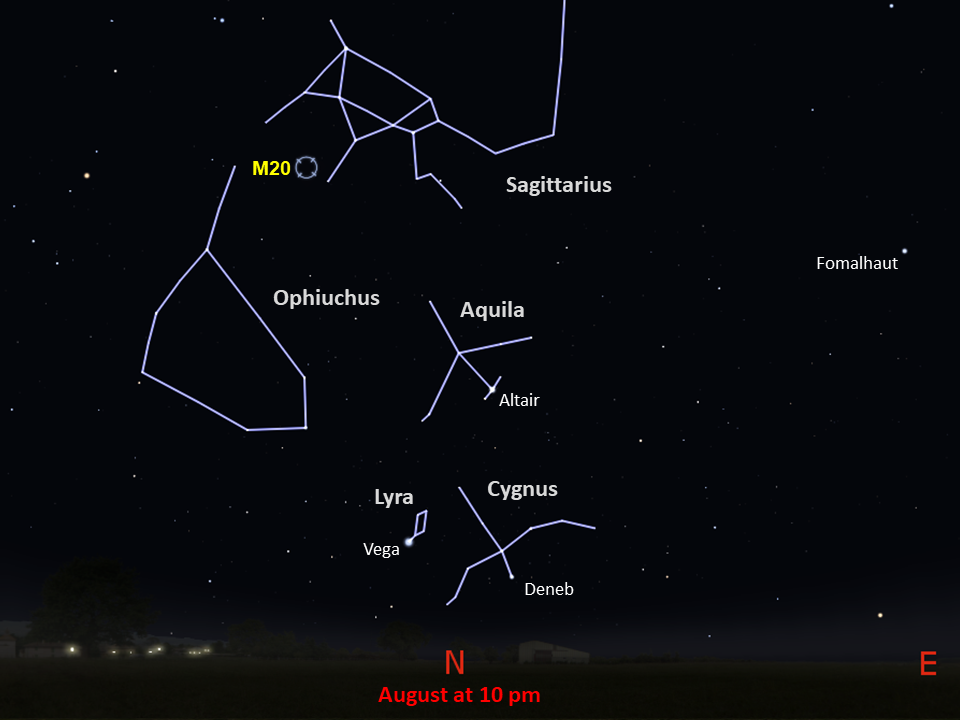
locator star chart for M20
This star chart for M20 represents the view from mid-southern latitudes for the given month and time.
Image courtesy of Stellarium

Explore Hubble's Messier Catalog

The following pages contain some of Hubble’s best images of Messier objects.
Hubble’s Messier Catalog

Overview The Messier catalog, begun by astronomer Charles Messier in the 18th Century and revised over the years, includes some…

Messier 1 (The Crab Nebula)

Better known as the Crab Nebula, Charles Messier originally mistook Messier 1 for Halley’s Comet, which inspired him to create…
Messier 2

Hubble's image of Messier 2 is comprised of visible and infrared wavelengths of light.