















Pulsars
Spinning neutron stars beam pulses of radiation into the universe.

Pulsars are the lighthouses of the universe. They’re neutron stars ― the very dense remnants of a dead star ― that are highly magnetic and rotate rapidly as they emit beams of radiation, generally from the vicinity of their magnetic poles.
As the pulsar spins around on its axis, it sweeps a beam of radiation around the cosmos like a turning lighthouse that shines out into the sea. From Earth, we see the beam as it sweeps rapidly past as a pulse of radiation. So far, astronomers have discovered over 3,000 pulsars. The fastest can spin hundreds of times per second and are called millisecond pulsars, while the slowest can take almost 6.7 hours to rotate just once around.
Discovered in 1967 by astrophysicist Jocelyn Bell Burnell while working on her doctorate at the University of Cambridge’s Radio Astronomy Observatory, pulsars were the first observed evidence of the existence of neutron stars. They were named for the periodic, pulsating signal that persisted in Bell Burnell’s analyses of radio wave sources in the Vulpecula constellation. She jokingly named them LGM for “Little Green Men” because the timing of the signals seemed too precise and consistent to be natural. Later, astrophysicists Franco Pacini, Thomas Gold, and others identified the pulsars as neutron stars emitting radio waves as they spun around.
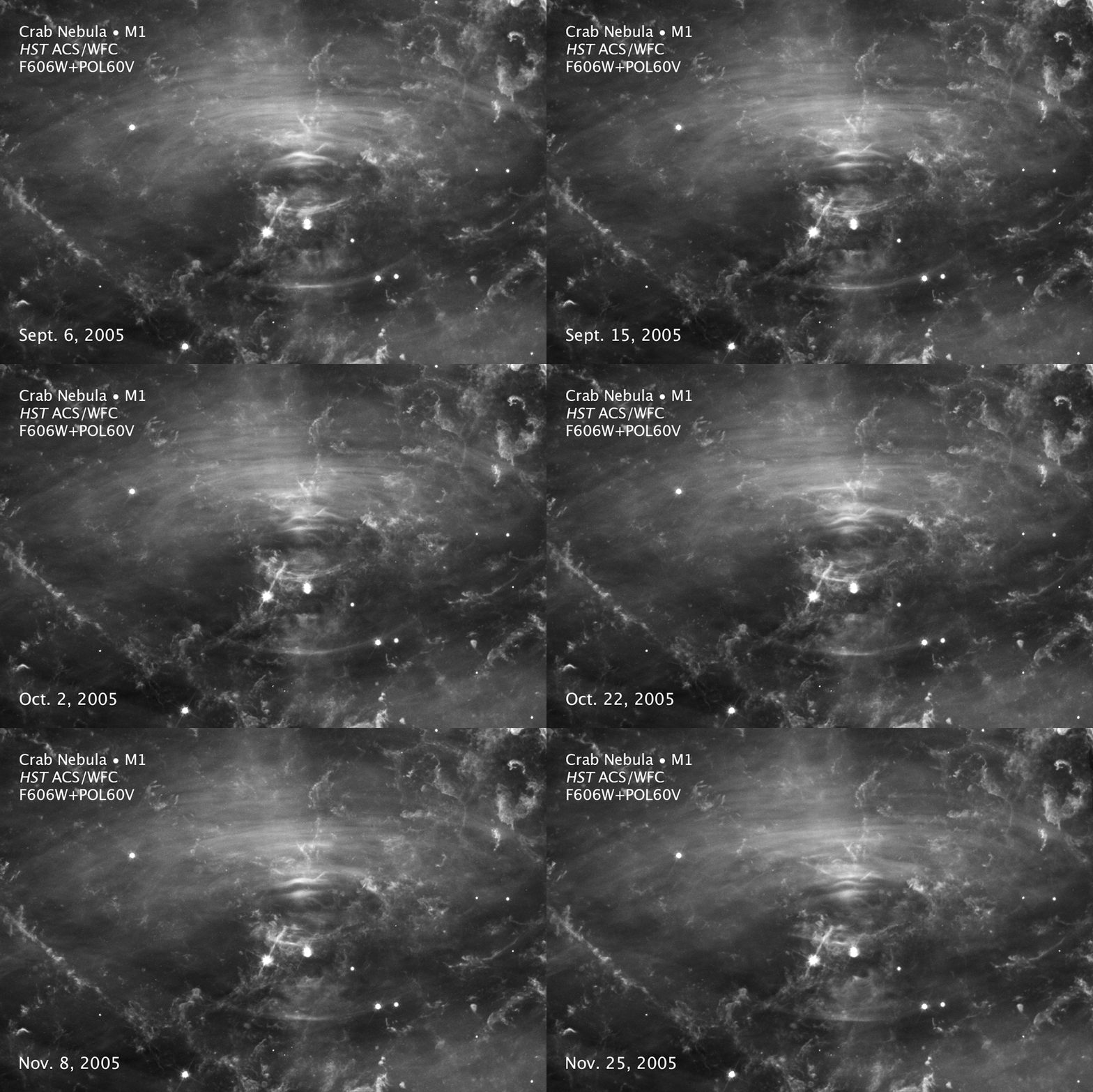
Hubble helped advance our understanding of pulsars by imaging them in visible light. In particular, Hubble’s observations of the Crab Nebula over time have shown wisp-like features of pulsar “wind” rippling away from the pulsar and colliding into the body of the nebula.
How Do Pulsars Form?
The nature of pulsars is closely tied to the neutron star’s formation. If a neutron star spins quickly enough, it should be a pulsar, which is why most neutron stars likely start off as pulsars.
When a massive star between eight and 20 times the mass of the Sun runs out of fuel, the star collapses. Protons and electrons in the core are crushed together so tightly that they become neutrons. If the core of the star is between 1.2 to 3 times the mass of the Sun, it can stabilize to become a neutron star. This means that the subatomic forces that keep neutrons from occupying the same space prevent gravity from further collapsing the dying star into a black hole.
In a matter of seconds, the star becomes a small and highly dense remnant of its former self ― just a teaspoon of neutron star material would weigh 10 million tons. The exact nature of how pulsars gain their enormous magnetic fields ― trillions of times stronger than Earth’s magnetic field ― is still unknown and under investigation, but the high magnetism of the parent star may be retained and even magnified by the compression of the magnetic field lines during its collapse.
The pulsar’s rapid spinning is due to the conservation of angular momentum as the neutron star compresses into a much smaller and denser object than the original star. This is the same principle that causes figure skaters to spin faster as they bring their limbs closer in.

What Causes a Pulsar's Beam?
A pulsar’s beams emanate from its magnetic poles, which may form randomly and independently of the rotational poles. As a pulsar spins, its magnetic field channels and accelerates charged particles until they are moving at close to the speed of light. The fast-moving particles stream along the pulsar’s magnetic field lines. Some are launched from the surface into space while others rain back down on the pulsar and heat up the surface.
Pulsars slow down with age as they release energy. At a certain point, rotation will slow down so much that the electrical currents stop. A pulsar dies out when its electric fields are no longer strong enough to generate beams.
Looking To the Future
Pulsars aren’t just a cool astronomical phenomenon. They could revolutionize space exploration. The precision of the pulsar’s period ― the time it takes to complete one rotation ― can increase the accuracy of position calculations. The Station Explorer for X-ray Timing and Navigation Technology (SEXTANT) experiment on the International Space Station showed the usefulness of pulsars to navigate in space. The experiment tracked pulsars in multiple directions around the spacecraft, measuring when the pulses arrive. If the spacecraft’s location changes, it will receive pulses earlier from some pulsars and later from others, allowing it to work out its position.
As Hubble scans the skies, it will continue to keep an eye out for pulsars, helping us learn more about these unique astronomical objects.