


















1 min read
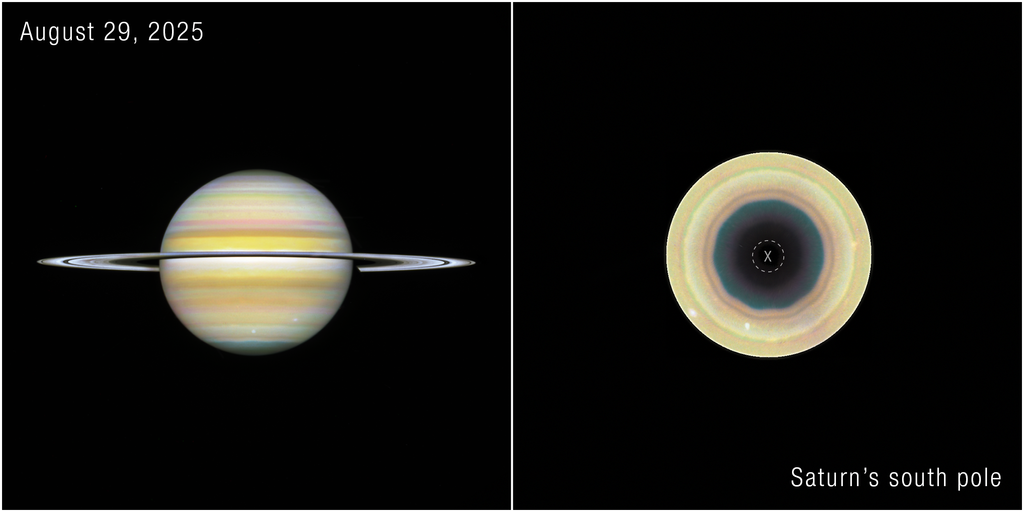
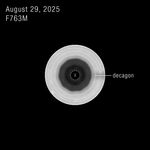
Decagon on Saturn’s South Pole (Color)
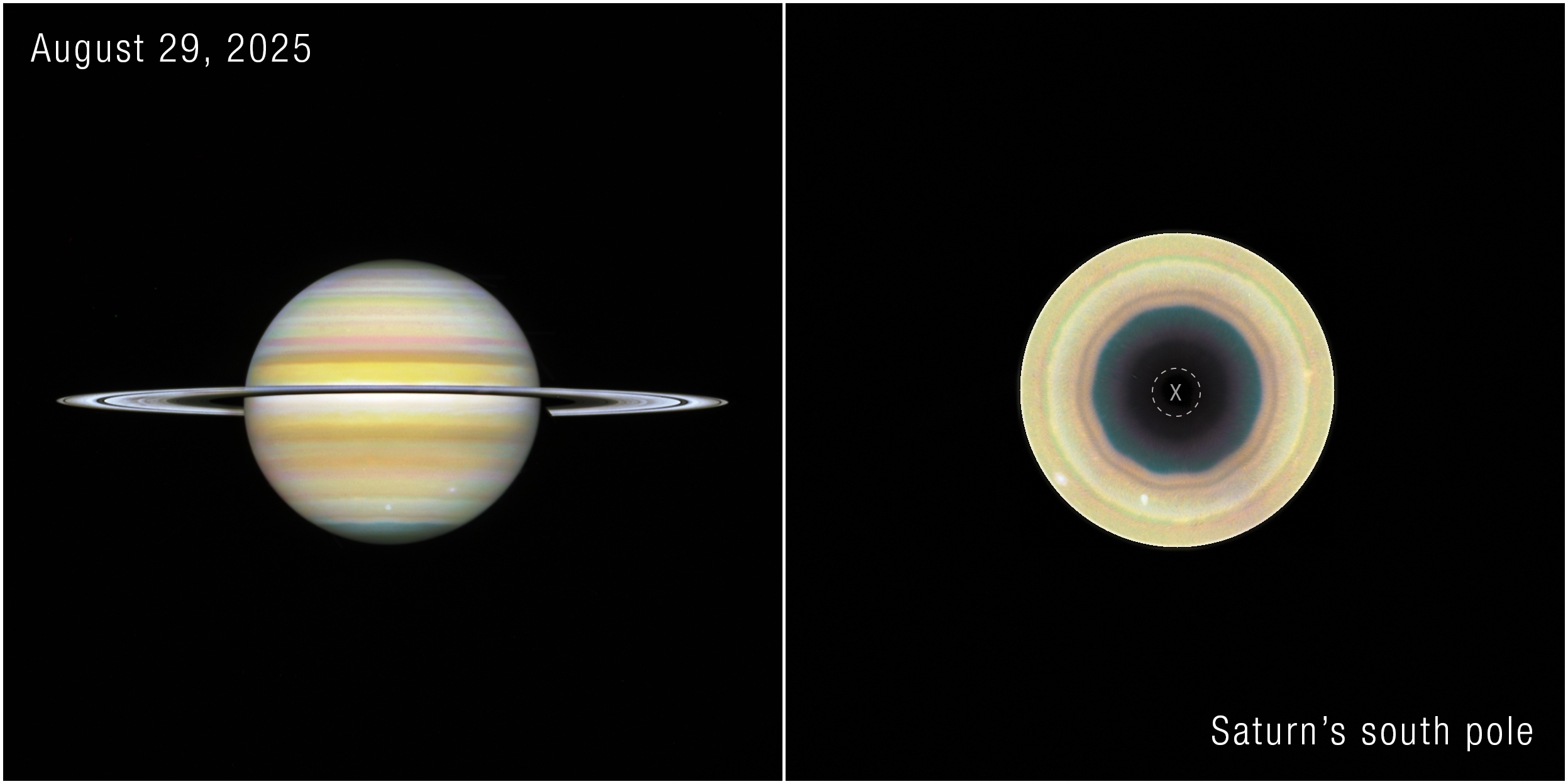
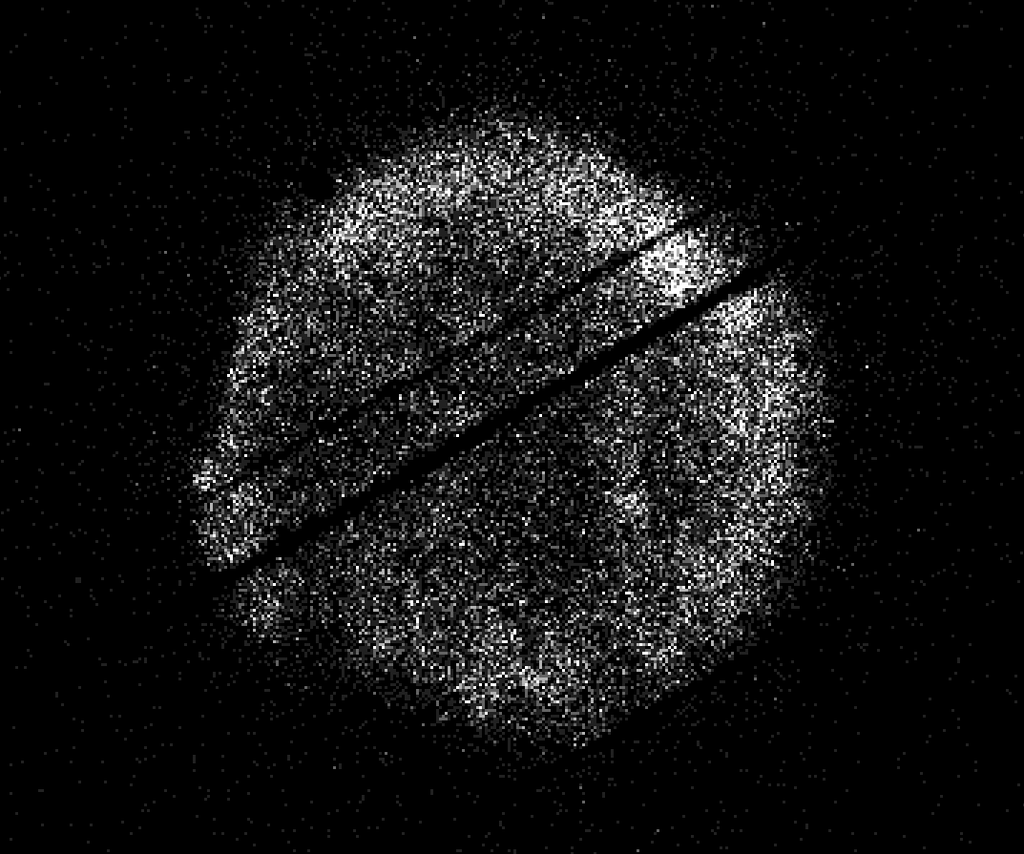
Two views of Saturn from NASA’s Hubble Space Telescope reveal a giant, evolving 10-sided atmospheric wave encircling the planet’s south pole. The feature, called a decagon, is the first large, persistent, regular-sided pattern observed at Saturn’s southern hemisphere.
By comparing observations taken over several years, researchers found that the pattern has become increasingly distinct since 2023, suggesting they may be witnessing a new atmospheric phenomenon develop on the gas giant. The observations, captured by Hubble's Wide Field Camera 3, were made as part of Hubble’s Outer Planet Atmosphere’s Legacy (OPAL) program, which has monitored the Jupiter, Saturn, Uranus, and Neptune for more than a decade.
The “X” and dashed circle in the image on the right represent where data was not captured by Hubble.
About the Data
- Data DescriptionData DescriptionProposal: A description of the observations, their scientific justification, and the links to the data available in the science archive.
Science Team: The astronomers who planned the observations and analyzed the data. "PI" refers to the Principal Investigator.These images were created with Hubble data from proposal: 17843 (A. Simon).
- InstrumentInstrumentThe science instrument used to produce the data.WFC3/UVIS
- Exposure DatesExposure DatesThe date(s) that the telescope made its observations and the total exposure time.29 Aug 2025
- FiltersFiltersThe camera filters that were used in the science observations.F395N, F502N, F631N
- Object NameObject NameA name or catalog number that astronomers use to identify an astronomical object.Saturn
- Object DescriptionObject DescriptionThe type of astronomical object.Gas giant in our solar system
- Release DateSeptember 2, 2026
- Science ReleaseNASA’s Hubble Tracks New Decagon Encircling Saturn’s South Pole
- CreditImage: NASA, ESA, STScI, Agustin Sánchez-Lavega (UPV), Amy Simon (NASA-GSFC), Michael Wong (UC Berkeley); Image Processing: Alyssa Pagan
These images were acquired by the WFC3/UVIS instrument on Hubble. The color results from assigning different hues (colors) to a monochromatic (grayscale) image. In this case, the assigned colors are: Blue: F395N, Green: F502N, Red: F631N
Share
Details
Claire Andreoli
NASA’s Goddard Space Flight Center
Greenbelt, Maryland
claire.andreoli@nasa.gov