














Suggested Searches

1 min read

Farthest Fast Radio Burst Host Galaxy Spectrum
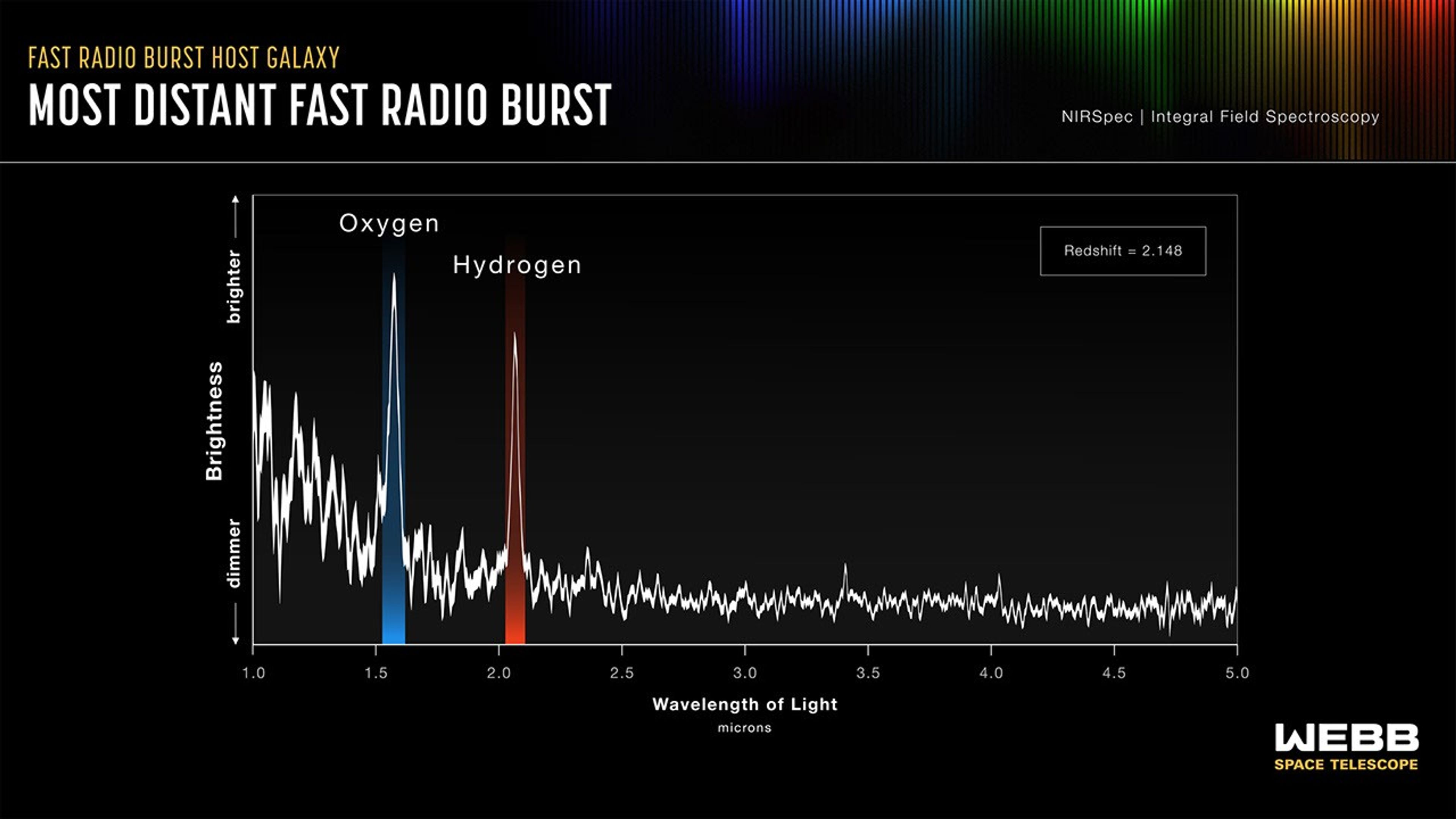
A graphic titled “Fast Radio Burst Host Galaxy; Most Distant Fast Radio Burst; NIRSpec Integral Field Spectroscopy.” A graph plots brightness of light versus wavelength. The y axis is labeled brightness with an up arrow labeled brighter and a down arrow labeled dimmer. The x axis is labeled “Wavelength of Light, microns” and goes from 1.0 to 5.0 with tickmarks every 0.5 microns. A jagged white line slopes downward from left to right between 1.0 and 2.5 microns, and is mostly flat beyond that. A prominent peak at 1.6 microns is labeled Oxygen with a transparent blue vertical band. Another peak at 2.1 microns is labeled Hydrogen with a transparent red vertical band. At upper right, a box contains text reading “Redshift = 2.148”.

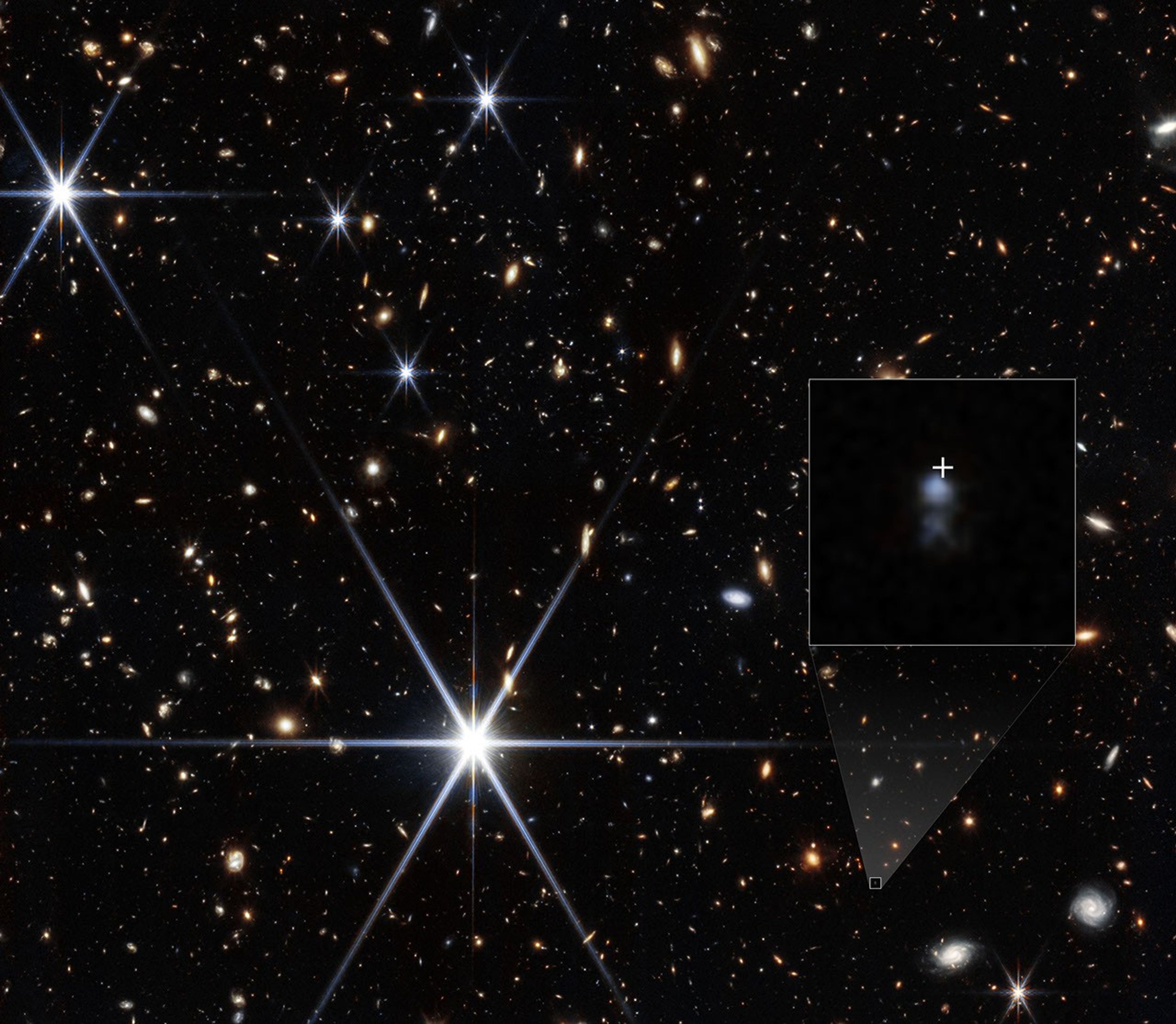
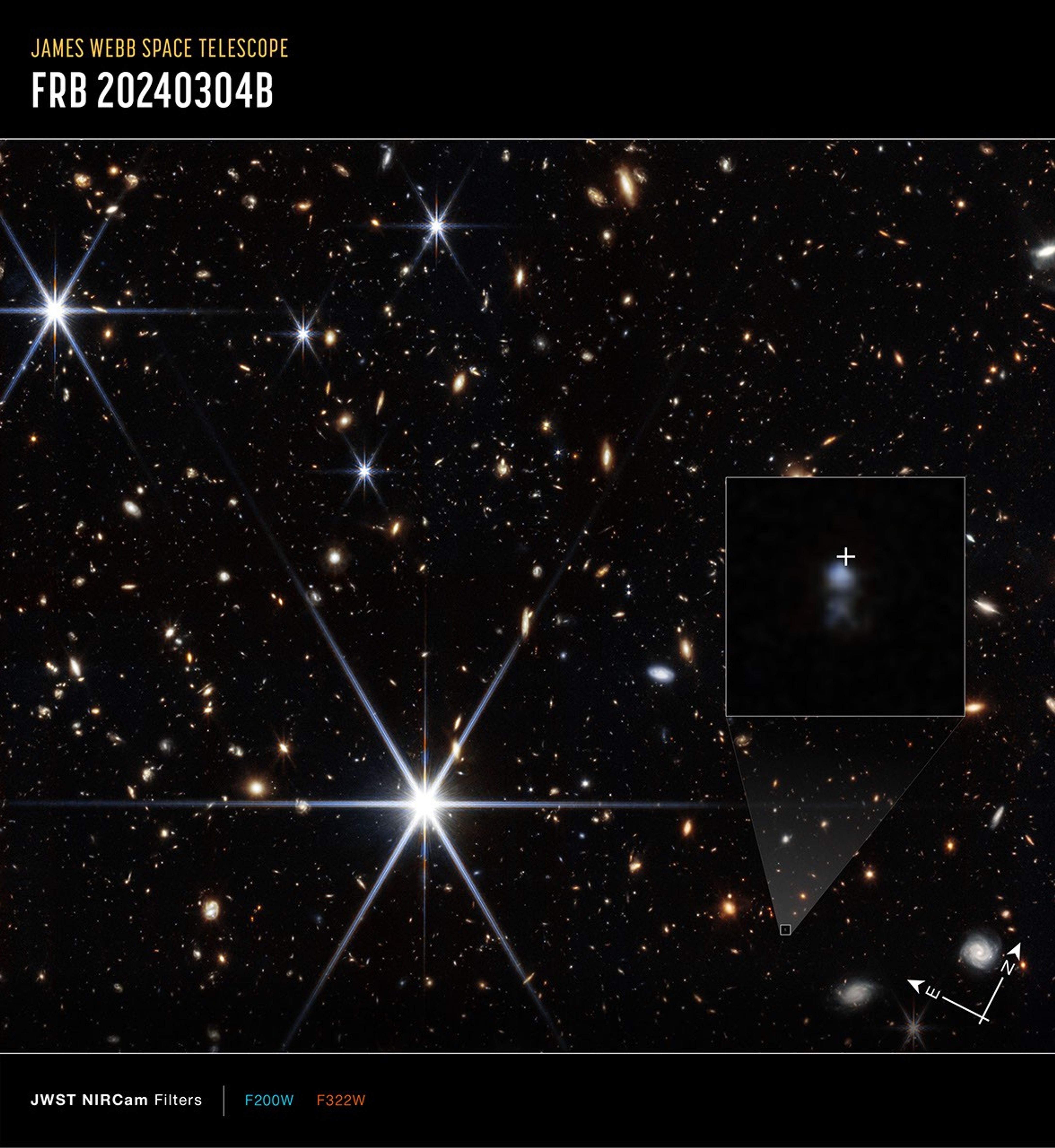
Astronomers using NASA’s James Webb Space Telescope were able to study the host galaxy of the most distant known fast radio burst (FRB). By detecting light emitted from oxygen and nitrogen, they were able to determine the galaxy’s cosmological redshift, thereby confirming the FRB occurred just 3 billion years after the big bang.

  • Release Date
    October 8, 2026
  • Science Release
    Webb Measures Distance to Farthest Fast Radio Burst, Suggesting Origin
  • Credit
    Illustration: NASA, ESA, CSA, Joseph Olmsted (STScI); Science: Manisha Caleb (SIfA)

Downloads

  • Full res (For Print), 3840 × 2160
    tif (6.67 MB)
  • Full res (For Display), 3840 × 2160
    jpg (586.23 KB)
  • For Display (Half Res), 1920 × 1080
    jpg (203.65 KB)

Share

Details

Last Updated
Oct 08, 2026
Contact
Media

Laura Betz
NASA’s Goddard Space Flight Center
Greenbelt, Maryland
laura.e.betz@nasa.gov