











1 min read
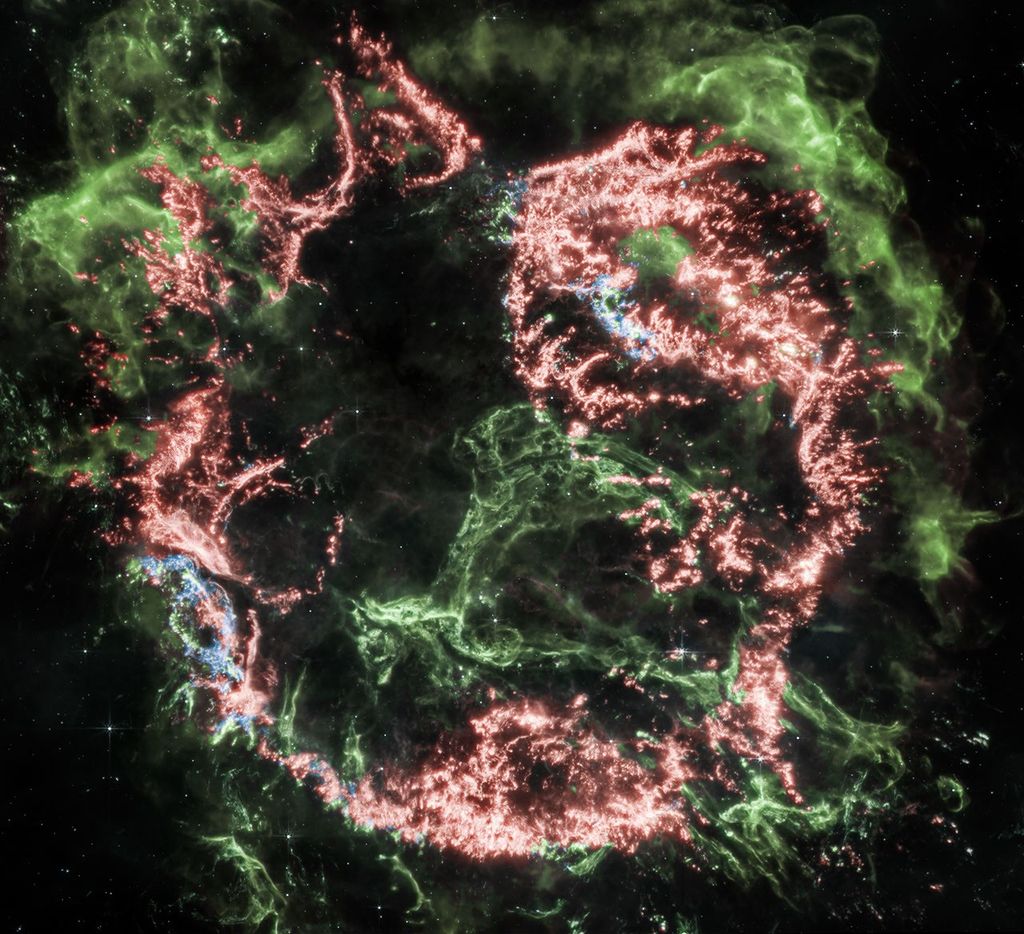
Dust In Cassiopeia A (MIRI Image)
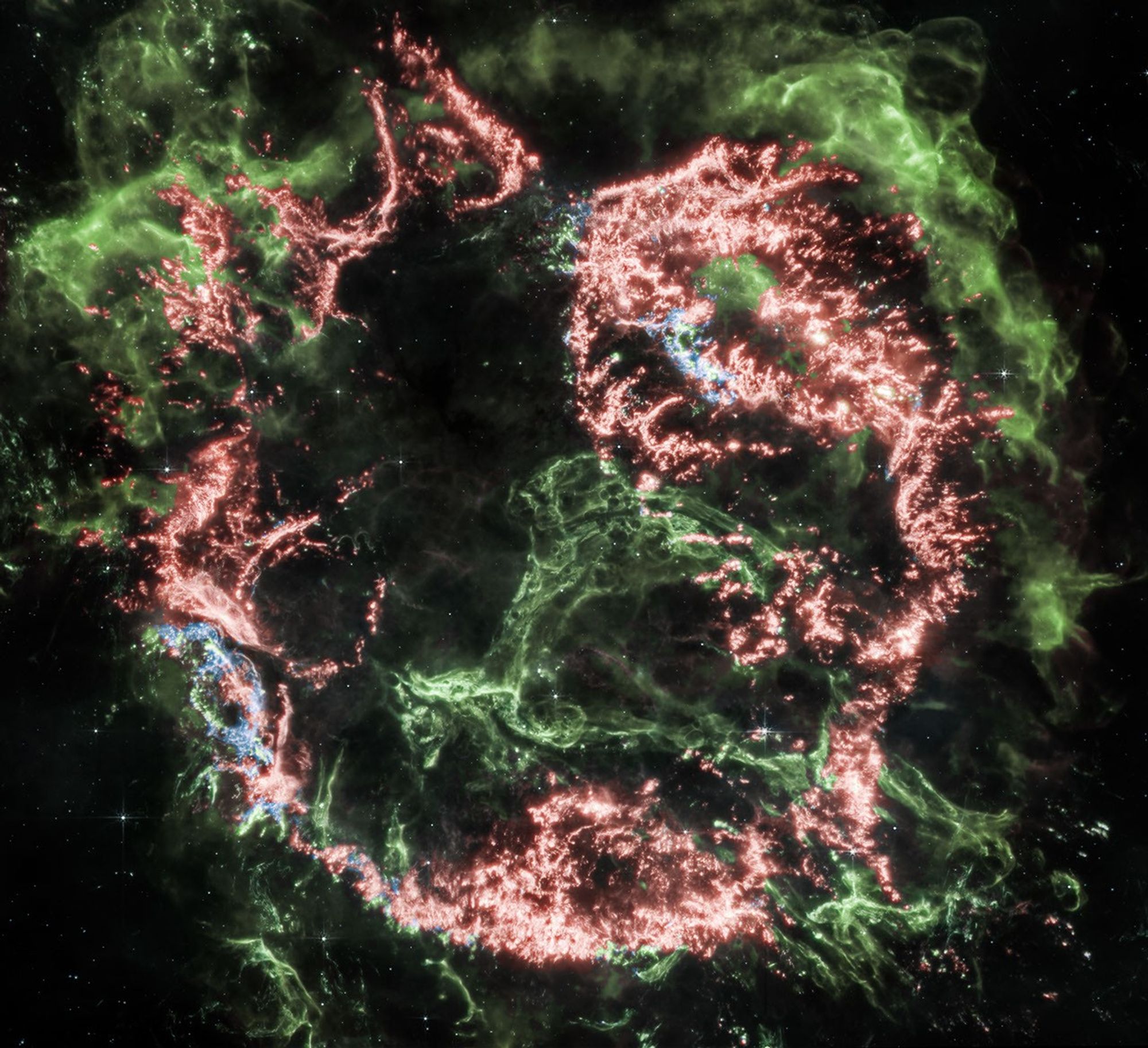
NASA’s James Webb Space Telescope reveals the hot dust that makes up the supernova remnant Cassiopeia A (Cas A). The three regions that were observed to map the dust composition carry information about the structure of the star that exploded.
Two of the targeted areas were inside Cas A’s reverse-shocked region, where an inward-moving shock wave collides with debris thrown outward by the supernova. Webb observed that the ejecta in one of the two contained mostly silica dust, while the other was dominated by carbon dust. The third target was the “Green Monster,” a structure first discovered by Webb, which was found to be rich in complex magnesium silicates. By studying these elements in clumps of dust and gas, Webb found evidence of a shell merger, a process in which the layers inside Cas A’s original star mixed before the explosion.
Deep Zoom Image
Dive deeper into this image.
About the Object
- R.A. PositionR.A. PositionRight ascension – analogous to longitude – is one component of an object's position.23:23:24.00
- Dec. PositionDec. PositionDeclination – analogous to latitude – is one component of an object's position.+58:48:54.00
- ConstellationConstellationOne of 88 recognized regions of the celestial sphere in which the object appears.Cassiopeia
- DistanceDistanceThe physical distance from Earth to the astronomical object. Distances within our solar system are usually measured in Astronomical Units (AU). Distances between stars are usually measured in light-years. Interstellar distances can also be measured in parsecs.11,090 light-years
- DimensionsDimensionsThe physical size of the object or the apparent angle it subtends on the sky.Image is about 24 light-years across
About the Data
- Data DescriptionData DescriptionProposal: A description of the observations, their scientific justification, and the links to the data available in the science archive.
Science Team: The astronomers who planned the observations and analyzed the data. "PI" refers to the Principal Investigator.This image was created with Webb data from proposal: 1947 (D. Milisavljevic).
- InstrumentInstrumentThe science instrument used to produce the data.MIRI, MIRI/IFU
- Exposure DatesExposure DatesThe date(s) that the telescope made its observations and the total exposure time.August 4, 2022
- FiltersFiltersThe camera filters that were used in the science observations.MIRI MRS, F560W, F770W, F1000W, F1130W, F1280W, F1800W, F2100W, F2550W
- Object NameObject NameA name or catalog number that astronomers use to identify an astronomical object.Cassiopeia A; SNR G111.7-02.1
- Object DescriptionObject DescriptionThe type of astronomical object.Supernova remnant
- Release DateNovember 23, 2026
- Science ReleaseNASA’s Webb Shows How Supernova Dust Chronicles Star Evolution
- CreditImage: NASA, ESA, CSA, STScI, Tea Temim (Columbia University), Rick Arendt (UMBC), Dan Milisavljevic (Purdue University); Image Processing: Joseph DePasquale (STScI)
The colors in this image represents separate dust families. Mg2SiO4 CSM dust is shown in green, SiO2 dust in magenta, and Ne-rich dust is shown in blue.
Deep Zoom Image
Related Multimedia
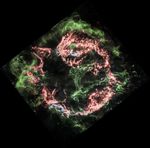
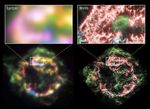
Dust in Cassiopeia A (Spitzer and Webb)
NASA’s retired Spitzer Space Telescope observed the supernova remnant Cassiopeia A, helping to identify key regions that NASA’s James Webb Space Telescope later examined. Webb’s higher resolution provides finer details into the chemistry of the remnant’s dust.
Share
Details
Laura Betz
NASA’s Goddard Space Flight Center
Greenbelt, Maryland
laura.e.betz@nasa.gov