













1 min read
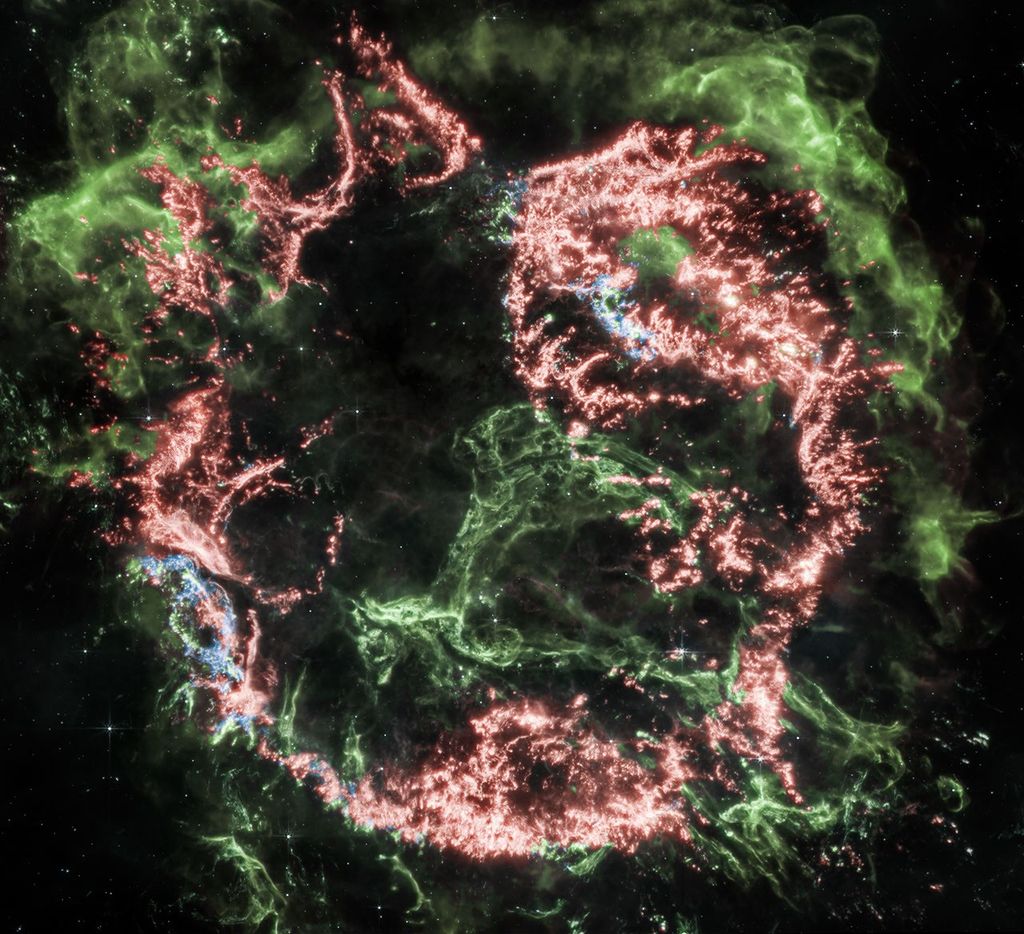
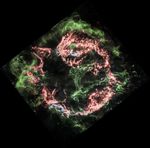
Dust in Cassiopeia A (Spitzer and Webb)
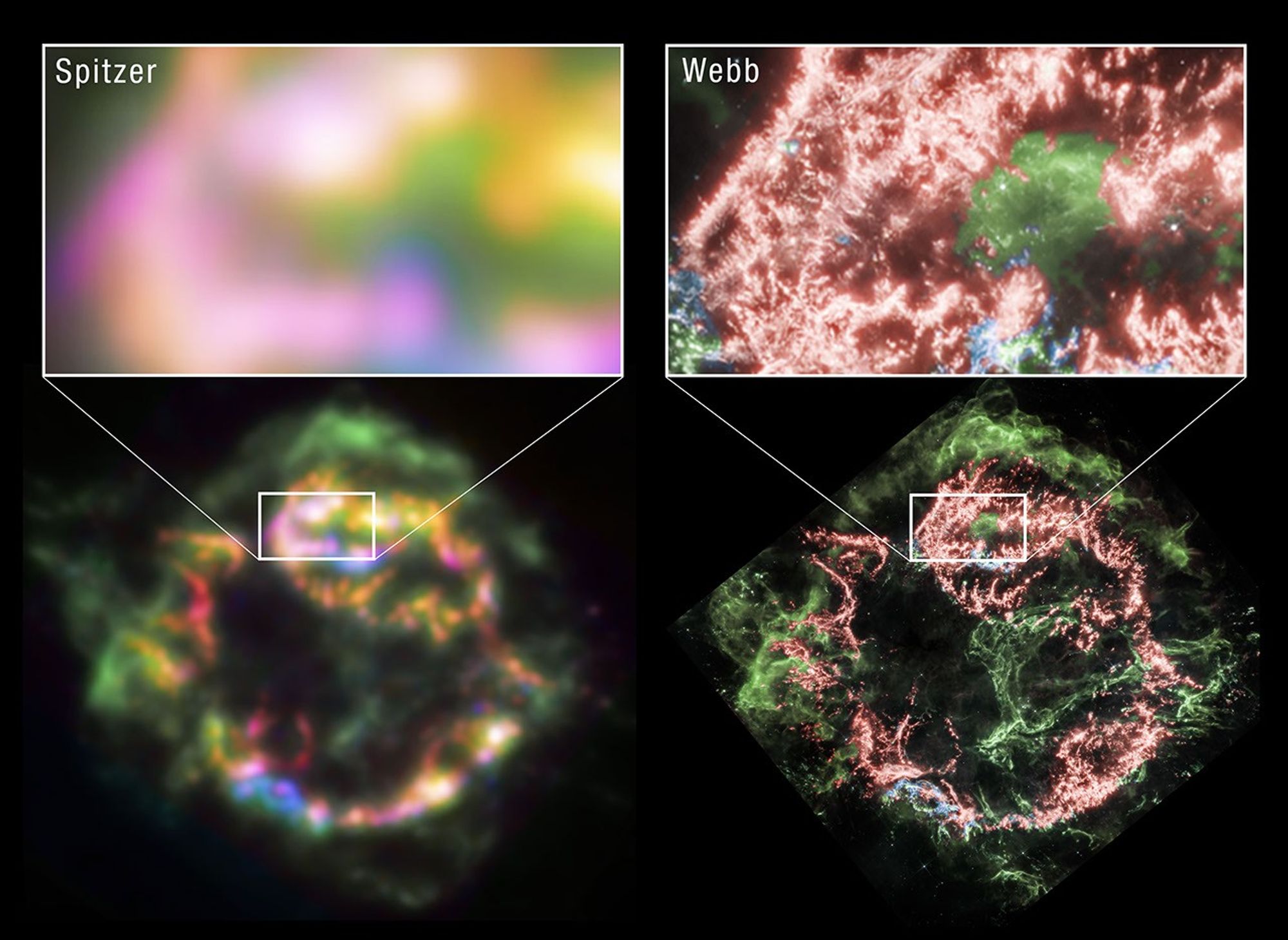
NASA’s retired Spitzer Space Telescope observed the supernova remnant Cassiopeia A (Cas A), helping identify key regions that NASA’s James Webb Space Telescope later examined in greater detail. Webb’s higher resolution enabled astronomers to create a map of Cas A’s dust chemistry across the entire remnant. This map provides crucial insights into shell mergers, a process in which the layers of elements formed during a star’s life begin to mix before the star explodes. These findings also reveal details about the structure of Cas A’s original star and provide astronomers with a new way to infer the internal structure of exploded stars by studying the dust preserved in their supernova remnants.
Deep Zoom Image
Dive deeper into this image.
About the Object
- R.A. PositionR.A. PositionRight ascension – analogous to longitude – is one component of an object's position.23:23:24.00
- Dec. PositionDec. PositionDeclination – analogous to latitude – is one component of an object's position.+58:48:54.00
- ConstellationConstellationOne of 88 recognized regions of the celestial sphere in which the object appears.Cassiopeia
- DistanceDistanceThe physical distance from Earth to the astronomical object. Distances within our solar system are usually measured in Astronomical Units (AU). Distances between stars are usually measured in light-years. Interstellar distances can also be measured in parsecs.11,090 light-years
- DimensionsDimensionsThe physical size of the object or the apparent angle it subtends on the sky.Image is about 24 light-years across
About the Data
- Data DescriptionData DescriptionProposal: A description of the observations, their scientific justification, and the links to the data available in the science archive.
Science Team: The astronomers who planned the observations and analyzed the data. "PI" refers to the Principal Investigator.This image was created with Webb data from proposal: 1947 (D. Milisavljevic).
- InstrumentInstrumentThe science instrument used to produce the data.MIRI, MIRI/IFU, Spitzer
- Exposure DatesExposure DatesThe date(s) that the telescope made its observations and the total exposure time.August 4, 2022
- FiltersFiltersThe camera filters that were used in the science observations.MIRI MRS, F560W, F770W, F1000W, F1130W, F1280W, F1800W, F2100W, F2550W
- Object NameObject NameA name or catalog number that astronomers use to identify an astronomical object.Cassiopeia A; SNR G111.7-02.1
- Object DescriptionObject DescriptionThe type of astronomical object.Supernova remnant
- Release DateNovember 23, 2026
- Science ReleaseNASA’s Webb Shows How Supernova Dust Chronicles Star Evolution
- CreditImage: NASA, ESA, CSA, STScI, Tea Temim (Columbia University), Rick Arendt (UMBC), Dan Milisavljevic (Purdue University); Image Processing: Joseph DePasquale (STScI), Alyssa Pagan (STScI)
The colors in this image represents separate dust families. Mg2SiO4 CSM dust is shown in green, SiO2 dust in magenta, and Ne-rich dust is shown in blue.
Deep Zoom Image
Related Multimedia
Share
Details
Laura Betz
NASA’s Goddard Space Flight Center
Greenbelt, Maryland
laura.e.betz@nasa.gov