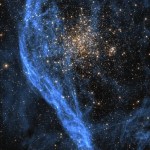























Messier 28
This globular cluster holds a dense neutron star that rotates once every three milliseconds.
Distance
18,000 light-years
Apparent Magnitude
7.7
constellation
Sagittarius
object type
Globular Cluster
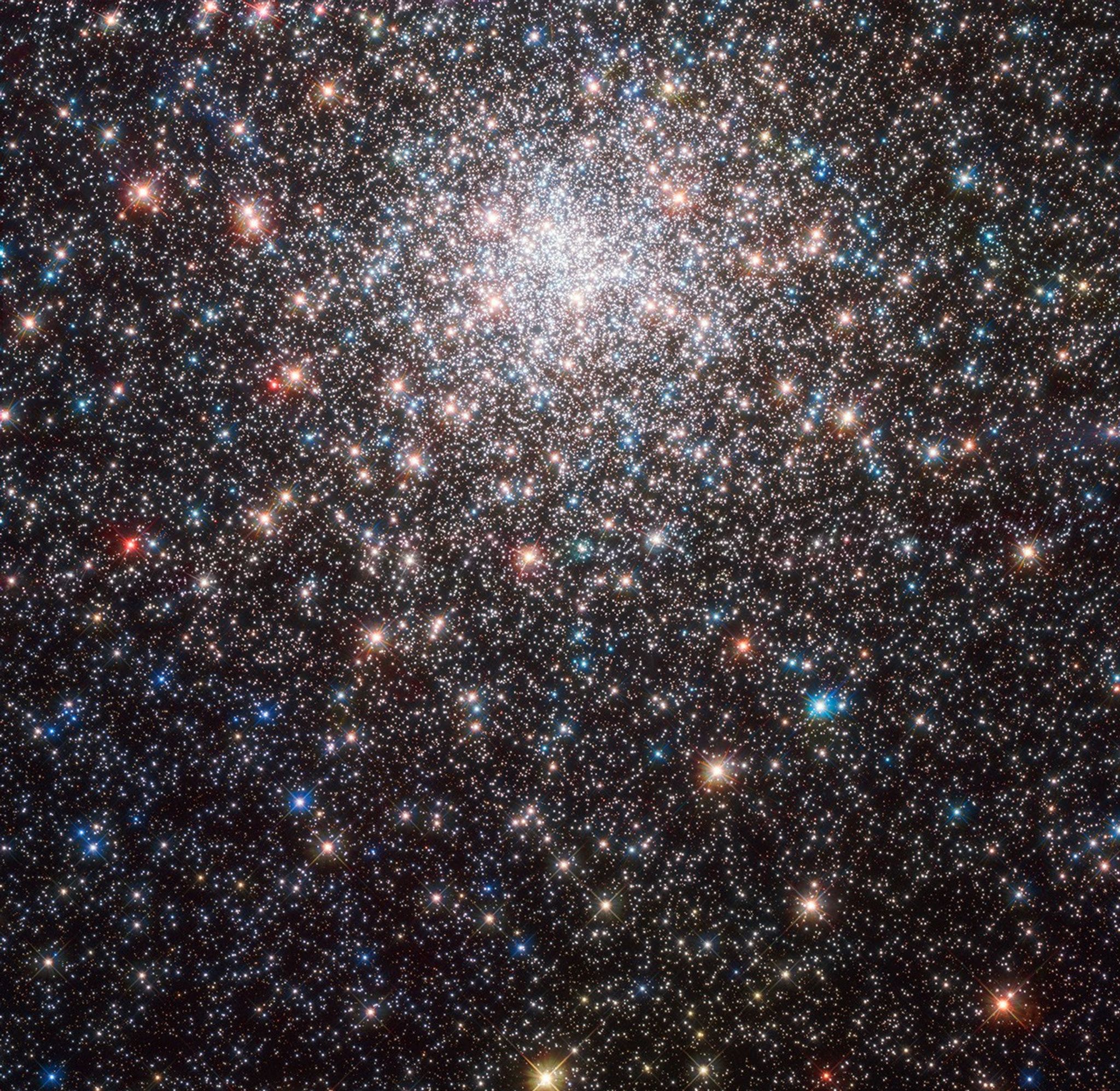
M28 is a globular cluster located 18,000 light-years away from Earth in the constellation Sagittarius. It was discovered by Charles Messier in 1764. With an apparent magnitude of 7.7, the cluster appears as a faint patch of light through a pair of binoculars. Large telescopes can resolve its individual stars more effectively. The month of August is the best time to view M28.
The cluster is most notable for being the first of its kind known to contain a millisecond pulsar: PSR B1821–24. This dense neutron star rotates rapidly (about once every three milliseconds) and emits radiation from its poles, which sweeps past Earth as the star spins, much like a beam of light from a lighthouse. This makes it appear to be pulsing to observers on Earth. PSR B1821–24 was discovered in 1986 using a radio telescope in England called the Lovell Telescope.

For more information about Hubble’s observations of M28, see:

Explore Hubble's Messier Catalog
The following pages contain some of Hubble’s best images of Messier objects.
Overview The Messier catalog, begun by astronomer Charles Messier in the 18th Century and revised over the years, includes some…

Better known as the Crab Nebula, Charles Messier originally mistook Messier 1 for Halley’s Comet, which inspired him to create…
Hubble's image of Messier 2 is comprised of visible and infrared wavelengths of light.