
















1 min read
Andromeda Galaxy
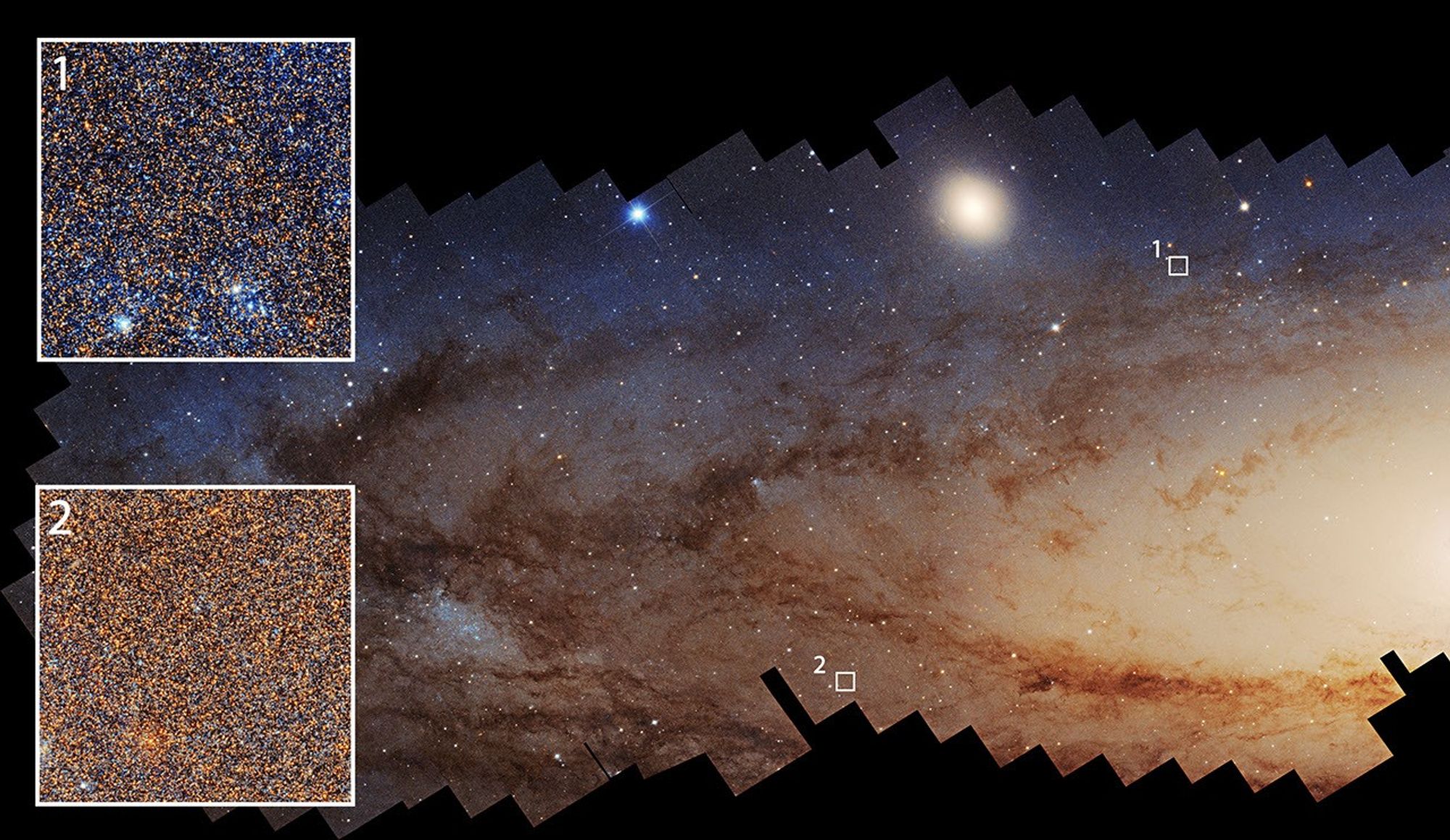
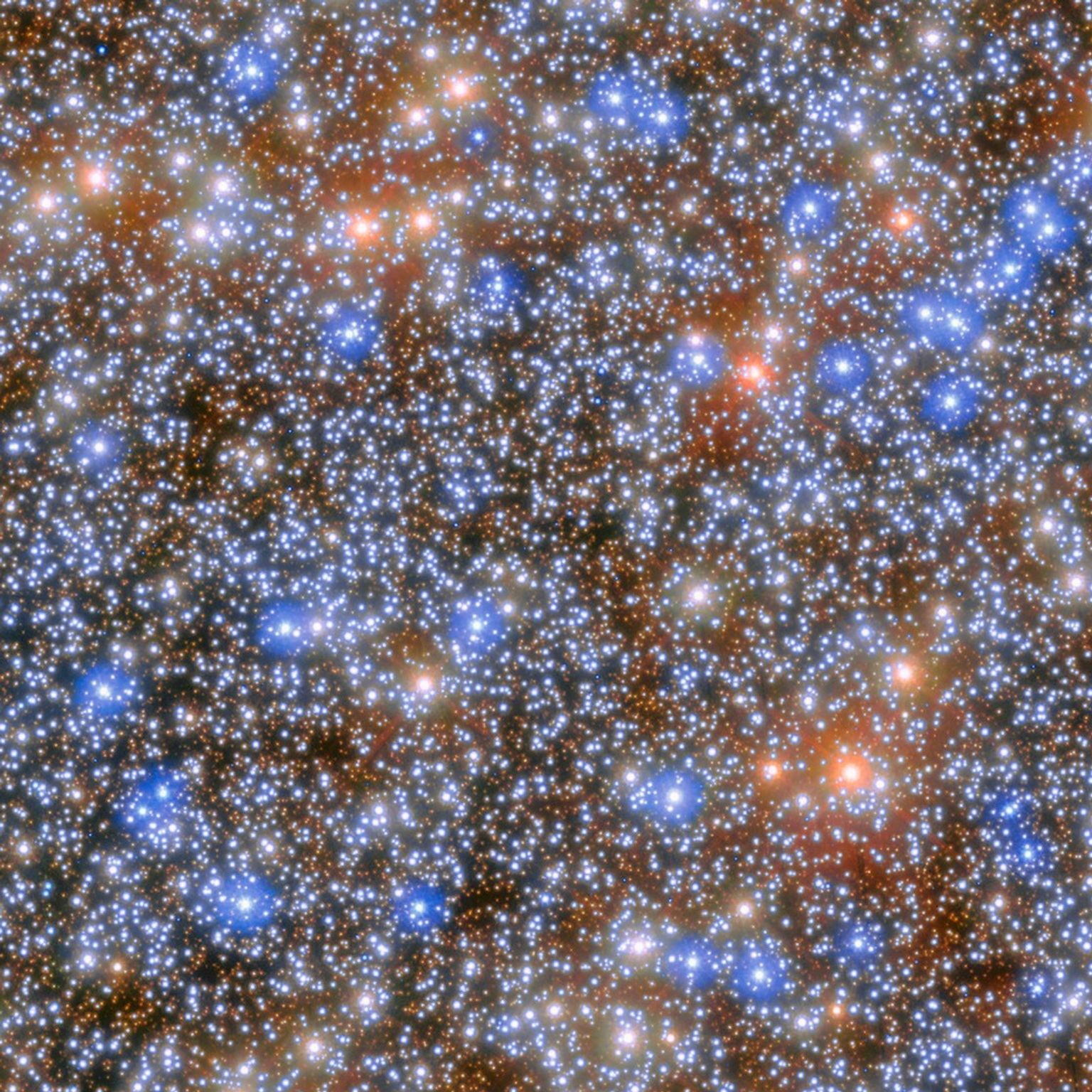
Astronomers have divided imagery of the Andromeda galaxy taken by NASA’s Hubble Space Telescope into thousands of squares 300 light-years on a side and determined the history of star formation within each parcel to gain a comprehensive view of the galaxy’s past. This image highlights two such regions.
Massive stars are bluer and short-lived, while less massive stars are redder and longer-lived. As a result, areas that have experienced recent star formation (1) tend to have a larger fraction of blue stars, while areas with less recent star formation (2) typically have a redder population.
About the Object
- R.A. PositionR.A. PositionRight ascension – analogous to longitude – is one component of an object's position.00:42
- Dec. PositionDec. PositionDeclination – analogous to latitude – is one component of an object's position.+41:15
- ConstellationConstellationOne of 88 recognized regions of the celestial sphere in which the object appears.Andromeda
- DistanceDistanceThe physical distance from Earth to the astronomical object. Distances within our solar system are usually measured in Astronomical Units (AU). Distances between stars are usually measured in light-years. Interstellar distances can also be measured in parsecs.2.5 million light-years
About the Data
- Data DescriptionData DescriptionProposal: A description of the observations, their scientific justification, and the links to the data available in the science archive.
Science Team: The astronomers who planned the observations and analyzed the data. "PI" refers to the Principal Investigator.Data of M31 were obtained from the HST PHAT and PHAST Treasury proposals: P.I. J. Dalcanton and B. Williams (University of Washington) et al. 12058, 12073, 12109, 12107, 12074, 12105, 12113, 12075, 12057, 12111, 12115, 12071, 12114, 12072, 12056, 12106, 12059, 12108, 12110, 12112, 12055, 12076, 12070, 16778, 16778, 16796, 16796, 16797, 16797, 16798, 16798, 16799, 16799, 16800, 16800, 16801
- InstrumentInstrumentThe science instrument used to produce the data.ACS
- Exposure DatesExposure DatesThe date(s) that the telescope made its observations and the total exposure time.July 2010 - Dec 2022
- FiltersFiltersThe camera filters that were used in the science observations.F475W, F814W
- Object NameObject NameA name or catalog number that astronomers use to identify an astronomical object.Andromeda Galaxy
- Object DescriptionObject DescriptionThe type of astronomical object.Spiral Galaxy
- Release DateJuly 27, 2026
- Science ReleaseNASA’s Hubble Shows Star Formation in Andromeda Galaxy Winding Down
- CreditImage: NASA, ESA, Benjamin Williams (UWashington), Zhuo Chen (UWashington), L. Clifton Johnson (Northwestern); Image Processing: Joseph DePasquale (STScI)
Downloads
This image is a composite of separate exposures acquired by the ACS instrument on the Hubble Space Telescope. Several filters were used to sample broad wavelength ranges. The color results from assigning different hues (colors) to each monochromatic (grayscale) image associated with an individual filter. In this case, the assigned colors are: Blue: F475W (g) Yellow: F814W (I)
Share
Details
Claire Andreoli
NASA’s Goddard Space Flight Center
Greenbelt, Maryland
claire.andreoli@nasa.gov