
























1 min read
Full Trifid Nebula (Rubin Image with Hubble Close-up)

At left is a complete view of the Trifid Nebula (Messier 20 or M20) captured by the NSF-DOE Vera C. Rubin Observatory in Chile. A white box in the lower-left portion of the pink region shows the area NASA's Hubble Space Telescope targeted, and Hubble’s new image is featured at right.
Rubin’s field of view is approximately 56 light-years across, while Hubble’s is about four light-years across.
The color assignments in the images vary based on the filters in the telescopes’ cameras. Rubin takes broadband images, which capture the full visible spectrum to show natural colors in red, green, and blue. For this image, Hubble captured narrowband images of specific chemical elements. Sulfur, hydrogen, and oxygen were mapped to red, green, and blue, respectively, to make this composite image.
About the Object
- R.A. PositionR.A. PositionRight ascension – analogous to longitude – is one component of an object's position.18:02:23
- Dec. PositionDec. PositionDeclination – analogous to latitude – is one component of an object's position.-23:01:48
- ConstellationConstellationOne of 88 recognized regions of the celestial sphere in which the object appears.Sculptor
- DistanceDistanceThe physical distance from Earth to the astronomical object. Distances within our solar system are usually measured in Astronomical Units (AU). Distances between stars are usually measured in light-years. Interstellar distances can also be measured in parsecs.5,000 light-years
- DimensionsDimensionsThe physical size of the object or the apparent angle it subtends on the sky.Image is 2.7 arcmin across (about 4 light-years)
About the Data
- Data DescriptionData DescriptionProposal: A description of the observations, their scientific justification, and the links to the data available in the science archive.
Science Team: The astronomers who planned the observations and analyzed the data. "PI" refers to the Principal Investigator.These images were created with Hubble data from proposal: 18209 (C. Britt).
- InstrumentInstrumentThe science instrument used to produce the data.WFC3/UVIS
- Exposure DatesExposure DatesThe date(s) that the telescope made its observations and the total exposure time.February 20-23, 2026
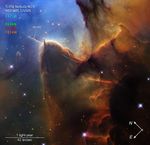
- FiltersFiltersThe camera filters that were used in the science observations.Hubble image on right: F502N (OII), F656N (H-alpha), F673N (SIII)
- Object NameObject NameA name or catalog number that astronomers use to identify an astronomical object.Trifid Nebula, Messier 20
- Object DescriptionObject DescriptionThe type of astronomical object.Emission Nebula, H II region
- Release DateApril 20, 2026
- Science ReleaseNASA’s Hubble Dazzles With Young Stars in Trifid Nebula
- CreditImage: Rubin Observatory, NASA, ESA, STScI
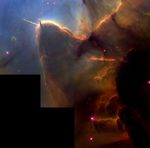
The image on the right was acquired by the WFC3/UVIS instrument on Hubble. The color results from assigning different hues (colors) to a monochromatic (grayscale) image. In this case, the assigned colors are: Blue: F502N, Green: F656N, Red: F673N
Related Images, Videos, & Articles
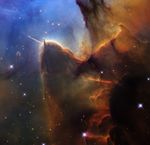
Image (2026): Trifid Nebula (Wide Field Camera 3)
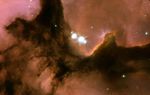
NASA celebrates Hubble’s 36th anniversary with a new image of the Trifid Nebula, a star-forming region it first captured in 1997. The telescope leveraged almost its full operational lifetime to show us changes in the nebula on human time scales with an improved camera.
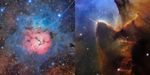
Image: Full Trifid Nebula (Rubin Image with Hubble Close-up)
A pullout shows where the Hubble Space Telescope’s close-up image is located within the wider Trifid Nebula. The image at left was taken by the NSF-DOE Vera C. Rubin Observatory in Chile. The color assignments in the images vary based on the filters in the telescopes’ cameras.
Share
Details
Claire Andreoli
NASA’s Goddard Space Flight Center
Greenbelt, Maryland
claire.andreoli@nasa.gov