
















1 min read
Dracula’s Chivito (IRAS 23077+6707)
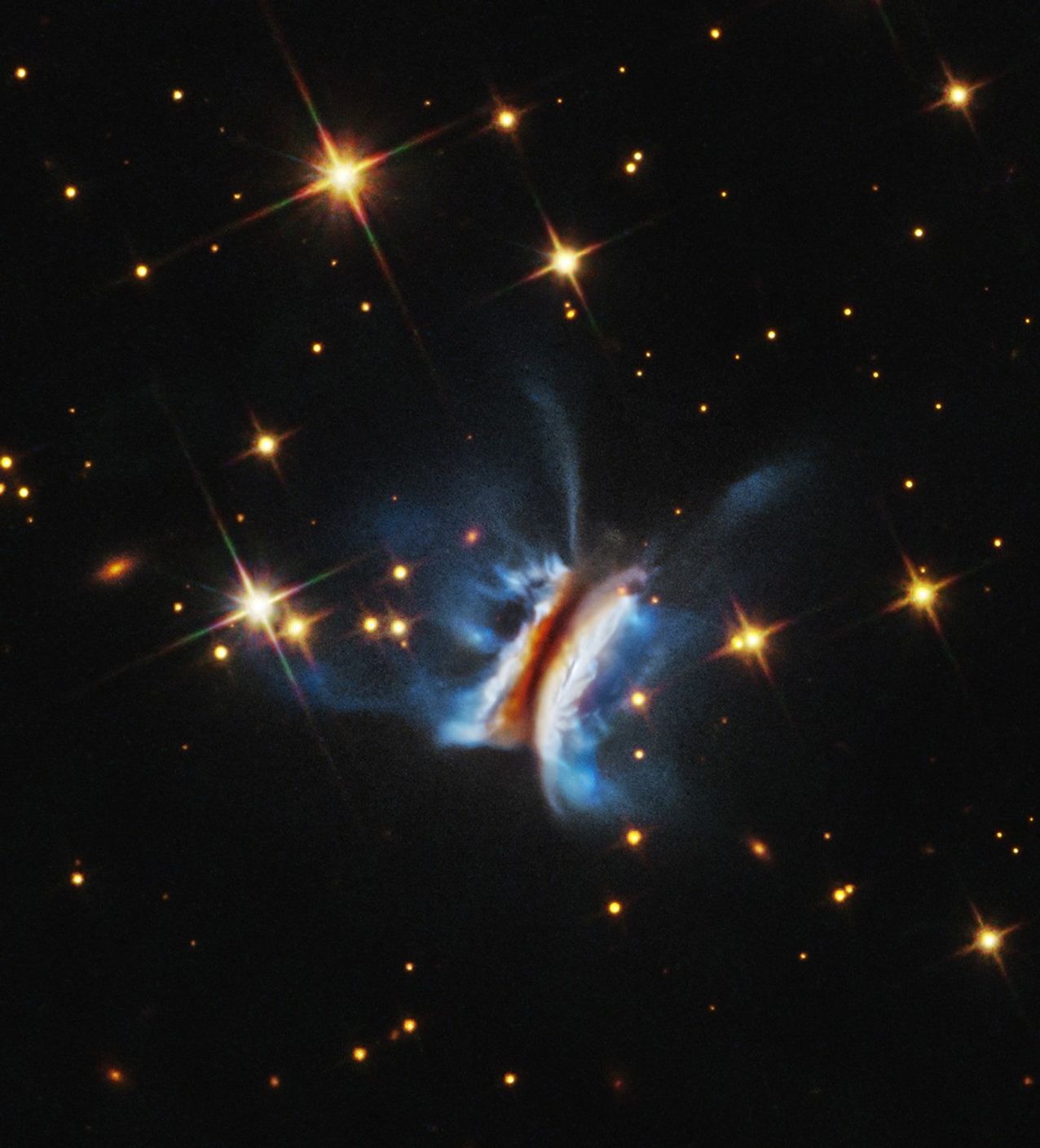
This Hubble Space Telescope image shows the largest planet-forming disk ever observed around a young star. It spans nearly 400 billion miles — 40 times the diameter of our solar system. Tilted nearly edge-on as seen from Earth, the dark, dusty disk resembles a hamburger. Hubble reveals it to be unusually chaotic, with bright wisps of material extending far above and below the disk—more than seen in any similar circumstellar disk. Cataloged as IRAS 23077+6707, the system is located approximately 1,000 light-years from Earth. The discovery marks a new milestone for Hubble and offers fresh insight into planet formation in extreme environments across the galaxy.
About the Object
- R.A. PositionR.A. PositionRight ascension – analogous to longitude – is one component of an object's position.23:09:43.83
- Dec. PositionDec. PositionDeclination – analogous to latitude – is one component of an object's position.+67:23:40.49
- ConstellationConstellationOne of 88 recognized regions of the celestial sphere in which the object appears.Cepheus
- DistanceDistanceThe physical distance from Earth to the astronomical object. Distances within our solar system are usually measured in Astronomical Units (AU). Distances between stars are usually measured in light-years. Interstellar distances can also be measured in parsecs.About 978 light-years
- DimensionsDimensionsThe physical size of the object or the apparent angle it subtends on the sky.Image is about 50 arcsec across (about 0.24 light-years)
About the Data
- Data DescriptionData DescriptionProposal: A description of the observations, their scientific justification, and the links to the data available in the science archive.
Science Team: The astronomers who planned the observations and analyzed the data. "PI" refers to the Principal Investigator.The Hubble observations include those from program 17751 (K. Monsch)
- InstrumentInstrumentThe science instrument used to produce the data.WFC3 UVIS+IR
- Exposure DatesExposure DatesThe date(s) that the telescope made its observations and the total exposure time.February 8, 2025
- FiltersFiltersThe camera filters that were used in the science observations.UVIS: F438W, F606W, F814W; IR: F105W, F125W, F160W
- Object NameObject NameA name or catalog number that astronomers use to identify an astronomical object.IRAS 23077+6707; Dracula's Chivito
- Object DescriptionObject DescriptionThe type of astronomical object.Very large protoplanetary disk
- Release DateDecember 23, 2025
- Science ReleaseNASA’s Hubble Reveals Largest Found Chaotic Birthplace of Planets
- CreditImage: NASA, ESA, STScI, Kristina Monsch (CfA); Image Processing: Joseph DePasquale (STScI)
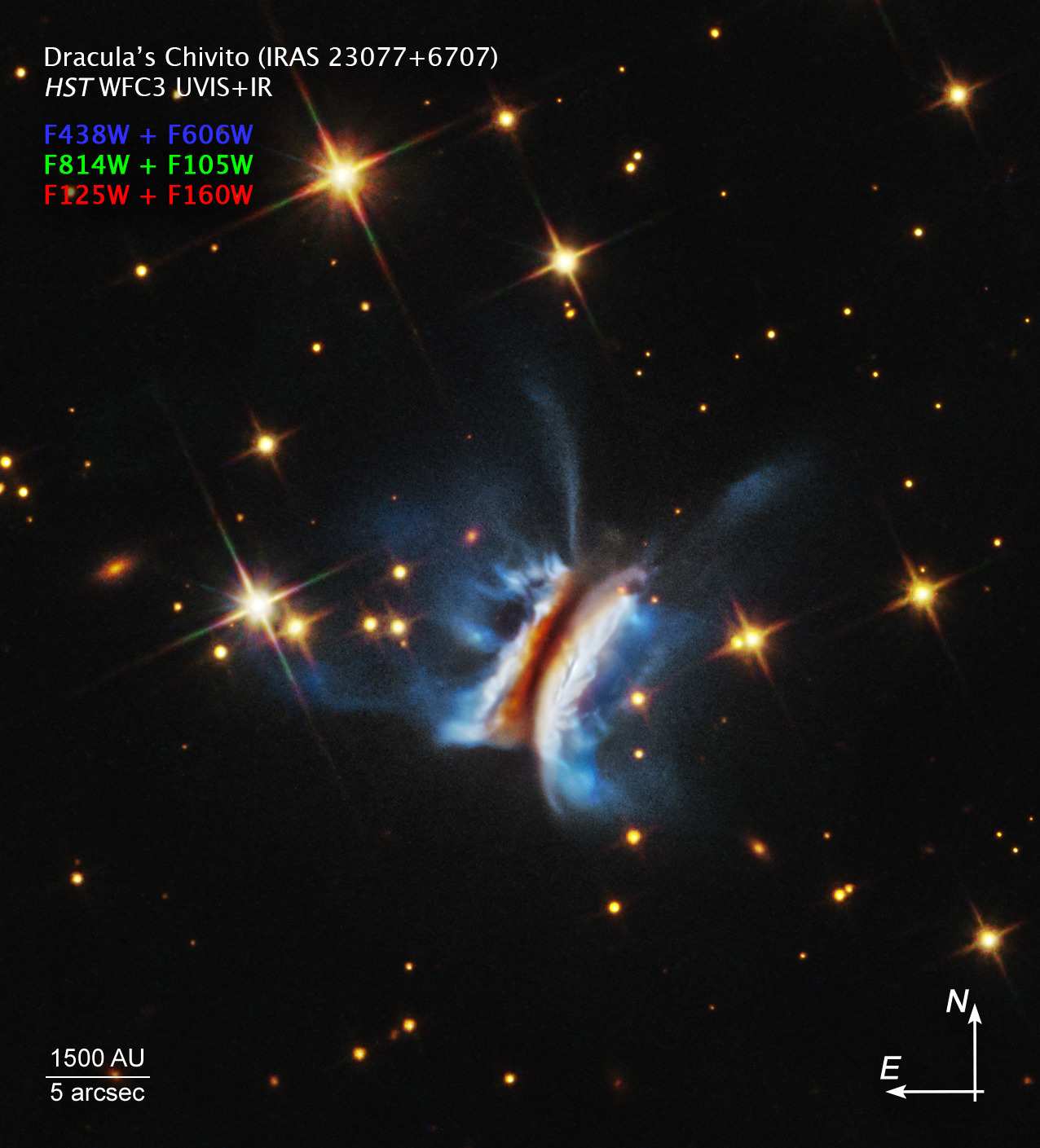
These images were acquired by the WFC3 Instrument on the Hubble Space Telescope. The color results from assigning different hues (colors) to a monochromatic (grayscale) image. In this case, the assigned colors are: Blue: F438W+F606W, Green: F814W+F105W, Red: F125W+F160W
Related Images & Videos

Share
Details
Claire Andreoli
NASA’s Goddard Space Flight Center
Greenbelt, Maryland
claire.andreoli@nasa.gov