
















Webb Science Theme
Early Universe
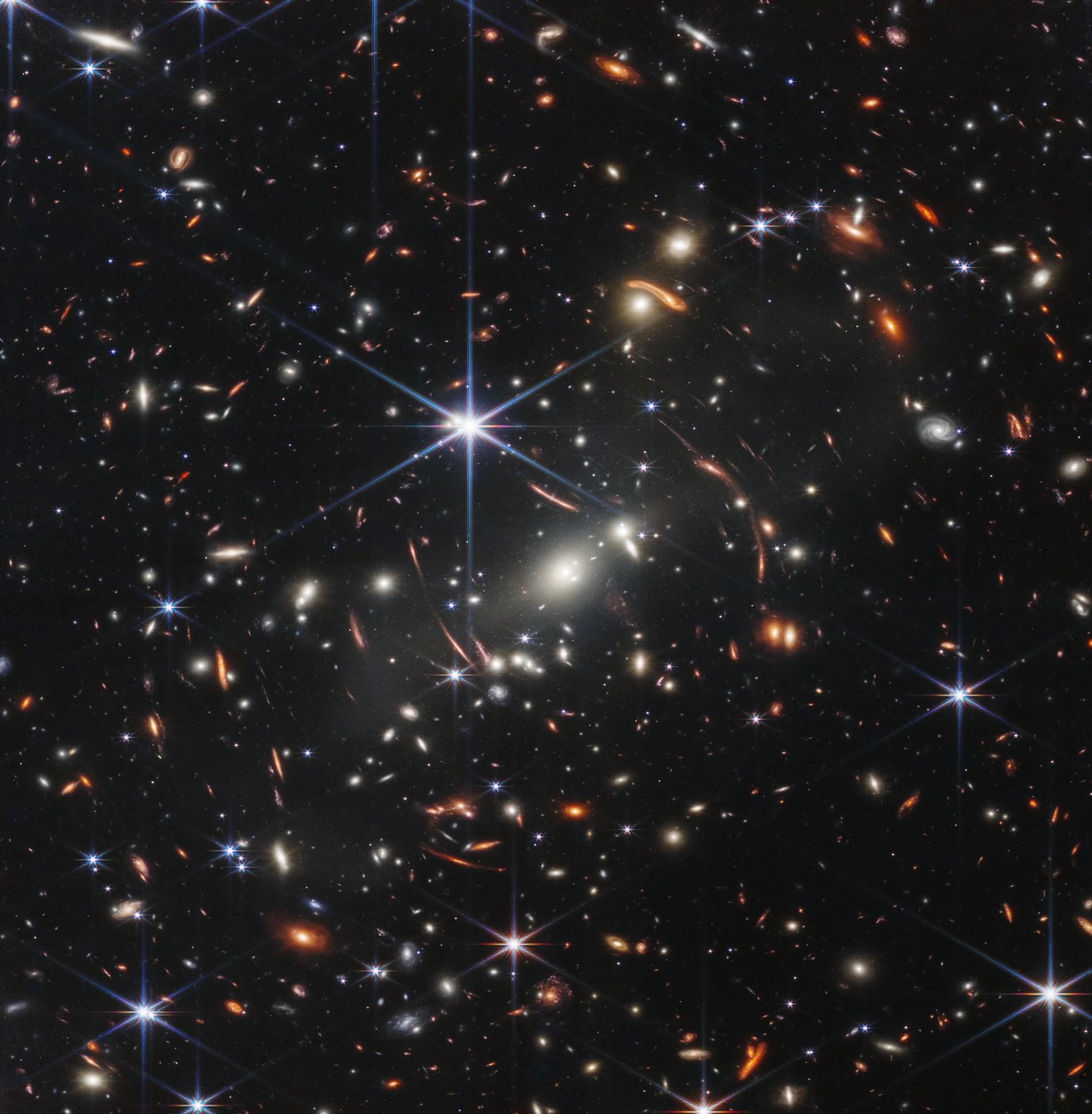
Webb is allowing astronomers to see, for the first time, the era in the early universe when the first stars and galaxies formed. Though other telescopes have seen further back, no telescope has ever had the infrared sensitivity or a large enough mirror to show us “Cosmic Dawn,” a period from approximately 50 million years to one billion years after the big bang.
Key Questions
Building on the established science from previous missions, scientists from around the world are using the Webb Telescope to advance our knowledge for these key questions.
How and when did the first stars and galaxies form?

How did the building blocks that make up everything, including humans, come to be?

What did the universe's first light (i.e. stars that fused the existing hydrogen atoms into more helium) look like?

How do black holes figure into the formation of the early universe?

What about the cosmic material that does not interact with or emit light, known as dark matter?

How did dark matter influence the formation of the first galaxies?

Key Findings / Discoveries : Early Universe
-
01
Finding galaxies further away than ever before seen
Webb has indeed been successful at finding galaxies further away than ever before seen. In 2024, Webb observed JADES-GS-z14-0, which was the record holder at a redshift of 14.32 until June of 2025, when MoM-z14 was confirmed to have a redshift of z = 14.44 placing the galaxy as existing about 280 million years after the big bang.
-
02
Little red dots
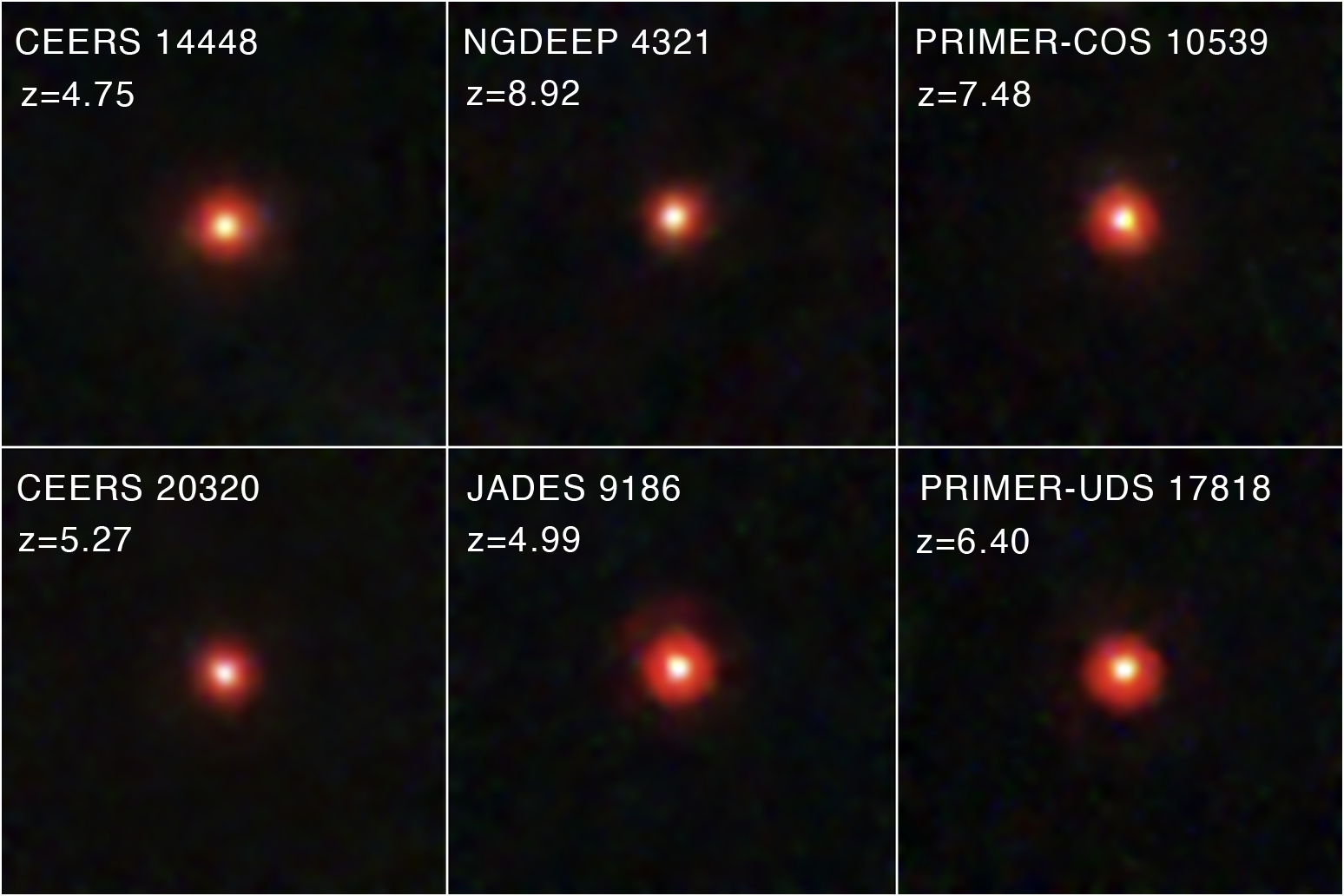
Little Red Dots (LRD) are objects so distant they hadn't been discovered before Webb. They emerged in large numbers about 600 million years after the big bang and seemingly mysteriously declined by 1.5 billion years post-big bang. Are they a new class of galaxy? Or perhaps an evolutionary phase of active supermassive black holes? Scientists are actively investigating these objects to learn more.
-
03
Black Holes forming before galaxies
Which came first, galaxies or black holes? New Webb observations of an object called QSO1 show that some supermassive black holes actually were enormous from their beginnings, forming without aid of a massive host galaxy or resulting from the collapse of stars. It’s shifting the traditional ideas around how black holes form and grow.
-
04
Confirmed earliest supernova to date
Webb confirmed the earliest supernova to date; this dying star exploded when the universe was only 730 million years old. Webb’s sharp infrared capability also allowed astronomers to locate the supernova’s very faint and distant host galaxy. Webb supported a whole chain of observations of international telescopes which began when a rare and super bright flash of light, called a gamma-ray burst (GRB), occurred in mid-March 2026.
-
05
Starburst galaxies full of star formation
Webb observed “little green galaxies” - starburst galaxies full of star formation that existed about one billion years after the big bang, that may have been the source of the ultraviolet light that reionized the neutral hydrogen in the universe.
-
06
Better understanding the timeline of the early universe
Webb spotted a galaxy that should have been obscured by neutral hydrogen, implying that perhaps the universe’s reionization process started earlier than scientists think. Or perhaps unexpectedly powerful sources of ionizing radiation existed at that time. A mystery to further investigate.
-
07
Star clusters which existed 600 million years after the big bang
Webb discerned distinct star clusters in the Firefly Sparkle galaxy, which existed 600 million years after the big bang - the first discovery of an actively forming galaxy as lightweight as the young Milky Way.
-
08
Scientists used Webb to measure the expansion of the universe
Scientists used Webb to measure the expansion of the universe, by pointing it at a gravitationally lensed supernova SN H0pe. The light from this exploding star has been bent and magnified by a galaxy cluster between it and us. The lensing effect allowed scientists to use it to calculate a value for the Hubble constant: the rate at which the universe is expanding.
-
09
The shape of the most common galaxies
Webb found that the most common galaxies in the early universe may have been elongated in shape, like “pool noodles” and “surfboards."
-
10
Star clusters in a galaxy when the universe was just 460 million years old
With the help of gravitational lensing, Webb detected five young, massive star clusters in a baby galaxy. The light from this galaxy was emitted when the universe was just 460 million years old, marking the first discovery of star clusters in a galaxy this early in cosmic history.
Introduction: Early Universe
How did the first stars and galaxies form, and how did the building blocks of everything, including humans, come to be? Knowing more about the universe’s early history may help us understand its future. Webb was designed to see a period of the early universe's history that we have not seen before. We don't know exactly when or how the universe made the first stars and galaxies. We are using Webb to see the first objects that formed as the universe cooled down after the big bang. We are here today because of these chemical elements that were produced in this first generation of stars and we want to better understand how that came to be. Webb is helping answer key questions about this era.
Besides investigating the early universe, Webb is also give us insights that allow us to look forward as well. For many years, scientists thought the universe’s current expansion was slowing down. But in fact, cosmic expansion is speeding up, and the universe may continue to expand forever. Scientists suspect a mysterious substance they call dark energy is accelerating expansion. Webb recently affirmed the universe’s expansion rate, but there is much astronomers don’t understand, including why this rate is faster than astronomers expected it to be.
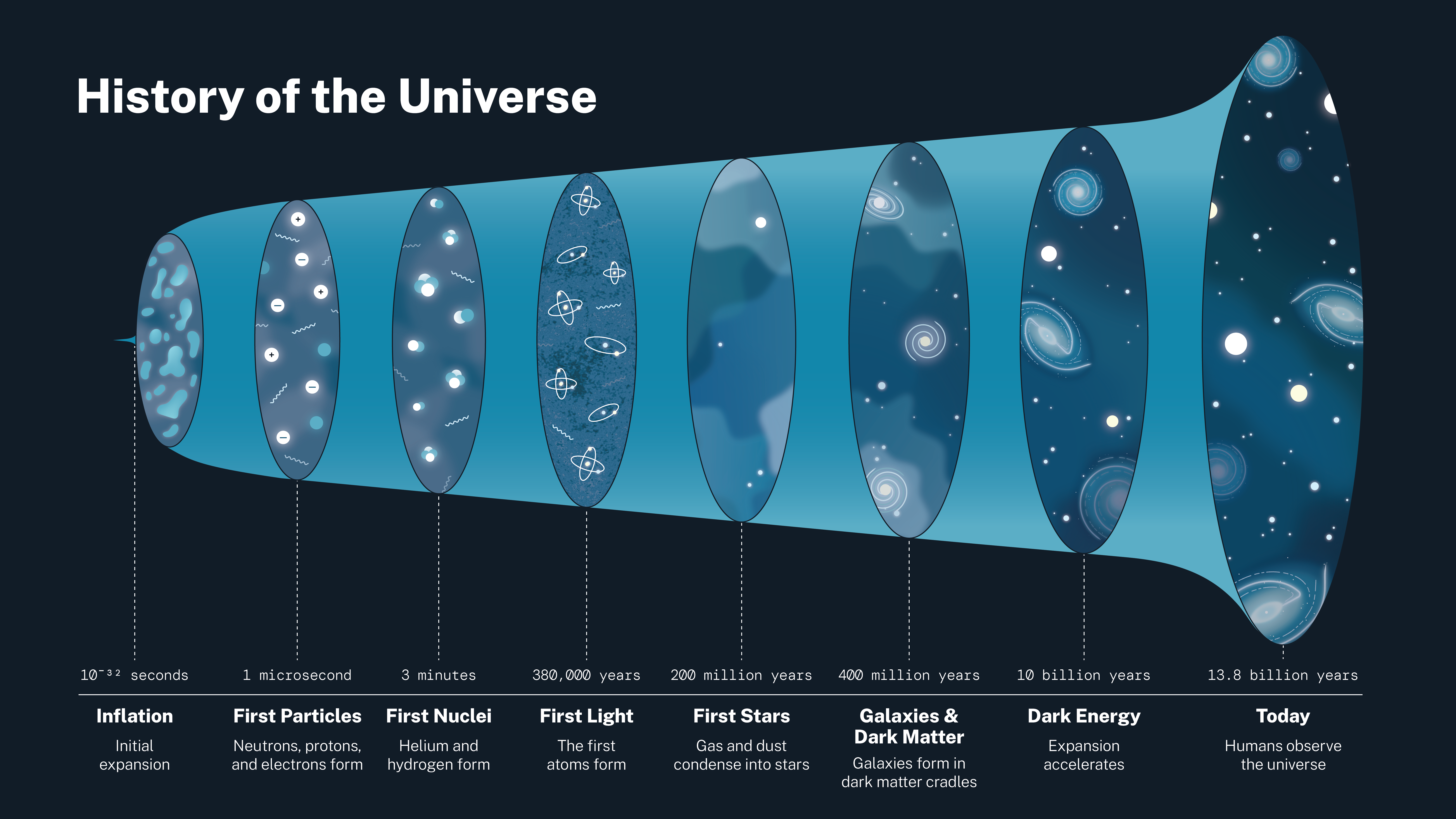
Astronomers have calculated that the universe is approximately 13.8 billion years old. The Hubble Space Telescope has seen back to about 500 million years after the big bang, revealing galaxies with much less defined and more compact structures, very different than those close to us in space and time.
Webb’s data show there are more massive galaxies in the early universe than expected. One possible reason might be that stars formed more quickly and more abundantly in the early universe than they do today. Researchers using Webb have also found that many distant galaxies have flattened oval disk and tube-like shapes, not spiral or elliptical structures — which requires additional research to fully explain.
Over the next 13-plus billion years, more stars formed, extinguished, and dispersed their elemental material into the universe. Galaxies grew in complexity and planetary systems formed around stars until finally our star, the Sun, formed in an arm of a large spiral galaxy, and a system of planets, moons, and asteroids formed in its orbit. The third-closest planet, rich in water and with just the right amount of heat and light from the Sun, would become our home in the universe. From 1 million miles above the Earth, Webb looks back to the beginning.
How is Webb able to see back in time?
Because light takes time to travel through space (at a consistent 186,000 miles or 300,000 kilometers per second), there is a delay between when we see something and when it actually happened. In the small space of a room, the time for light to travel from the bulb to the corner is not noticeable. Between the Earth and the Moon, light takes 1.3 seconds, which means that we see the Moon as it was 1.3 seconds ago. Multiplied over the vast distances of the universe, light can take billions of years to reach us, which actually causes a change in how we see it.
Imagine light leaving the first stars and galaxies nearly 13.6 billion years ago and traveling through space and time to reach our telescopes. By the time this light reaches us, its color or wavelength has been shifted towards the red, something we call a "redshift." Why? In this particular case, it's because when we talk about very distant objects, Einstein's General Relativity comes into play. It tells us that the expansion of the universe means it is the space between objects that actually stretches, causing objects (galaxies) to move away from each other. Furthermore, any light in that space will also stretch, shifting the light to longer wavelengths.
For very high redshifts (i.e., the farthest objects from us), that visible light is generally shifted into the near- and mid-infrared part of the electromagnetic spectrum. For that reason, to see the first stars and galaxies requires a powerful near- and mid-infrared telescope, which is exactly why Webb was built as it was.
As ancient light from the first galaxies traveled through space, the expansion of the universe stretched ultraviolet and visible wavelengths of light to infrared light, a process known as cosmological redshift. Webb was specifically designed to observe infrared light, which comes from some of the oldest galaxies to form. Being able to study these early objects is helping to fill in some gaps in our knowledge: How did early stars and galaxies take shape? How do black holes figure into the formation of the early universe? What about the cosmic material that does not interact with or emit light, known as dark matter? How did dark matter influence the formation of the first galaxies? These are some of the perplexing and fascinating questions that astronomers are beginning to unravel with Webb.

In Depth: What is Webb Studying?

Cosmic Inflation
When we think about the beginnings of the universe, we think about the big bang, but can science tell us what, if anything, came before the big bang? Missions that looked at the very early universe present evidence that the big bang was preceded by a period called "cosmic inflation." Scientists think that around 13.8 billion years ago, for just a fraction of a second, the universe expanded faster than the speed of light. Scientists aren’t sure what came before inflation or what powered it, but when cosmic inflation stopped, the energy driving it transferred to matter and light, what we know as the big bang.
Inflationary theory is really an extension of the big bang theory, and it helps us explain why the universe looks the way it does today, by assigning it a specific set of initial conditions. Inflationary theory explains many aspects of the universe we observe today, like its flatness, or lack of curvature, on the largest scales. Inflation may have also magnified density differences that naturally occur on space’s smallest, quantum-level scales, which eventually helped form the universe’s large-scale structures.
The Era Of Recombination
After the big bang, the universe was like a hot soup of particles (i.e. protons, neutrons, and electrons). When the universe started cooling, the protons and neutrons began combining into ionized atoms of hydrogen and deuterium. Deuterium further fused into helium-4. These ionized atoms of hydrogen and helium attracted electrons turning them into neutral atoms. Ultimately the composition of the universe at this point was three times more hydrogen than helium with just trace amounts of other light elements.
Until around a few hundred million years or so after the big bang, the universe was a very dark place. There were no stars, and there were no galaxies.
This process of particles pairing up is called "Recombination" and it occurred approximately 240,000 to 300,000 years after the big bang. The universe went from being opaque to transparent at this point. Light had formerly been stopped from traveling freely because it would frequently scatter off the free electrons. Now that the free electrons were bound to protons, light was no longer being impeded. "The era of recombination" is the earliest point in our cosmic history to which we can look back with any form of light. This is what we see as the Cosmic Microwave Background today with satellites like the Cosmic Microwave Background Explorer (COBE) and the Wilkinson Microwave Anisotropy Probe (WMAP). Following this are the cosmic dark ages - a period of time after the Universe became transparent but before the first stars formed. When the first stars formed, it ended the dark ages, and started the next epoch in our universe.
The Epoch Of Reionization
Another change occurred after the first stars started to form. Theory predicts that the first stars were 30 to 300 times as massive as our Sun and millions of times as bright, burning for only a few million years before exploding as supernovae. The energetic ultraviolet light from these first stars was capable of splitting hydrogen atoms back into electrons and protons (or ionizing them). This era, from the end of the dark ages to when the universe was around a billion years old, is known as "the epoch of reionization." It refers to the point when most of the neutral hydrogen was reionized by the increasing radiation from the first massive stars. Reionization is an important phenomenon in our universe's history as it presents one of the few means by which we can (indirectly) study these earliest stars. But scientists do not know exactly when the first stars formed and when this reionization process started to occur.
The emergence of these first stars marks the end of the "Dark Ages" in cosmic history, a period characterized by the absence of discrete sources of light. Understanding these first sources is critical, since they greatly influenced the formation of later objects such as galaxies. The first sources of light act as seeds for the later formation of larger objects.
Additionally, the first stars that exploded as supernovae might have collapsed further to form black holes. The black holes started to swallow gas and other stars to become objects known as "mini-quasars," which grew and merged to become the huge black holes now found at the centers of nearly all massive galaxies.
Latest Images in Theme
The image below is a slideshow of all NASA published imagery in the Early Universe theme.
USAGE: Hover over the image to see the image title and controls. Click the arrows to move through the slide show, click the image to go to a detail page with more info and the ability to download the image at various resolutions.

Latest Research: Early Universe
Below are all NASA published science articles and imagery relevant to the Early Universe Webb science theme. These articles include peer-reviewed science and blog entries (which at the time of publishing are "science in progress," and give previews of exciting new findings).
Filters

The complex puzzle known as little red dots has become more complete since their initial discovery by NASA’s James Webb…
While the primary purpose of NASA’s James Webb Space Telescope’s observations of galaxy cluster Abell S1063 was to look for…

NASA’s James Webb Space Telescope captured the deepest spectrum to date of a little red dot. More than 40 spectral…
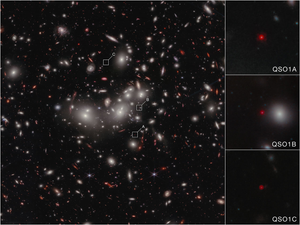
Which comes first, the galaxy or the black hole? We don’t know, but scientists have long thought it could be…
An image from NIRCam on NASA’s James Webb Space Telescope shows Little Red Dot Abell2744-QSO1, magnified and triply imaged by…
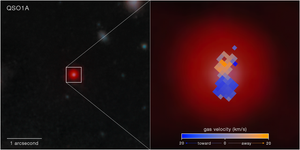
An image detail from NIRCam (left) on NASA’s James Webb Space Telescope shows Little Red Dot Abell2744-QSO1. A map of…
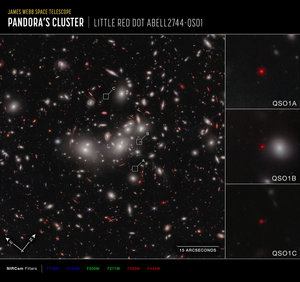
Image of Abell 2744 and Little Red Dot Abell2744-QSO1, captured by Webb’s NIRCam, with compass arrows, scale bar, and color…
A sonification is a translation of data into sound. In this sonification, the velocity of hydrogen gas moving around a…
The universe is full of clues hidden in light — and Webb has tools to find them. About 75% of…