


















1 min read
Dwarf Galaxy NGC 4449
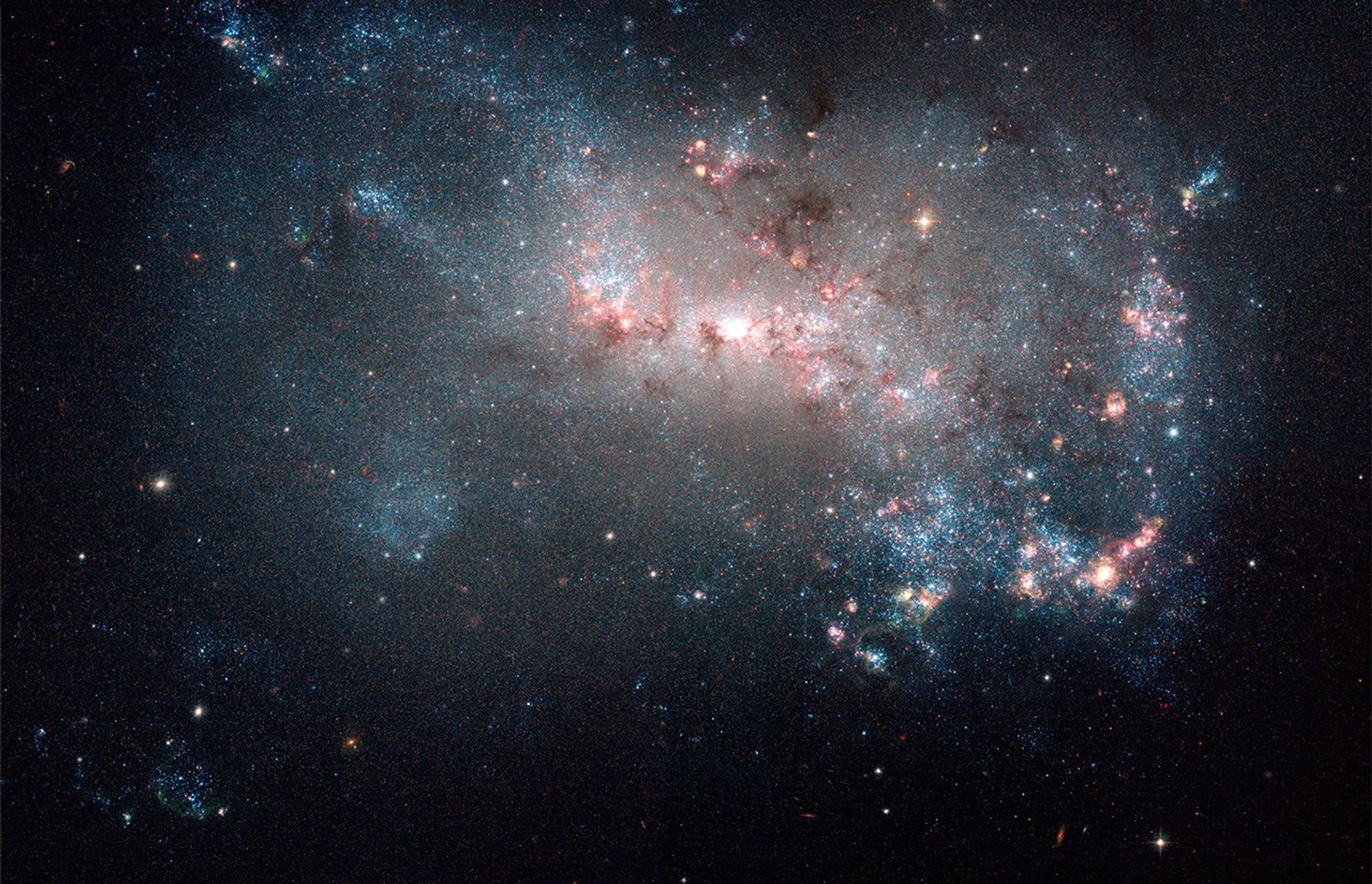
This is an image from NASA’s Hubble Space Telescope of NGC 4449, one of the dwarf galaxies in the Galaxies Losing Oxygen via Winds (GLOW) study. Researchers found that dwarf galaxies can hold onto only a small fraction of the oxygen made by stars. Energy from the low-mass galaxies’ massive stars and galactic winds unleashed by supernovae are apparently more effective at driving out the oxygen than current models predict.
Deep Zoom Image
Dive deeper into this image.
About the Object
- R.A. PositionR.A. PositionRight ascension – analogous to longitude – is one component of an object's position.12:28:09.48
- Dec. PositionDec. PositionDeclination – analogous to latitude – is one component of an object's position.44:05:56.41
- ConstellationConstellationOne of 88 recognized regions of the celestial sphere in which the object appears.Canes Venatici
- DistanceDistanceThe physical distance from Earth to the astronomical object. Distances within our solar system are usually measured in Astronomical Units (AU). Distances between stars are usually measured in light-years. Interstellar distances can also be measured in parsecs.12 million light-years
- DimensionsDimensionsThe physical size of the object or the apparent angle it subtends on the sky.Image is 5.1 arcmin across (about 18,000 light-years)
About the Data
- InstrumentInstrumentThe science instrument used to produce the data.ACS
- FiltersFiltersThe camera filters that were used in the science observations.F435W, F555W, F658N, F814W
- Object NameObject NameA name or catalog number that astronomers use to identify an astronomical object.NGC 4449
- Object DescriptionObject DescriptionThe type of astronomical object.Dwarf Galaxy
- Release DateNovember 2, 2026
- Science ReleaseNASA’s Hubble Uncovers Case of Missing Oxygen in Nearby Dwarf Galaxies
- CreditImage: NASA, ESA, Hubble Heritage–ESA/Hubble Collaboration, Alessandra Aloisi (STScI, ESA)
This image is a composite of separate exposures acquired by the ACS instrument on the Hubble Space Telescope. Several filters were used to sample broad wavelength ranges. The color results from assigning different hues (colors) to each monochromatic (grayscale) image associated with an individual filter. In this case, the assigned colors are: Blue: F435W Green: F555W Red: F658N Orange: F814W
Deep Zoom Image
Share
Details
Claire Andreoli
NASA’s Goddard Space Flight Center
Greenbelt, Maryland
claire.andreoli@nasa.gov