






















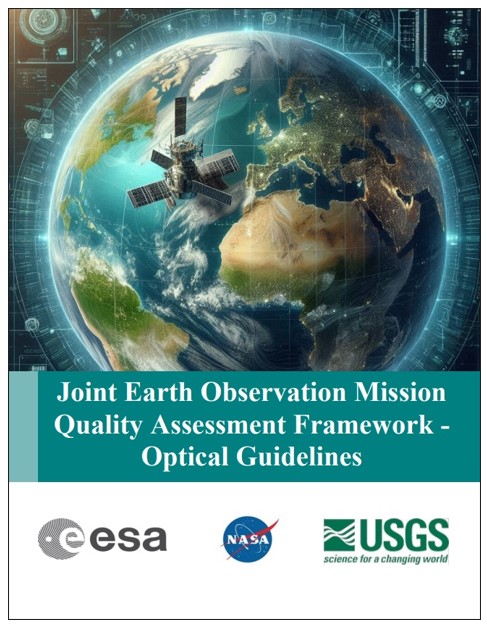
NASA's Commercial Satellite Data Acquisition (CSDA) program, in conjunction with the European Space Agency (ESA) and the U.S. Geological Survey (USGS), has released the Joint Earth Observation Mission Quality Assessment Framework – Optical Guidelines.
Released on April 26, 2026, the Optical Guidelines document provides specific guidelines for the mission quality assessment of optical sensors as part of the implementation of the generic Earth Observation (EO) mission quality assessment for the optical domain. This document summarizes the goals of the Joint Earth Observation Mission Quality Assessment Framework, reviews how optical mission quality is demonstrated through documentation, outlines guidelines for verifying that a mission’s data quality aligns with stated sensor performance, and provides appendices containing information on common radiometric and geometric calibration and validation practices.
“The release of these joint guidelines for EO data from optical missions both documents the rigorous standards we have for commercial data and bolsters the confidence of the user community in the CSDA’s commercial data acquisitions,” said CSDA Project Manager Dana Ostrenga. “By releasing this document to the public, we’re giving end-users the opportunity to review the approach for verifying whether the quality of commercial EO data is consistent with the stated performance of the mission.”
The Joint Earth Observation Mission Quality Assessment Framework was produced as part of an ESA and NASA partnership supporting Earthnet Data Assessment Project (EDAP) and CSDA activities, the document details the methodology used to assess the quality of data from commercial satellite data providers. This framework provides standardized, transparent, and repeatable data quality assessment processes and outputs to support mission selection, data integration, and the trusted use of commercial EO data for science and applications. Furthermore, the agencies intend to update the guidelines in step with the evolution of the market and the advancement of Earth sciences and applications of EO data products.
About the Joint EO Mission Quality Assessment Framework
The expanding range of applications for EO data products and the availability of low-cost launch services have resulted in a growing number of commercial EO satellite systems. This growth in the marketplace has prompted space agencies like NASA, ESA, and others to explore the acquisition of commercial EO data products and their potential to complement the capabilities and services currently available for scientific and operational purposes.
To ensure that decisions regarding the acquisition of commercial data can be made with confidence, ESA, NASA, and other stakeholders agreed there was a need for an objective framework to assess the quality of data from commercial sources. To that end, ESA established the EDAP, which performs early assessments of EO mission data to evaluate their quality and the potential integration of these missions as third-party missions within ESA’s Earthnet program. The development of EDAP led to the Joint Earth Observation Mission Quality Assessment Framework, which was later customized for the different types of sensors used in atmospheric, synthetic aperture radar, thermal infrared, and now, optical EO missions.
This joint framework serves as the foundation for the CSDA program's comprehensive evaluation process to ensure the quality of commercial EO data. The process focuses on assessing geometric and radiometric quality, validating data against trusted reference datasets, ensuring completeness and traceability of dataset documentation, and evaluating data accessibility and utility. Together, these rigorous evaluation efforts help build trust in commercial partnerships, ensure scientific integrity and interoperability, and foster innovation within the EO community.
For additional information on the release of the Joint Earth Observation Mission Quality Assessment Framework – Optical Guidelines, see the announcement on the ESA website.